

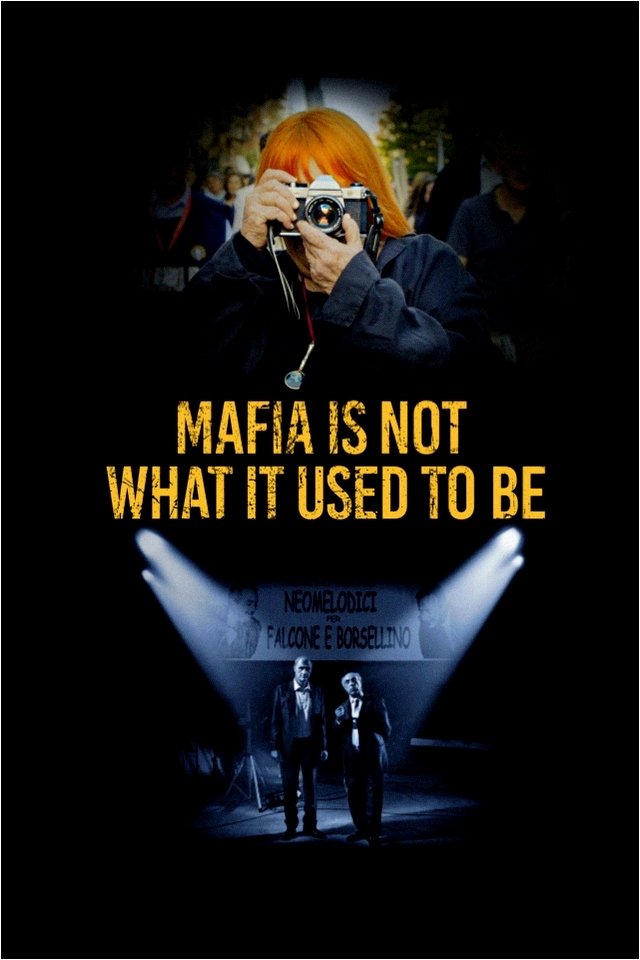
Mafia Is Not What It Used to Be
Documentary
Overview
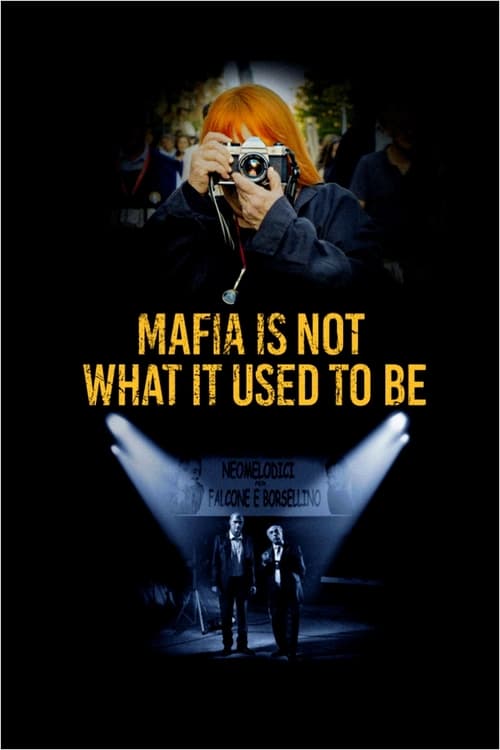
Palermo, Sicily, Italy, 2017. Twenty-five years after the murders of anti-mafia judges Giovanni Falcone, on May 23, 1992, and Paolo Borsellino, on July 19, 1992; and on the occasion of the tributes held in memory of both heroes, skeptical photographer Letizia Battaglia, chronicler of their titanic combat, criticizes the opportunism of shady characters who, like businessman Ciccio Mira, profit from the commemoration of both tragedies.
Top Cast
Franco Maresco
Self - Filmmaker / Narrator (voice)
Letizia Battaglia
Self - Photographer
Ciccio Mira
Self - Event Manager
Matteo Mannino
Self - Event Producer
Cristian Miscel
Self - Singer
Franco Zecchin
Self - Photographer
Attilio Bolzoni
Self - Journalist
Davide Chianello
Self
Mario D'Annunzio
Self
Giovanna Di Rosalia
Self
Salvatore 'Tony' Gambino
Self - Singer
Stefano Giordano
Self










Franco Maresco
Franco Maresco
Self - Filmmaker / Narrator (voice)
Franco Maresco
Self - Filmmaker / Narrator (voice)
Letizia Battaglia
Letizia Battaglia
Self - Photographer
Letizia Battaglia
Self - Photographer
Ciccio Mira
Ciccio Mira
Self - Event Manager
Ciccio Mira
Self - Event Manager
Matteo Mannino
Matteo Mannino
Self - Event Producer
Matteo Mannino
Self - Event Producer
Cristian Miscel
Cristian Miscel
Self - Singer
Cristian Miscel
Self - Singer
Franco Zecchin
Franco Zecchin
Self - Photographer
Franco Zecchin
Self - Photographer
Attilio Bolzoni
Attilio Bolzoni
Self - Journalist
Attilio Bolzoni
Self - Journalist
Davide Chianello
Davide Chianello
Self
Davide Chianello
Self
Mario D'Annunzio
Mario D'Annunzio
Self
Mario D'Annunzio
Self
Giovanna Di Rosalia
Giovanna Di Rosalia
Self
Giovanna Di Rosalia
Self
Similar Movies
More faithful than ever to the spirit of the cult series that has been inspiring filmmakers for nearly thirty years, STRIP-TEASE INTEGRAL offers us, this time on the big screen, five sensitive, touching, sometimes absurd, often funny, sometimes dark, sometimes bright - but always the vanities of human society in all their marvelous banality.
The adventurous life of Natacha Rambova (1897-1966), an American artist, born Winifred Kimball Shaughnessy, who reincarnated herself countless times: false Russian dancer, silent film actress, scenographer and costume designer, writer, spiritist, Egyptologist, indefatigable traveler, mysterious and curious; an amazing 20th century woman who created the myth of Rudolph Valentino.
The ideal of youth is at the centre of this eloquent film, mixing documentary and fiction, art and experimentation. Demonstrating both formal and narrative freedom, Bélanger weaves a deliberately loose weave in which the initiatory journey of two young people, wandering through Montreal in search of a job, unfolds. But not just any job. The two idealists want a job that will satisfy their desire for freedom, peace and respect. Of course, even though the breath of renewal from Expo 67 still floats here and there, the world they encounter does not correspond - by far - to their aspirations. Strangers in this country that tells them nothing, they come across brutally, materialism, violence, and egocentrism.
Marina Carrère d'Encausse lifts the veil on the intimate questions that preoccupy her as well as society at large: those related to the end of life. The doctor-journalist introduces Antoine, her partner, who is suffering from Charcot's disease, an incurable illness, and who wishes to choose how he ends his life. Is the current law in France sufficient? Should it simply be better enforced, allowing better access to palliative care? Should assisted suicide and euthanasia be legalized? Marina meets with patients concerned about the end of life, caregivers, and politicians in France, as well as in Belgium, Switzerland, and Canada, countries where euthanasia and assisted suicide are legal.
During the Syrian civil war, the district of Yarmouk, home to thousands of Palestinians, became the scene of dramatic and ferocious fighting. The film follows the destiny of civilians during the brutal sieges, imposed by the Syrian regime, that took place in the wake of the battles. With his camera, Abdallah Al-Khatib composes a love song to a place that proudly resists the atrocities of war.