

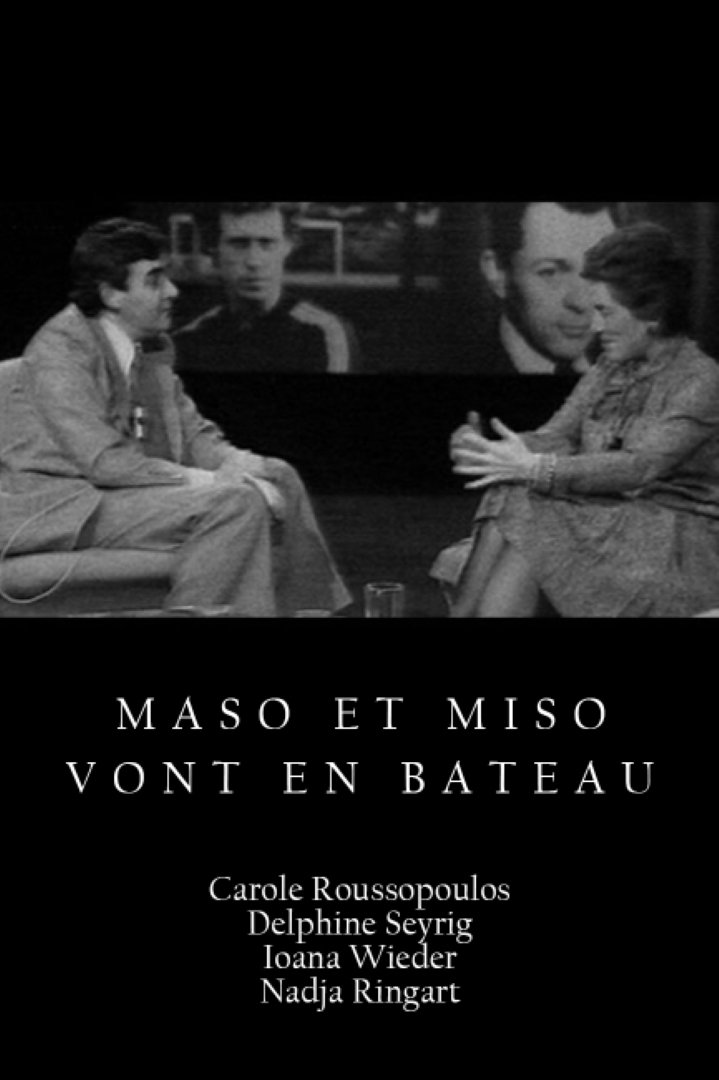
Maso and Miso Go Boating
Documentary
Overview
The year 1975 is declared “year of the woman”. On this occasion Bernard Pivot invited Françoise Giroud on television, then Secretary of State for Women. Faced with statements, a group of women filmmakers parody the issues in a provocative way.









José Artur
José Artur
Self (archive footage)
José Artur
Self (archive footage)
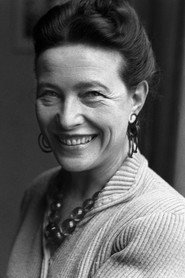
Simone de Beauvoir
Simone de Beauvoir
Self
Simone de Beauvoir
Self

Françoise Giroud
Françoise Giroud
Self (archive footage)
Françoise Giroud
Self (archive footage)

Bernard Pivot
Bernard Pivot
Self (archive footage)
Bernard Pivot
Self (archive footage)
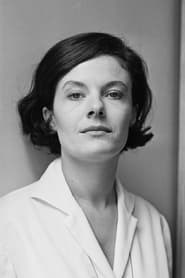
Delphine Seyrig
Delphine Seyrig
Self
Delphine Seyrig
Self

Ioana Wieder
Ioana Wieder
Self
Ioana Wieder
Self
Similar Movies
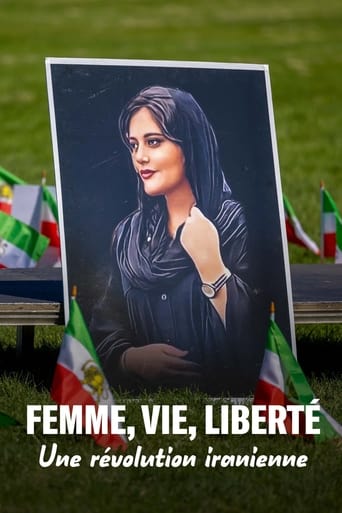
On September 16, 2022, in Teheran, the murder by police of the young Mahsa Amini, arrested for "wearing a headscarf contrary to the law", sparked off an unprecedented insurrection. Within hours, a spontaneous movement formed around the rallying cry: "Woman, life, freedom". For the first time, women, joined by men and students, took the initiative and removed their veils, the hated symbol of the Islamic Republic. The Iranian population, from all regions and social categories, rose up in protest. Social networks went wild. The diaspora (between 5–8 million Iranians) took up the cause, and the whole world discovered the scale of this mobilization: could the theocratic regime be overthrown this time?
After years of being silenced through violent opposition, Norma Burton, one of the key founders of the first women’s shelter in Tulsa, OK, tells an untold story of the battered women's movement. In the late 1970s and early 1980’s LGBTQ, BIPOC, and formerly abused women across the US gathered in secret to create a grassroots movement that became today's National Coalition Against Domestic Violence, despite persecution and death threats. Norma recounts to her daughter, director Nisha Burton, how she and her collaborators alerted the police of rising cases of domestic violence and ultimately decided to take matters into their own hands by conducting support gatherings in their homes around the kitchen table. These meetings led to the founding of the first battered women’s shelter in Tulsa, OK in 1975. The years that followed were filled with harassment and verbal and physical attacks on Norma and fellow organizers, but today these courageous advocates continue to support the movement.

Béatrice Dalle, Lio, Brigitte Fontaine, Corinne Masiero, Aïssa Maïga, Virginie Despentes, Maria Schneider, Gisèle Halimi, Juliette Gréco, and Adèle Haenel—these women lived on their own terms, defying conventions and embracing lives often deemed "scandalous." Labeled frivolous, hysterical, or simply too free and too loud, they faced criticism yet used controversy as a force for change, challenging norms and advancing women's rights. This documentary retraces seventy years of their bold and unconventional journeys, telling the story of the fearless women who shaped history and fought for a more equal world.

As the forces of ISIS and Assad tear through villages and society in Syria and Northern Iraq, a group of brave and idealistic women are taking up arms against them—and winning inspiring victories. Members of “The Free Women’s Party” come from Paris, Turkish Kurdistan, and other parts of the world. Their dream: To create a Democratic Syria, and a society based on gender equality. Guns in hand, these women are carrying on a movement with roots that run 40 years deep in the Kurdish Workers’ Party (PKK) in Turkey. GIRL’S WAR honors the legacy of Sakine Cansiz, co-founder of the PKK who was assassinated in Paris in 2013, and reflects on the sacrifices made by all of the women in the movement, who have endured jail, rape, war, and persecution in their quest to liberate their lives and sisters from male dominance. With scenes of solidarity, strength, and love amongst these brave women soldiers, GIRL'S WAR is a surprising story of Middle Eastern feminism on the front lines.
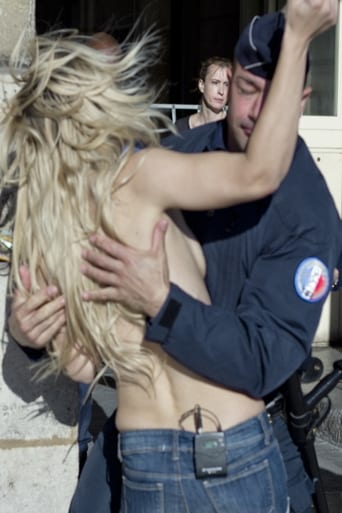
Born in Ukraine in 2008 in the wake of the "Orange Revolution," the feminist movement Femen fights for democracy, freedom of the press, women's rights, and against corruption, prostitution, sexism, racism, poverty, and religion. The activists quickly caught the attention of the media with their shocking protests. In 2012, at the creation of Femen France, Caroline Fourest followed their actions. They notably affirmed their support for "Marriage for All" by protesting on November 18, 2012, during the demonstration organized by the Civitas Institute against the bill, provoking sharp clashes.
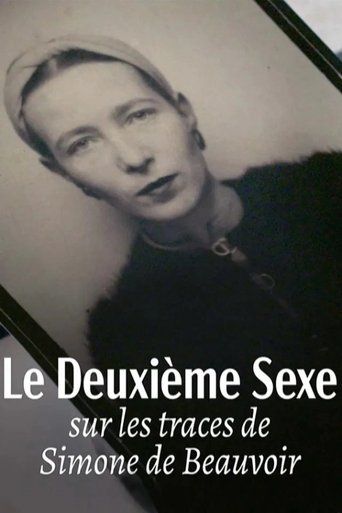
Published in 1949, The Second Sex became the bible of global feminism. An essential work that passionately advocates for gender equality, women's independence, and the liberation of morals. Today, how does this seminal work continue to resonate in our contemporary world? Conceived as an initiatory journey to the origins of Simone de Beauvoir's thinking, the film The Second Sex: In the Footsteps of Simone de Beauvoir takes us to the United States, to the places that inspired the philosopher and nourished her theories. An American road trip bringing together the worst and the best, predatory capitalism and mad love. A unique reinterpretation in the company of the great thinkers of our century.