

Sunny's Time Now
Music · Documentary
Overview
Retracing the longstanding career of avant-garde drummer Sunny Murray, one of the most influential figures of the Free jazz revolution. Through a series of interviews with key time witnesses as well as historic and contemporary concert footage, it reassesses the relationship between the libertarian music movement and the political events of the 1960s, whose social claims it so intimately reflected. By doing so, it also recounts how the most radical forms of musical expression were excluded from the major production and distribution networks as the libertarian ideal went out of fashion. Beyond its historical approach, the film follows Sunny Murray on current gigs, showing his daily struggle to perpetuate a musical genre which is still widely ignored by the general public. In doing so, Sunny's time now also dwells on the near-clandestine community of aficionados who continue to worship the gods of their musical coming of age, and whose unfaltering support has permitted free ...


Sunny Murray
Sunny Murray
Self
Sunny Murray
Self
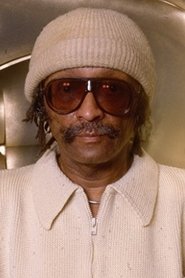
Cecil Taylor
Cecil Taylor
Self
Cecil Taylor
Self
Tony Oxley
Tony Oxley
Self
Tony Oxley
Self
Val Wilmer
Val Wilmer
Self
Val Wilmer
Self

Robert Wyatt
Robert Wyatt
Self
Robert Wyatt
Self
Edwin Pouncey
Edwin Pouncey
Self
Edwin Pouncey
Self
Similar Movies
This feature-length documentary chronicles the life and playful methods of Dutch pianist and composer Misha Mengelberg, a significant figure in post-WWII European Jazz and free improvisation. Archival footage, rehearsal / performance sequences and interviews with both Mengelberg (the "godfather of Dutch improvised music") and key collaborators provide a clear insight in Mengelberg's original way of thinking and way of working.
In this short film from 1967, filmmaker Henry English attempts to place a context around saxophonist and composer Marion Brown’s flurries of notes and expression. Juxtaposed against performance footage and scenes from Brown’s environment are the musician’s spoken observations in which he, in a gentle Georgia accent, explains some of who he is and how his chosen form of expression (wild, free lines of spontaneous sound) may not be as alien as it must have seemed in 1967. (Austin Film Society)
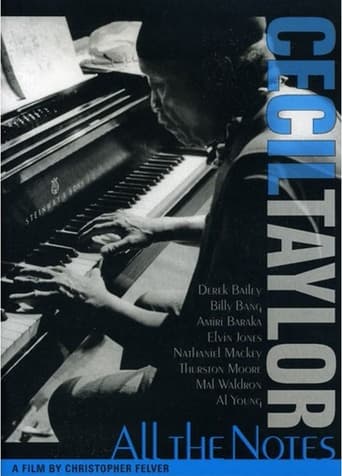
Cecil Taylor was the grand master of free jazz piano. "All the Notes" captures in breezy fashion the unconventional stance of this media-shy modern musical genius, regarded as one of the true giants of post-war music. Seated at his beloved and battered piano in his Brooklyn brownstone the maestro holds court with frequent stentorian pronouncements on life, art and music.
"This film explores how freedom of speech — including dissent — is afforded to all Americans, and shows freedom of expression in art, music, dance, architecture, and science. The film also emphasizes the importance of the individual’s contribution to the whole of society and demonstrates how a productive and creative society is formed by the open and respectful exchange of ideas. The film was written, produced, and directed by William Greaves" (National Archives).
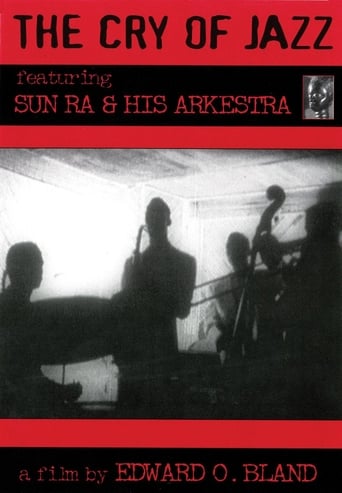
Filmed in Chicago & finished in 1959, The Cry of Jazz is filmmaker, composer and arranger Edward O. Bland's polemical essay on the politics of music and race - a forecast of what he called "the death of jazz." A landmark moment in black film, foreseeing the civil unrest of subsequent decades, it also features the only known footage of visionary pianist Sun Ra from his beloved Chicago period. Featured are ample images of tenor saxophonist John Gilmore and the rest of Ra's Arkestra in Windy City nightclubs, all shot in glorious black & white.
An experimental music ensemble is recording an album. They want a very specific sound: the sound of thick air. The sound engineer struggles to understand and to find that sound. A tale of sleepless nights and loud music, a noise-injected collage composed of diaristic footage, a found narrative (memories of a popular 60s band), original music and field recordings.
Although the free jazz movement of the 1960s and '70s was much maligned in some jazz circles, its pioneers - brilliant talents like Ornette Coleman, Cecil Taylor, Sun Ra, Albert Ayler, and John Coltrane - are today acknowledged as central to the evolution of jazz as America's most innovative art form. FIRE MUSIC showcases the architects of a movement whose radical brand of improvisation pushed harmonic and rhythmic boundaries, and produced landmark albums like Coleman's Free Jazz: A Collective Inspiration and Coltrane's Ascension. A rich trove of archival footage conjures the 1960s jazz scene along with incisive reflections by critic Gary Giddins and a number of the movement's key players.
Live archive release from the Jazz legend. Thelonious Monk Paris 1969 is a fascinating and important late-career document of the legendary Jazz pianist and composer in performance with his Quartet at the Salle Pleyel concert hall in Paris, France on December 15, 1969. The concert also featured a surprise guest appearance from renowned drummer Philly Joe Jones. Filmed in Black & White.