

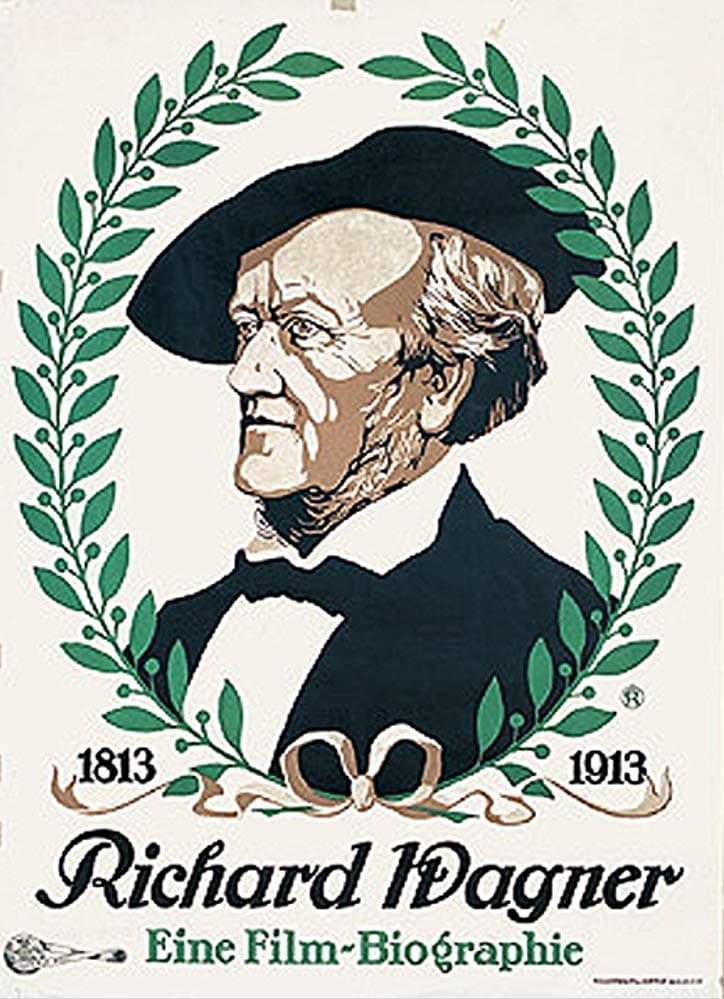
The Life and Works of Richard Wagner
Drama · History · Music
Overview
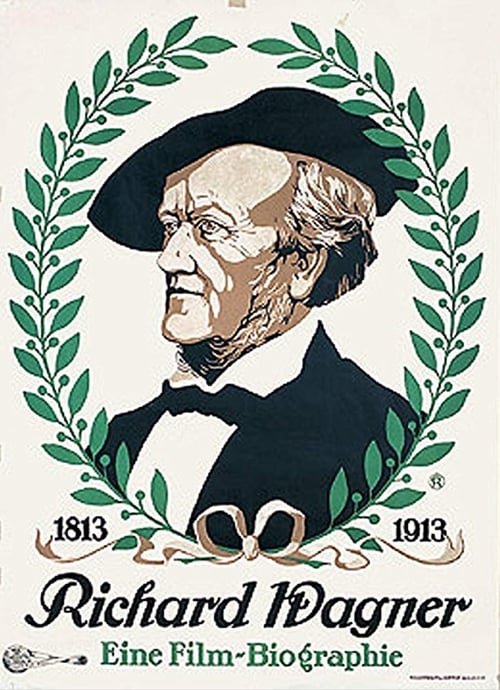
This biographical portrait of composer Richard Wagner (1813-1883), feature-length and lavishly produced, was released in conjunction with the centennial of his birth. It's an outstanding achievement in many respects. Naturally it looks primitive by modern standards, but contemporary viewers should bear in mind that it was made at a time when the motion picture industry was still in its infancy, and feature films were still a novelty. The very notion of a silent movie about a composer may seem odd, but Wagner is an ideal choice, simply because his life was so tempestuous and dramatic. Wagner's personality was operatic, while his tumultuous love life unfolded like a soap opera. He knew great success and abysmal failure, luxury one day and poverty the next. He participated in the wave of revolutions that swept Europe in the late 1840s, and had to flee Germany under threat of arrest.



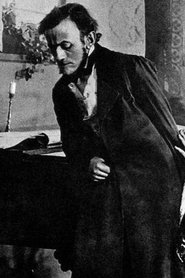
Giuseppe Becce
Giuseppe Becce
Richard Wagner
Giuseppe Becce
Richard Wagner

Olga Engl
Olga Engl
Cosima von Bülow
Olga Engl
Cosima von Bülow

Manny Ziener
Manny Ziener
Minna Planer
Manny Ziener
Minna Planer

Ernst Reicher
Ernst Reicher
Ludwig II.
Ernst Reicher
Ludwig II.

Miriam Horwitz
Miriam Horwitz
Mathilde Wesendonk
Miriam Horwitz
Mathilde Wesendonk
Max Maximilian
Max Maximilian
Max Maximilian
William Wauer
William Wauer
William Wauer
Similar Movies

Drusilla Ives, a young Quaker girl living on an isolated island, leaves to become the servant of the spendthrift Duke of Guisenberry in London, who is the Lord of her village. She finds that she is attracted to the bustling city's night life, and when the duke discovers that she is a fine dancer, he helps her turn professional. In short order she becomes known as Diana Valrose, the city's favorite dancer. Unfortunately, her strict father and her Quaker fiancee, John Christison, back on the island find out about her newfound fame and career and strongly disapprove--her father places a curse on her and her boyfriend marries her sister Faith. Complications ensue.
A feud in the Adirondack Mountains develops when Randolph Shaw will not give up a shack and its acreage adjoining the estate of Lord Cecil Bazelhurst, whose wife, the former Evelyn Banks of Jersey City, married him for his title and now wants to get rid of Randolph's ugly shack. When Randolph meets Cecil's sister Penelope, a romance begins which is furthered after one of the Bazelhurst servants shoots Randolph in the arm for trespassing and Penelope, who earlier had looked upon the feud as a joke, runs away to Randolph's house and accepts his engagement proposal. Cecil and his men pursue Penelope, but are frightened away by Randolph's men and are forced to spend a miserable stormy night in the woods. The next day everyone becomes reconciled when Lady Evelyn realizes that the desired property will now be in the family, and Randolph offers Cecil and his men dry, if ill-fitting, garments to wear.

When her traveling theatrical group goes broke, Poppy, an actress in the troupe, finds herself stranded in Singapore. She's reduced to working in a bar in the seedy part of town as a "hostess", where she meets a down-on-his-luck Englishman. While drunk he gets into a fight, and is forced to kill his opponent in self-defense. The girl helps him escape and goes to Sam, a shady plantation owner, to try to get them out of Singapore. However, Sam has his own plans for Poppy, and they don't include potential rivals for her affections.

Mudos testigos is a cinematographic collage made from all the surviving material of Colombian silent films, re-editing the images in such a way as to create a single imaginary film: the impossible love story of Efraín and Alicia that traces the convulsive first half of the twentieth century in Colombia. Compiled by the late Luis Ospina and finished posthumously by Jeronimo Atehortúa.
Molly Bawn. British silent drama movie. Directed by Cecil M Hepworth. Starring Alma Taylor, Stewart Rome an Violet Hopson. adaptation of the1878 Irish novel of the same name by Margaret Wolfe Hungerford. Molly Bawn the novel by M. W. Hungerford contains her most famous idiom: "Beauty is in the eye of the beholder." It is also referenced in chapter 8 of James Joyce's Ulysses.