


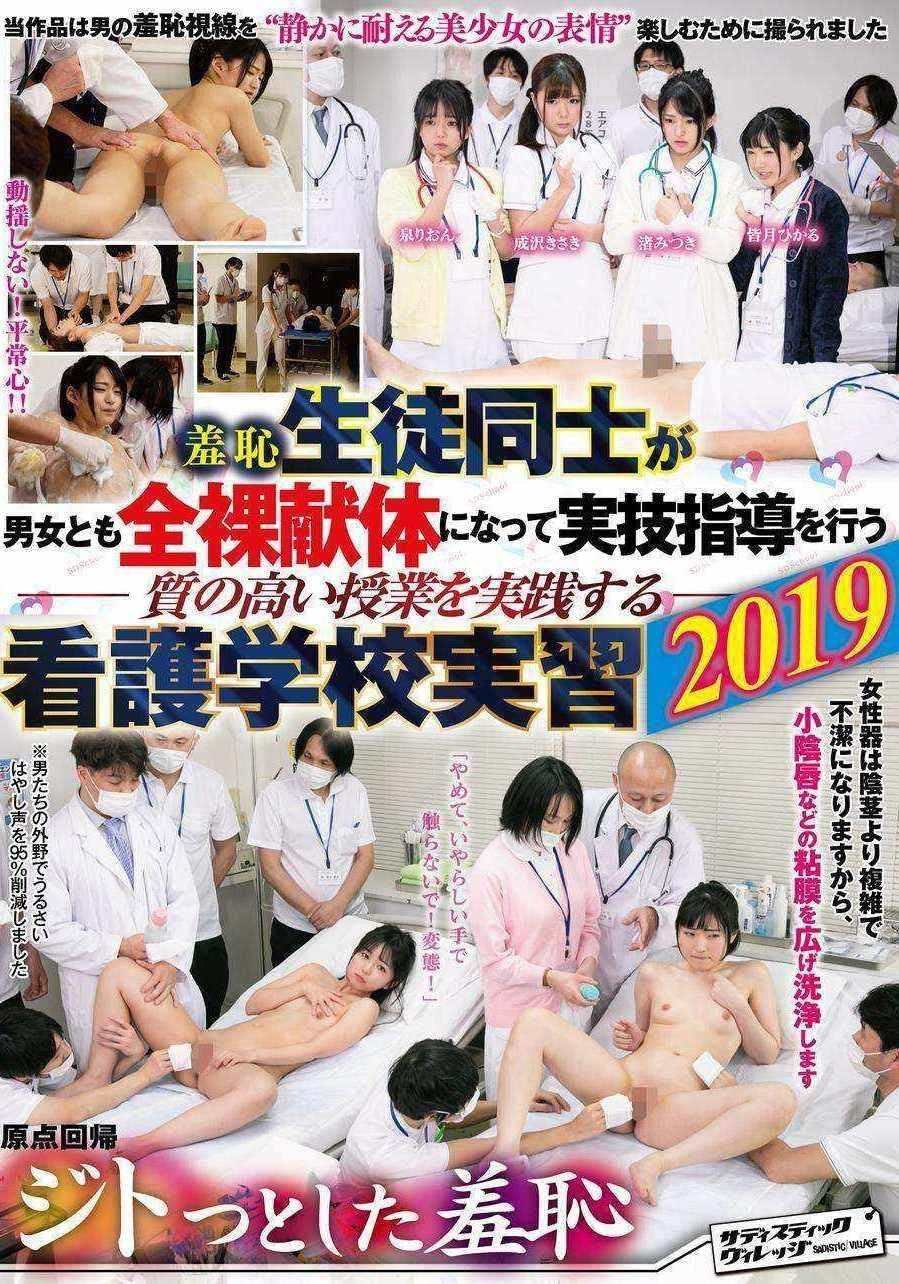
Humiliation: Male And Female Students Alike Get Naked At This Nursing College To Learn Practical Skills 2019
Documentary
Overview
Introduced "classes in which students practice as subjects" "Saddy Nursing School" has dramatically increased the passing rate of the national examination. Through "living classes" using each other's bodies for both boys and girls By experiencing the "shame" that the patient feels, the training content is imprinted in the brain along with the memory. The 7th work in the series. The "boy's voice" and "too annoying instructor" who were scolded in the previous work have been renewed and returned to the origin. It is a work that you can thoroughly enjoy the expression of a beautiful girl who is distorted by shame.











Hikaru Minazuki
Hikaru Minazuki
Hikaru Minazuki

Kisaki Narusawa
Kisaki Narusawa
Kisaki Narusawa

Mitsuki Nagisa
Mitsuki Nagisa
Mitsuki Nagisa

Rion Izumi
Rion Izumi
Rion Izumi

Pierre Ken
Pierre Ken
Pierre Ken

Hideyuki Setune
Hideyuki Setune
Hideyuki Setune
Similar Movies

A Calling to Care is the inspiring story of 55 year-old Grace Stanley, a Canadian nurse who left her home and prestigious career behind to answer a calling halfway around the world in Karachi, Pakistan. Teaching nursing to local women in a strict Muslim culture that forbids them to even to touch men is a formidable task. However, Grace challenges her own values and belief systems to find common ground with her students, helping them to excel and feel respect for themselves in a culture that doesn't respect them. Whether it is getting her hands painted with henna, swimming fully-clothed in the ocean, or marching bravely with them on International Women's Day, Grace bonds with her students in a very special way, and ultimately discovers how the West can learn a lot more from the Third World than she ever thought.
Charlie Cullen was an experienced registered nurse, trusted and beloved by his colleagues at Somerset Medical Center in New Jersey. He is also one of history’s most prolific serial killers, with a body count potentially numbering in the hundreds across multiple medical facilities in the Northeast.
We aren't dying the way we used to. We have ventilators, dialysis machines, ICUs-technologies that can "fix" us and keep our bodies alive-which have radically changed how we make medical decisions. In our death-denying culture, no matter how sick we get, there is always "hope." Defining Hope tells the story of patients dealing with life-threatening illness as they move between ICUs, operating rooms, hospice care and home. Diane is a nurse caring for end-stage cancer patients when she is diagnosed with ovarian cancer herself. 23-year-old Alena undergoes a risky brain surgery that destroys her short-term memory. 95-year-old Berthold lives with his elderly wife who struggles to honor his wish of dying peacefully at home. Defining Hope follows these patients and others- and the nurses that guide them along the way- as they face death, embrace hope, and ultimately redefine what makes life worth living.

This RKO-Pathe Screenliner short looks at the duties of the modern nurse. The story tracks the education of a student nurse as she works toward graduation and shows the earning of her cap during her student days, in retrospect. At the beginning, she wears the Student Nurse uniform dress and apron only, with no cap. She appears later in the movie as a more experienced Senior student with her cap already wearing a stripe. This was frequently done in the three year hospital programs to differentiate the Junior level students from the Seniors, more experienced and closer to Graduation. The capping ceremony illustrated shows the bare headed students receiving their plain white cap, and addressing it as something from her past that she will remember fondly.
Shows masked mental patients enacting various schizophrenic symptoms as they were understood at the time. A disturbing film that raises questions about the condition and treatment of its subjects. (archive.org) “Abstract: This film describes and demonstrates four types of schizophrenia. Filmed at various New York institutions, it shows patients singly and grouped in large, outside recreational areas. Some patients are blindfolded. Symptoms shown include: social apathy, delusions, hallucinations, hebephrenic reactions, cerea flexibilitas, rigidity, motor stereotypes, posturing, and echopraxia.” (Guide to Mental Health Motion Pictures)