

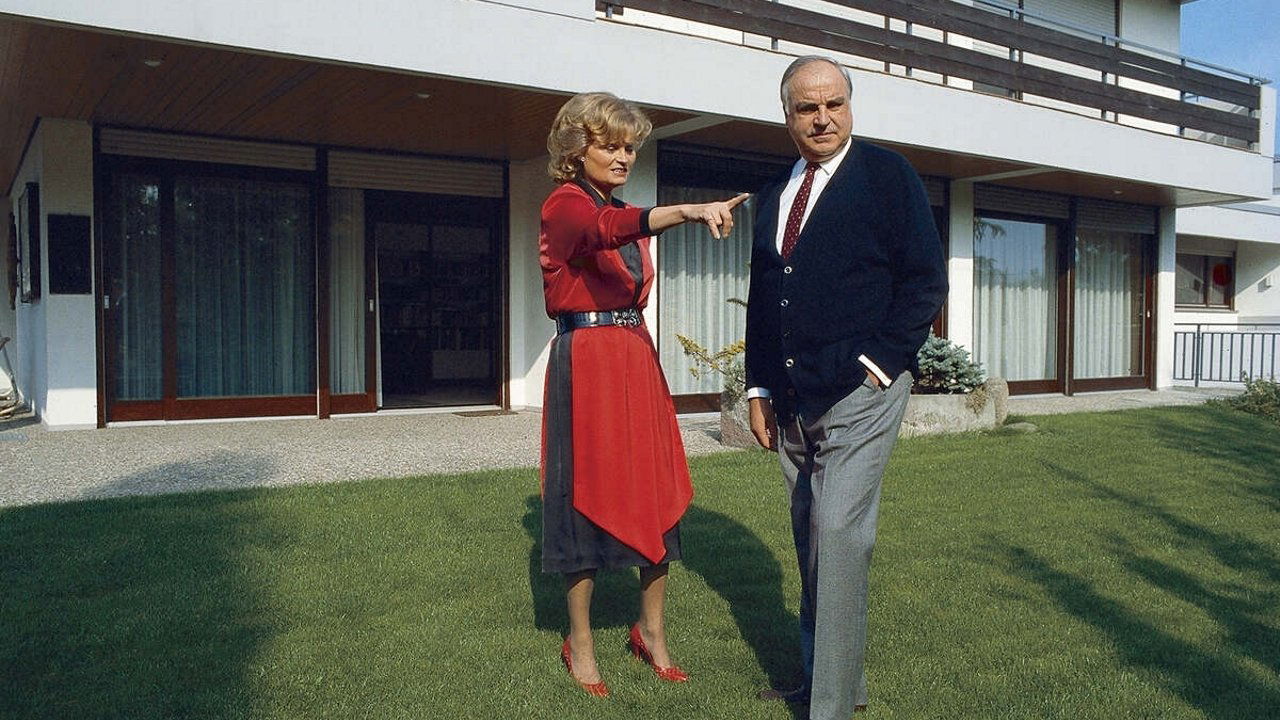
Hannelore Kohl - Die erste Frau
Documentary
Overview
Hannelore Kohl was the brave political wife, the wife of the Eternal Chancellor. The reliable companion on his way to power. His campaigns were hers too. Last but not least, his success was based on her strength. Hannelore Kohl lived in her husband's iron power system. When she fell seriously ill, Hannelore Kohl retreated more and more from the light of the public to a life in the dark. Until she put an end to her life on July 5, 2001. The documentation chronologically traces the life of Hannelore Kohl using archive recordings from over half a century of German history.






Hannelore Kohl
Hannelore Kohl
Self (archive footage)
Hannelore Kohl
Self (archive footage)

Helmut Kohl
Helmut Kohl
Self (archive footage)
Helmut Kohl
Self (archive footage)
Rena Krebs
Rena Krebs
Self
Rena Krebs
Self
Walter Kohl
Walter Kohl
Self
Walter Kohl
Self
Peter Kohl
Peter Kohl
Self
Peter Kohl
Self
Bernhard Vogel
Bernhard Vogel
Self
Bernhard Vogel
Self
Edeltraud Otto
Edeltraud Otto
Self
Edeltraud Otto
Self
Sabine Gräfin von Nayhauß-Cormons
Sabine Gräfin von Nayhauß-Cormons
Self
Sabine Gräfin von Nayhauß-Cormons
Self
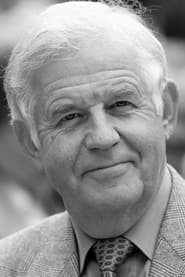
Kurt Biedenkopf
Kurt Biedenkopf
Self
Kurt Biedenkopf
Self
Hilde Seeber
Hilde Seeber
Self
Hilde Seeber
Self
Similar Movies

On October 10, 2005, Angela Merkel becomes German Chancellor. After 16 years, she now wants to clear the field. We take a look back at the many different faces of our Chancellor. In addition to Wolfgang Bosbach, Gregor Gysi and Kai Diekmann, extreme mountaineer Reinhold Messner, presenter Nina Eichinger, comedian Wigald Boning, former minister Annette Schavan, former President of the Bundestag Nobert Lammert, actress Uschi Glas and entrepreneur Gloria von Thurn und Taxis share their very personal views.
In this documentary, Joachim Hellwig uses partly unpublished footage to shed light on a dark chapter of German history and shows the entanglements between the politicians' claims to power and the interests of industry and business in Germany from the beginning of the First World War to the end of the Second World War (1914 to 1945). The Nuremberg War Crimes and Industrial Trials served as the basis for this documentary.
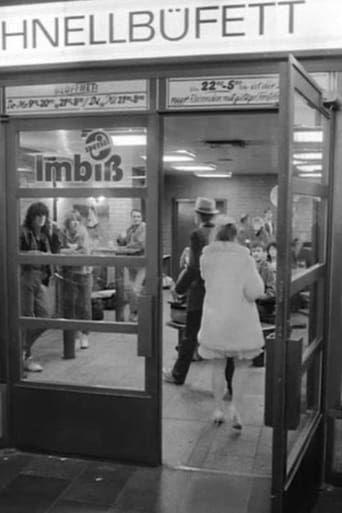
The lower level of Lichtenberg Station in Belin in early October 1989: the beginning of the end for the GDR. In the snack bar, the staff are catering for travellers of every kind while in the background the authorities maintain a flow of triumphal statements, but those months between August and October come to feel like sitting out the death throes. Careful observation of people and their work as the current of history suddenly becomes perceptible.

Angela Merkel's decision in autumn 2015 to open the borders for refugees split the country - some praised the moral stance, others criticized the surrender of sovereignty. Yet what would appear to be well-planned activity is in reality a policy of muddling along, chance, trial and error. The Driven Ones is a chronicle of the refugee crisis which shows that the political actors are being driven along, crushed between self-imposed constraints and events that have spun out of control.
Study of the relationship between observer and landscape in the contemplative experience. The view building the landscape from the necessary distance. The delimitation of its borders against the total continuum of nature. The observer immersed in the path of his gaze across the landscape. Resting the gaze in the details that make the globallity. The view selecting the space included as a landscape.
A documentary portrait of Tiit Pääsuke, the most prominent painter in contemporary Estonia. Artist per excellence, creator of the imaginary picture-landscapes, a charming person, adorer of the woman’s beauty, gentleman and a colonel in local whisky club - Tallinn Uisge Beatha Club. “When painting, I compose the details of my pictures, my human models not as traditional painter, but more like film or theatre director works with actors, my compositions are as performances, theatrical happenings”. - Tiit Pääsuke

In 1931 the rains stopped and the "black blizzards" began. Powerful dust storms carrying millions of tons of stinging, blinding black dirt swept across the Southern Plains — the panhandles of Texas and Oklahoma, western Kansas, and the eastern portions of Colorado and New Mexico. Topsoil that had taken a thousand years per inch to build suddenly blew away in only minutes. One journalist traveling through the devastated region dubbed it the "Dust Bowl." This American Experience film presents the remarkable story of the determined people who clung to their homes and way of life, enduring drought, dust, disease — even death — for nearly a decade. Less well-known than those who sought refuge in California, typified by the Joad family in John Steinbeck's "The Grapes of Wrath," the Dust Bowlers who stayed overcame an almost unbelievable series of calamities and disasters.