

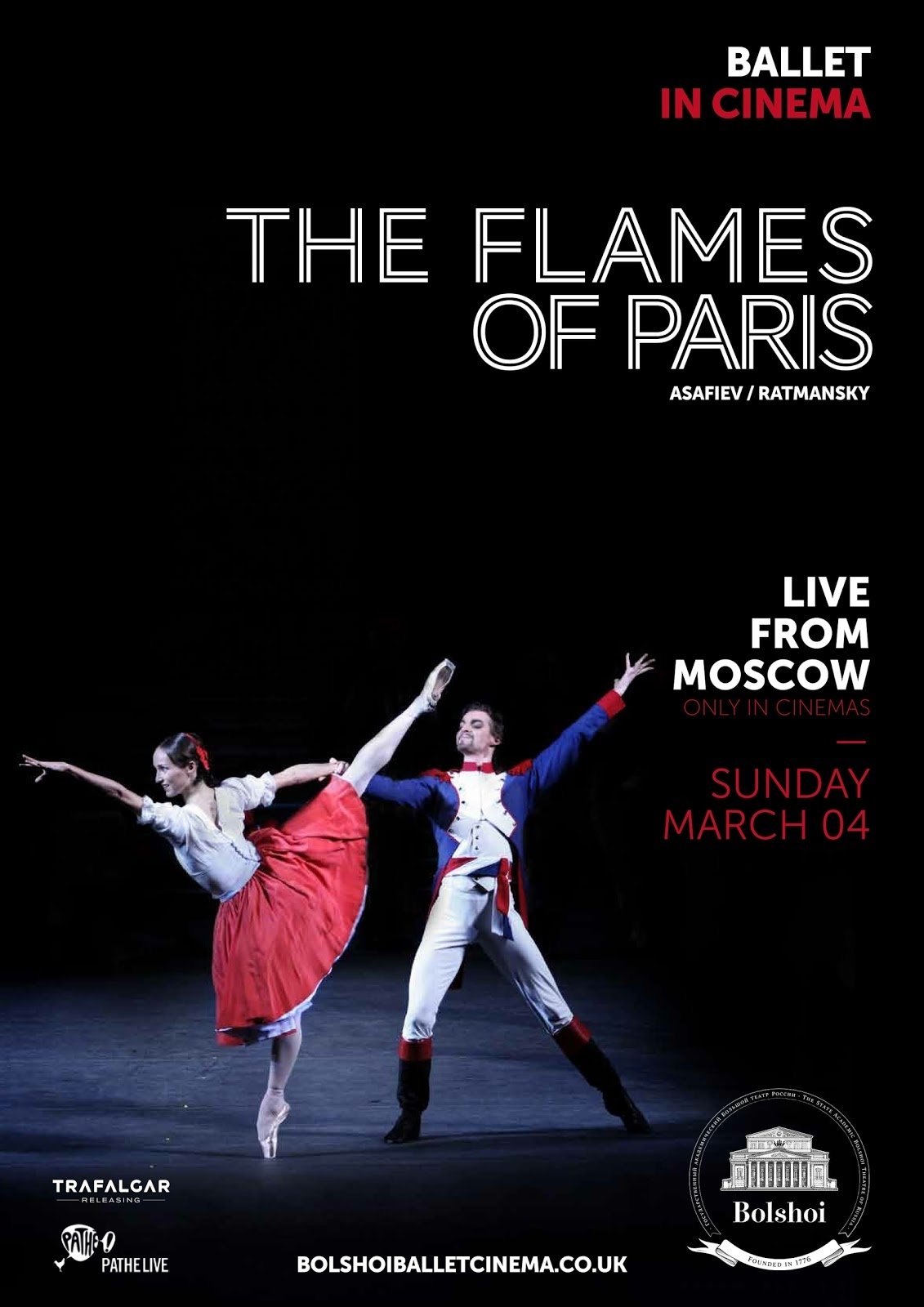
Bolshoi Ballet: The Flames of Paris
Music · History · Drama
Overview
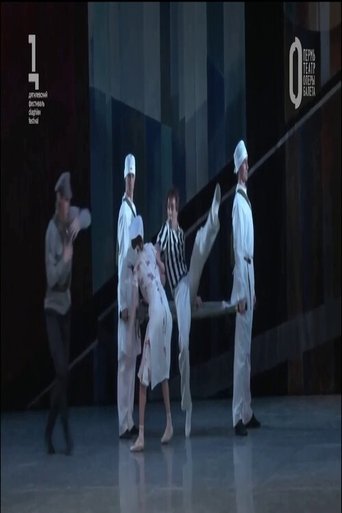
Flames of Paris (Russian: Пла́мя Пари́жа) is a full-length ballet in four acts, choreographed by Vasily Vainonen to music by Boris Asafyev based on songs of the French Revolution. The libretto by Nicolai Volkov and Vladimir Dmitriev was adapted from a book by Felix Gras.









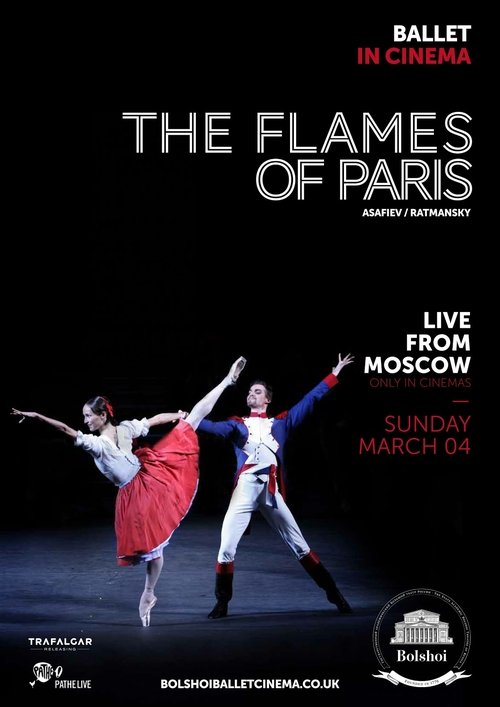

Margarita Shrayner
Margarita Shrayner
Jeanne
Margarita Shrayner
Jeanne

Igor Tsvirko
Igor Tsvirko
Philippe
Igor Tsvirko
Philippe
Similar Movies
The classic Mariinsky (Kirov) production of the greatest of all ballets. Filmed in the imperial splendor of the Mariinsky Theatre, St Petersburg. Starring Ulyana Lopatkina, Danila Korsuntsev and the breathtaking Mariinsky corps de ballet. Conducted by the great Russian maestro Valery Gergiev.
The film traces Sam McKinlay’s early days as a punk skateboarder through his academic development as a conceptual artist into a highly esteemed noise practitioner whose work bridges the gap between the gallery world and the sleaze of exploitation film imagery. It documents the physical processes of his work and the distillation of visuals into sound, most notably addressing the appeal of abstraction—from the cheap effects of old monster movie makeup to the ‘masks’ created by the heavy cosmetic makeup of 1920s flapper culture and actresses like Pamela Stanford in Jess Franco’s Lorna the Exorcist (The Rita has albums or EPs named after several eurotrash actresses, including The Nylons of Laura Antonelli (2009) and Monica Swinn/Pamela Stanford (2016)).
Sara joins Julliard in New York to fulfill her and her mother's dream of becoming the Prima ballerina of the school. She befriends her roommates, Zoe and Miles, who teach hip-hop classes. She has ballet classes with the rigid and famous Monique Delacroix that she idolizes - Monique requires full commitment, discipline and hard work from her students. When Miles, who is a composer, invites Sara to help him compose the music for the dance choreography Sara's passion for hip-hop is sparked and she also falls in love with Miles. When she is assigned to perform Giselle in an important event, she feels divided between the technique of the ballet and the creative work offered by Miles.
In the seaside town of Rochefort, twin sisters Delphine and Solange dream of love and artistic fulfillment beyond their quiet lives. As sailors, artists, musicians, and chance visitors pass through town during a weekend fair, a web of near-misses and romantic longing brings ideal partners tantalizingly close—without their realizing it.
In the spring of 1913, Parisian businessman Gabriel Astruc opens a new theater on the Champs Elysées. The first performance is the premiere of Igor Stravinsky's 'The Rite of Spring', danced by the Ballet Russes. The rehearsal process is extremely fraught: the orchestra dislike Stravinsky's harsh, atonal music; the dancers dislike the 'ugly' choreography of Vaslav Nijinsky. The volatile, bisexual Nijinsky is in a strained relationship with the much older Sergei Diaghilev, the Ballet Russes' charismatic but manipulative impresario. Public expectation is extremely high after Nijinsky's success in 'L'apres-midi d'un faune'. Finally, 'The Rite of Spring' premieres to a gossip-loving, febrile, fashion-conscious Parisian audience sharply divided as to its merits.
Young and extremely talented dancer Yulya Olshanskaya from a small mining town draws a “happy ticket”: she is noticed by a former ballet dancer Pototsky and he promises her a future of great ballerina, worthy of the main stage of the country. However, in order to become a diamond, anyone, even the most outstanding brilliant, needs to be cut, and the way to the legendary stage of The Bolshoi Theatre for Yulya lies through the walls of the ballet school, where the more capricious teacher Galina Mikhailovna Beletskaya takes custody of the rebellious provincial. Turning into a prima will require incredible self-denial, and Yulya herself will have to make sure that the big ballet is not only the whiteness of the packs, the gold of the boxes and the slip of silk ribbons. But no obstacles will stop the one who has the big dream.
Swanhilda notices her fiancee Franz is infatuated with the beautiful Coppélia who sits reading on her balcony each day. Nearly breaking up the two sweethearts, Coppélia is not what she seems and Swanhilda decides to teach Franz a lesson… The Bolshoi’s unique version of Coppélia exhibits a fascinating reconstruction of the original 19th century choreography of this ebullient comedy involving a feisty heroine, a boyish fiancee with a wandering eye, and an old dollmaker. The company’s stunning corps de ballet shines in the divertissements and famous “dance of the hours,” and its principals abound in youthful energy and irresistible humor in this effervescent production.