


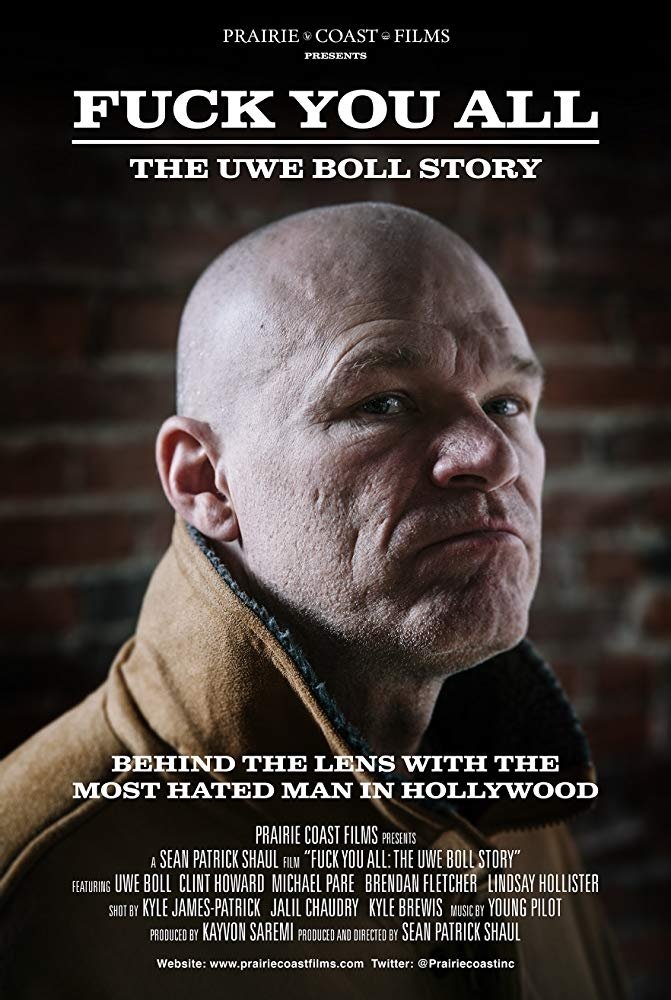
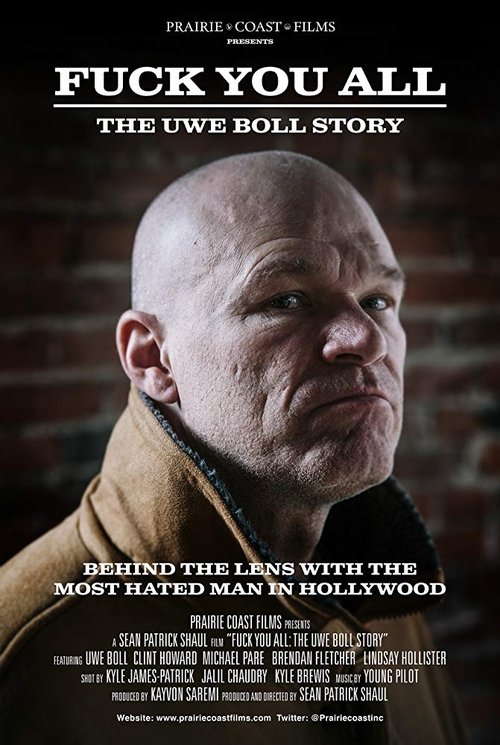
Fuck You All: The Uwe Boll Story
Documentary
Overview
Honing his craft as an indie filmmaker in Germany in the early 90s, Uwe Boll never could have imagined the life that lay before him. From working with Oscar-winning actors and making films with US$60million budgets to having actors publicly disparage him and online petitions demanding he stop making films, Boll continued to work; he has a filmography of 32 features, a career that has led to his new life as a successful high-end restauranteur. Already a cult legend, he will be remembered forever in the film world; for some, as a modern-day Ed Wood, who made films so bad, they're good, while for others, a prolific filmmaker who came from a small town in Germany and never compromised his integrity while forging his own unique Hollywood trajectory.


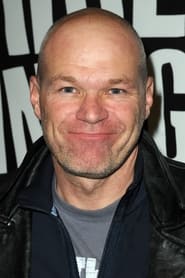
Uwe Boll
Uwe Boll
Self
Uwe Boll
Self

Clint Howard
Clint Howard
Self
Clint Howard
Self
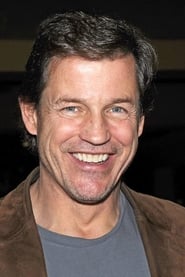
Michael Paré
Michael Paré
Self
Michael Paré
Self

Guinevere Turner
Guinevere Turner
Self
Guinevere Turner
Self

Lindsay Hollister
Lindsay Hollister
Self
Lindsay Hollister
Self

Brendan Fletcher
Brendan Fletcher
Self
Brendan Fletcher
Self
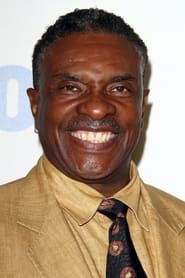
Keith David
Keith David
Self
Keith David
Self
Natalie Boll
Natalie Boll
Self
Natalie Boll
Self
Dan Clarke
Dan Clarke
Self
Dan Clarke
Self
Bryan C. Knight
Bryan C. Knight
Self
Bryan C. Knight
Self
Similar Movies
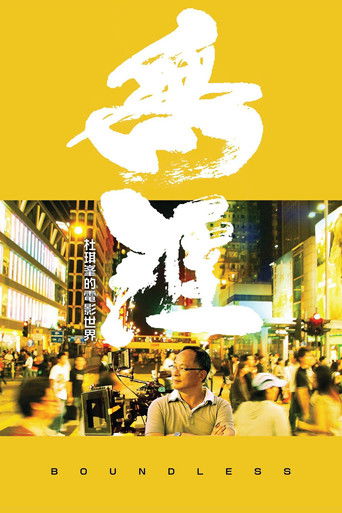
As Hong Kong's foremost filmmaker, Johnnie To himself becomes the protagonist of this painstaking documentary exploring him and his Boundless world of film. A film student from Beijing and avid Johnnie To fan, Ferris Lin boldly approached To with a proposal to document the master director for his graduation thesis. To agreed immediately and Lin's camera closely followed him for over two years, capturing the man behind the movies and the myths. The result is Boundless, a candid profile of one of Hong Kong's greatest directors and a heartfelt love letter to Hong Kong cinema.
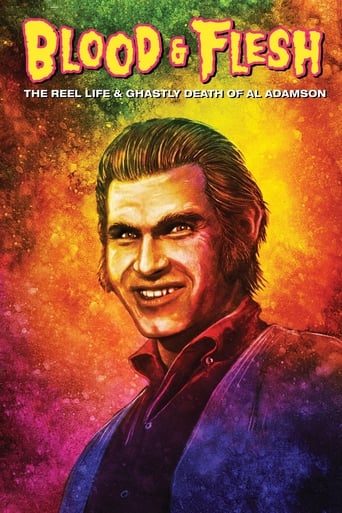
Brought to life through archival material and the reflections of over 40 colleagues, friends and fans, BLOOD & FLESH is much more than the story of a moviemaking life most unusual. It beautifully captures the worlds of outsider filmmaker communities that existed in California in the ’70s, and the weird ways they intersected with Hollywood mainstream and union indies. On Adamson shoots, regular Orson Welles crew and cinematographers like Gary Graver, Vilmos Szigmond and Lazlo Kovaks worked alongside Bud Cardos — and at one point, Charles Manson! Director David Gregory (founder of Severin Films, director of LOST SOUL: THE DOOMED JOURNEY OF RICHARD STANLEY’S ISLAND OF DR. MOREAU) spent years making this film, speaking to everyone down to the cops who investigated Adamson’s murder, vividly encapsulating both a bold life and tragic demise, with alien conspiracies, go-go dancers and Colonel Sanders coming in along the way. If you’ve got even a passing interest in cinema, you want to see this
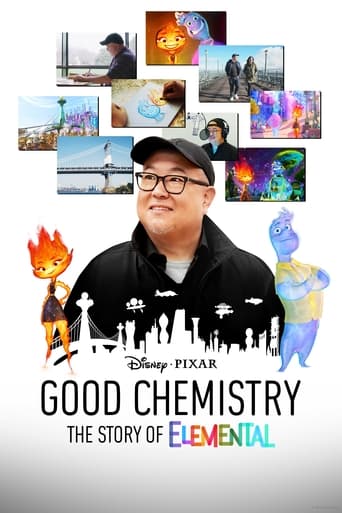
Pixar director Peter Sohn takes viewers on a humorous personal journey through the inspiration behind Disney and Pixar’s feature film “Elemental.” “Good Chemistry: The Story of Elemental” traces his parents’ voyage from Korea to New York, explores his dad’s former grocery shop in the heart of the Bronx, and delves into his choice of a career in animation, rather than the family business.
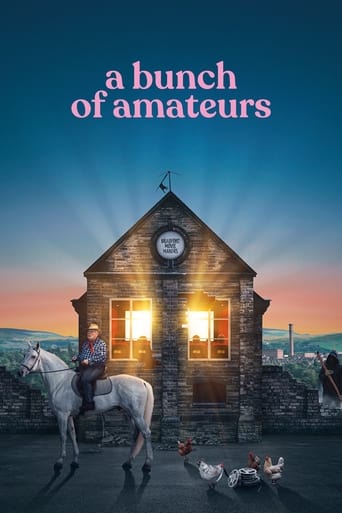
A bunch of British working class amateur filmmakers with nothing left to lose tackle one of Hollywood's greatest musicals in order to save their beloved Club. Britain’s oldest amateur filmmaking club struggles to survive, as its members grow old amid flickering memories and hardships. In the northern industrial town of Bradford, England, a handful of diehard amateur filmmakers desperately cling to their dreams, and to each other, in this warm and funny look at shared artistic folly that speaks to the delusional dreamer in us all.
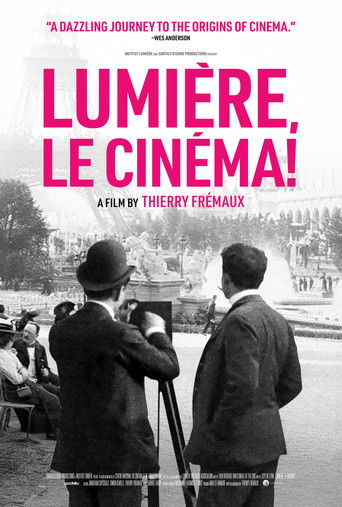
In one of those wonderful coincidences of history, lumière, the French word for “light,” was also the last name of brothers Auguste and Louis, whose brilliant invention, the cinematograph, helped to inaugurate the most beloved art form of the last 130 years. Institute Lumière director Thierry Frémaux uses Lumière, Le Cinema! to guide the viewer through over a hundred shorts—some famous, some forgotten, some never before seen—directed by Lumière and company. In the process, Frémaux illuminates how the brothers employed the camera as a creative instrument as they (and their operators) mastered framing, staging, and subject selection for quotidian and exotic microdocumentaries as well as the first ever fictional motion pictures. The result is not only a glorious re(telling) of the genesis of cinema but a profound meditation on the beautiful world captured—and the mysterious world imagined—by the Lumières.