

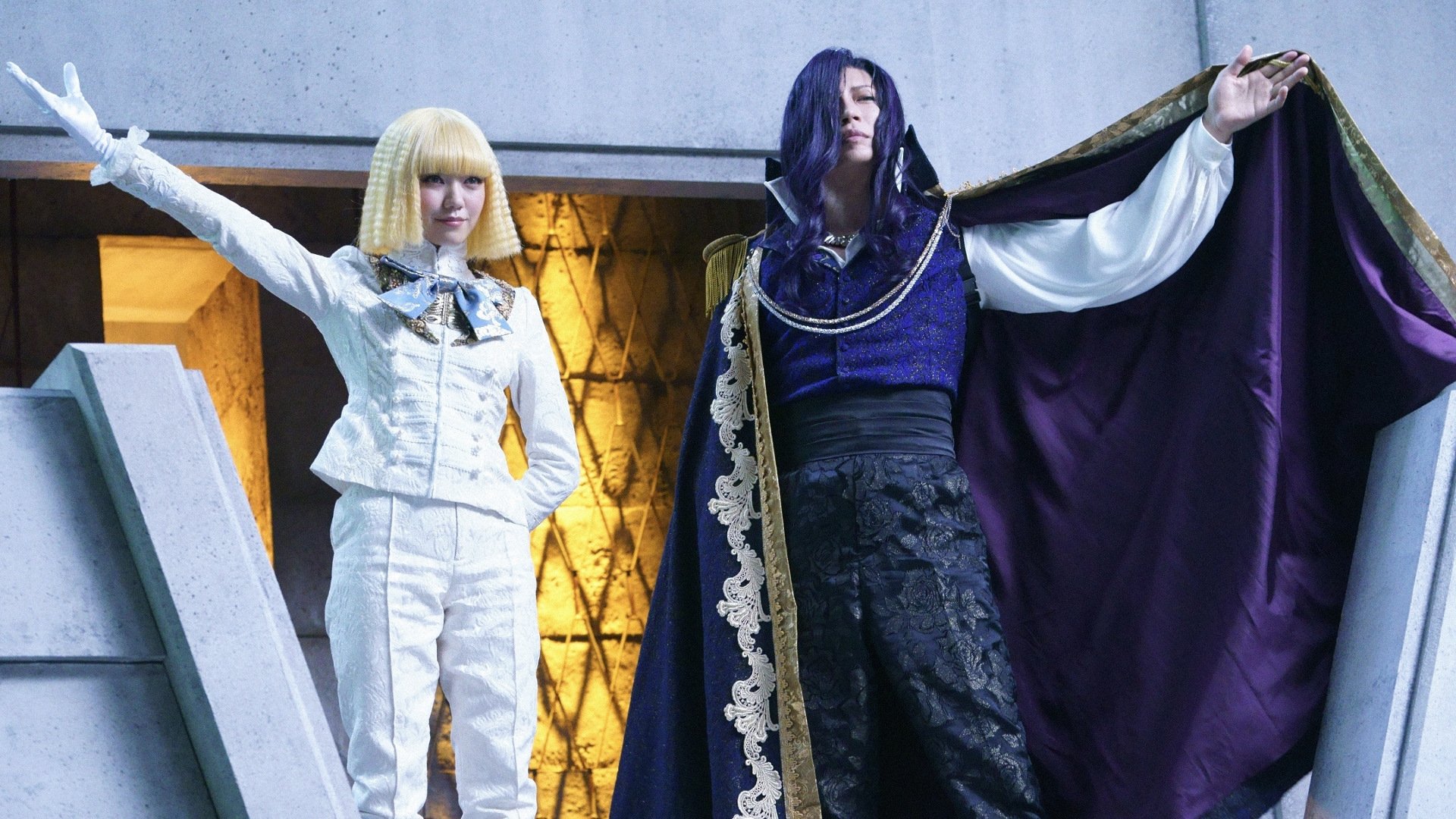

Fly Me to the Saitama
Comedy
Overview
People from Saitama Prefecture are persecuted and, because of this, they hide the fact that they are from there. In Tokyo, Momomi Hakuhodo is a male high school student and the son of the Tokyo governor. Physically, Momomi Hakuhodo looks like a girl. One day, he meets mysterious male transfer student Rei Asami. They are attracted to each other, but Rei Asami is from Saitama Prefecture.












Fumi Nikaido
Fumi Nikaido
Momomi Hakuhodo
Fumi Nikaido
Momomi Hakuhodo

GACKT
GACKT
Rei Asami
GACKT
Rei Asami

Yūsuke Iseya
Yūsuke Iseya
Sho Akutsu
Yūsuke Iseya
Sho Akutsu
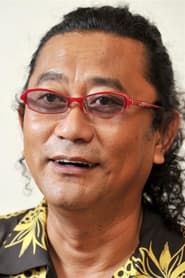
Brother Tom
Brother Tom
Yoshiumi Sugawara
Brother Tom
Yoshiumi Sugawara

Kumiko Aso
Kumiko Aso
Maki Sugawara
Kumiko Aso
Maki Sugawara

Haruka Shimazaki
Haruka Shimazaki
Manami Sugawara
Haruka Shimazaki
Manami Sugawara
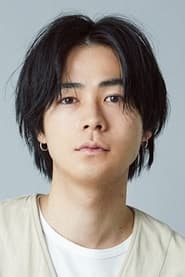
Ryo Narita
Ryo Narita
Haruto Igarashi
Ryo Narita
Haruto Igarashi

Shotaro Mamiya
Shotaro Mamiya
Shotaro Mamiya
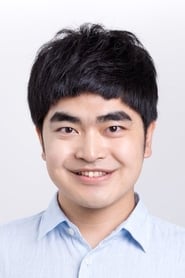
Ryo Kato
Ryo Kato
Nobuo Shimokawa
Ryo Kato
Nobuo Shimokawa

Masuwaka Tsubasa
Masuwaka Tsubasa
Okayo
Masuwaka Tsubasa
Okayo
Similar Movies
Only three days before their high school festival, guitarist Kei, drummer Kyoko, and bassist Nozomi are forced to recruit a new lead vocalist for their band. They choose Korean exchange student Son, though her comprehension of Japanese is a bit rough! It's a race against time as the group struggles to learn three songs for the festival's rock concert—including a classic '80s song by the Japanese punk rock band The Blue Hearts called "Linda Linda".
The year is 2020, the middle of the corona crisis. Art student Itsuka has her graduation exhibition canceled and must take home the piece which she had been working on for a year. In a whirlpool of emotions she clashes with her worried parents, her little sister overreacts to the virus and even her usually calm friend Hirai starts to build up frustration. In the middle of all that, she re-unites with Tanaka, who gave her the opportunity to absorb herself in painting, clashes with Hirai over their true feelings and tries to face her own future.
The story of a teenage boy called Yu, who falls for Yoko, a girl he runs into while working as an upskirt photographer in an offshoot of the porn industry. His attempts to woo her are complicated by a spot of cross-dressing – which convinces Yoko that she is lesbian – dalliances with kung-fu and crime, and a constant struggle with Catholic guilt.
Second year high school student Kodaka Hasegawa has transferred to his new school about a month ago, but he still hasn't made any friends. Kodaka Hasegawa was born from a Japanese father and a British mother. Because of his appearance, people think Kodaka Hasegawa is a troubled kid. One day, Kodaka Hasegawa sees classmate Yozora Mikazuki pleasantly talking to herself. Kodaka Hasegawa talks with her about how to make friends. To make friends, Yozora Mikazuki decides to form the Neighbor's Club and forces Kodaka to enroll in the club.
Brothers Keiji and Ryoichi move to a new neighborhood in the Tokyo suburbs after their father, an office clerk, is promoted. The boys join the local gang as lowly new kids and emerge as natural leaders after defeating a bully. While visiting the home of their father's boss, the brothers witness the ridicule their father endures to please his superior. Angry and embarrassed, the boys find their naive ideas about power being challenged.
A lighthearted take on director Yasujiro Ozu’s perennial theme of the challenges of intergenerational relationships, Good Morning tells the story of two young boys who stop speaking in protest after their parents refuse to buy a television set. Ozu weaves a wealth of subtle gags through a family portrait as rich as those of his dramatic films, mocking the foibles of the adult world through the eyes of his child protagonists. Shot in stunning color and set in a suburb of Tokyo where housewives gossip about the neighbors’ new washing machine and unemployed husbands look for work as door-to-door salesmen, this charming comedy refashions Ozu’s own silent classic I Was Born, But . . . to gently satirize consumerism in postwar Japan.