

Punk the Vote!
Documentary
Overview
Roach and Starbuck, two hardcore punks from Montreal, try to form their own political party, but run out of time due to Canada's electoral process. Instead, they decide to campaign for political office as independent candidates in a rich Montreal district called Outremont.
Ken Starbuck
Ken Starbuck
Self
Ken Starbuck
Self
Eric Denis
Eric Denis
Himself (as Roach)
Eric Denis
Himself (as Roach)
Similar Movies
We Were Feared chronicles the rise and fall of the Cuckoo's Nest punk rock club. Hailed as the birthplace of slam-dancing, the Nest famously shared a parking lot with a cowboy bar and the mayhem that would ensue when both clubs emptied was immortalized in the Vandals' songs “The Legend of Pat Brown” and “Urban Struggle.” Featuring interviews with the people who populated the scene, archival images of gigs, and live performances by Black Flag, the Circle Jerks, & T.S.O.L.

A rather incoherent post-breakup Sex Pistols "documentary", told from the point of view of Pistols manager Malcolm McLaren, whose (arguable) position is that the Sex Pistols in particular and punk rock in general were an elaborate scam perpetrated by him in order to make "a million pounds."
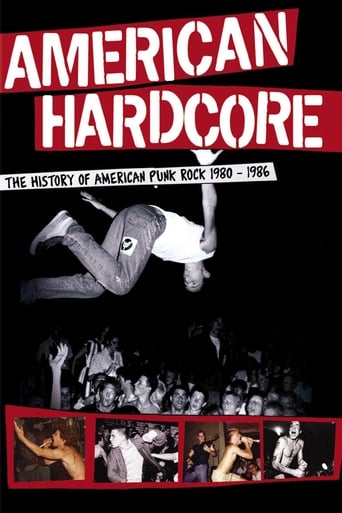
Inspired by Steven Blush's book "American Hardcore: A tribal history" Paul Rachman's feature documentary debut is a chronicle of the underground hardcore punk years from 1979 to 1986. Interviews and rare live footage from artists such as Black Flag, Bad Brains, Minor Threat, SS Decontrol and the Dead Kennedys.
A year has passed since the attacks on the Nord Stream gas pipelines, and it is still unclear what actually happened at the bottom of the Baltic Sea at that time. ARD, Süddeutsche Zeitung, and DIE ZEIT have joined forces for a large-scale investigation and set out to find the alleged perpetrators. An investigation into one of the most spectacular criminal cases of our time, an attack of historic proportions.
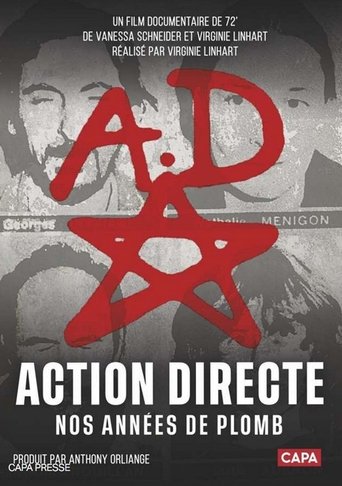
Between 1979 and 1987, a far-left group wreaked havoc across France. Robberies, bombings, assassinations. They struck hard and disappeared in a cloud of explosives, leaflets scattered in the wind, and relentless ideological demands. Their name? Action Directe. More than 80 attacks, 26 wounded, and 12 dead in less than ten years. Stunned French citizens discovered posters plastered everywhere showing portraits of these young women and men who looked like everyone else and whom nothing seemed to be able to stop. A long and intense manhunt began, culminating in the arrest of the group's leadership.

This documentary profiles economist and writer Marilyn Waring. In extensive interviews, Waring details her feminist approach to finances and challenges commonly accepted truths about the global economy. The filmmakers detail Waring's early rise to political prominence and her successful protests against nuclear arms. Waring also speaks candidly about wartime economies, suggesting that government policies tend to marginalize the fiscal contributions of women.
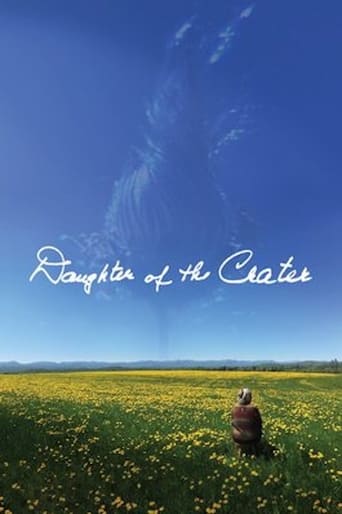
A woman with a deep love of the land, Yolande Simard Perrault sees her life as having been shaped by a planetary upheaval in Charlevoix, Quebec, millions of years ago. As enduring as the Canadian Shield, she’s a woman of strength and spirit, a child of the crater left by the meteor’s impact. This documentary portrays a determined woman who’s the reflection of a land created on an immense scale. She was the creative and life partner of filmmaker Pierre Perrault, who gave up everything to be by her side. The film charts the influence of her unquenchable dreams and her contribution to the building of a people’s collective memory. In a stream of images and words, Simard Perrault recounts the splendours of the landscape and the people who shaped it. Generous and boundless, she embarks on a quest for identity that nurtures and perpetuates the oeuvre of the man who breathed new life into Quebec cinema.
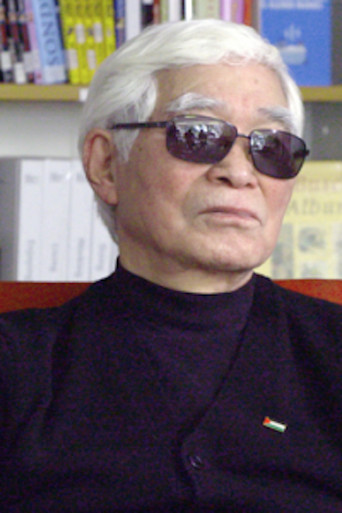
Masao Adachi, the author and director of experimental works and pinku-eiga in the 1960s, was a member of the Japanese New Left that shifted from being a filmmaker to a guerrilla fighter. In 1974, he joined the Japanese Red Army in Lebanon, which worked closely with the Popular Front for the Liberation of Palestine. Filmmaker Lutz Dammbeck met Adachi in Tokyo in 2018 and talked with him about a wide range of topics, including art, revolution, the influence of western avant-garde art and American underground; the Japanese Red Army; collaboration with secret services; the role of the Left after 1968; and the reasons for failures of leftist ideas and strategies.
In the early 1970s, rubber was still king in Akron, Ohio. But just a few short years later, Akron's most important product was, ever so briefly, music. In the mid-1970s, a group of local bands took over an old rubber workers' hang-out in downtown Akron called The Crypt and created a mix of punk and art rock that came to be known as "the Akron Sound." And for a while, it was almost "the next big thing." Almost. It's Everything, and Then It's Gone, a Western Reserve PBS production written and directed by Phil Hoffman., takes viewers back to a time when the music really did mean everything. And for the men and women in these local bands, it was a way out of the factory.
Bullet in a Bible documents one of the two biggest shows that Green Day have performed in their career. They played in front of a crowd of over 130,000 people at the Milton Keynes National Bowl in United Kingdom on June 18–19, 2005. The band was supported by Jimmy Eat World, Taking Back Sunday, and Hard-Fi during their American Idiot world tour. Fourteen of the twenty songs performed at these shows were included on the disc; missing out "Jaded", "Knowledge", "She", "Maria", "Homecoming" and "We Are The Champions". Bullet in a Bible was released as a double-LP set on November 10, 2009, as part of the band's 2009 vinyl re-release campaign.