

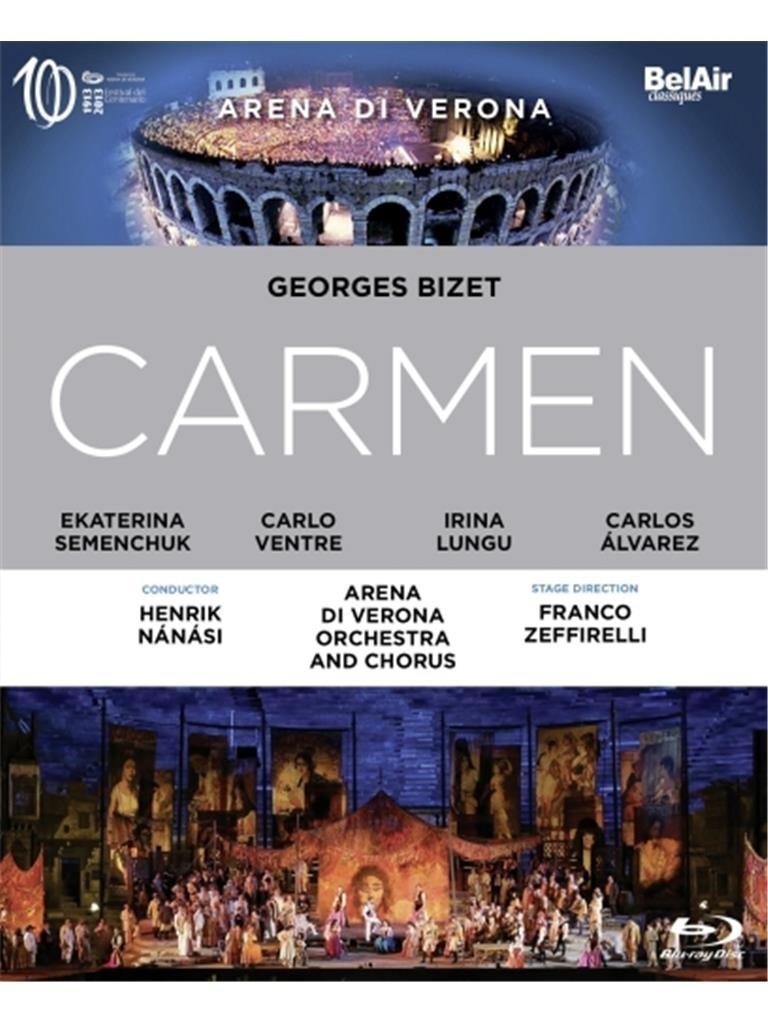
Carmen (Arena di Verona)
Music
Overview
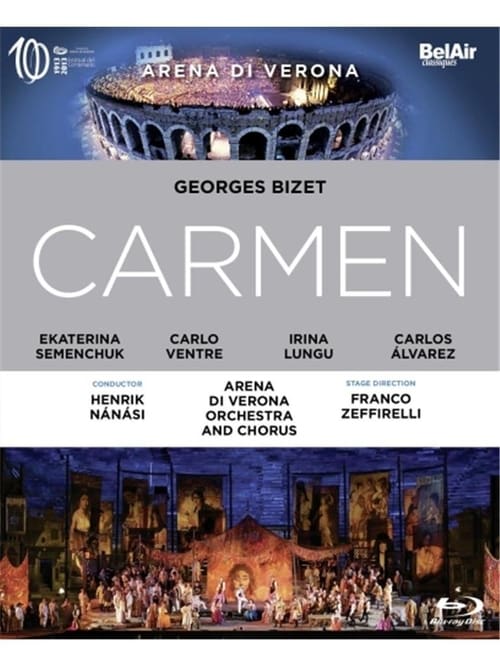
High Definition recording June 2014, Arena di Verona. This opulent production was directed by Franco Zeffirelli and sung by an international cast of excellent singers: Russian mezzo-soprano Ekaterina Semenchuk, soprano Irina Lungu, tenor Carlo Ventre and Carlos Alvarez. The famous opera is staged as a colourful feast for the eyes, true to its source and convincingly acted by soloists, chorus and ballet alike. Conducted by Henrik Nánási it is a gloriously sung musical experience.

Ekaterina Semenchuck
Ekaterina Semenchuck
Carmen
Ekaterina Semenchuck
Carmen
Irina Lungu
Irina Lungu
Micaëla
Irina Lungu
Micaëla
Carlo Ventre
Carlo Ventre
Don José
Carlo Ventre
Don José

Carlos Álvarez
Carlos Álvarez
Escamillo
Carlos Álvarez
Escamillo
Henrik Nánási
Henrik Nánási
Conductor
Henrik Nánási
Conductor
Francesco Verna
Francesco Verna
Moralès
Francesco Verna
Moralès
Seung Pil Choi
Seung Pil Choi
Zuniga
Seung Pil Choi
Zuniga
Federico Longhi
Federico Longhi
Dancaïre
Federico Longhi
Dancaïre
Paolo Antognetti
Paolo Antognetti
Le Remendado
Paolo Antognetti
Le Remendado
Francesca Micarelli
Francesca Micarelli
Frasquita
Francesca Micarelli
Frasquita
Similar Movies
The production bears the imprint of the conductor, Marko Letonja, and the director, Tobias Richter, whose understanding is ideal: both breathe a troupe spirit - specific to comedy - into this heterogeneous cast, which brings together young and old. Both give as much importance to recitatives as to arias and ensembles.
A young woman, married to a wealthy man, but miserably lonely; trapped within a world ruled with an iron fist. Katerina is driven by a lust for life and for love. Her husband, though, is impotent; her father-in-law a tyrant. No wonder, then, that she longs to free herself from this yoke. When Sergei starts work on the family estate, she sees in him a chance for salvation. However, their subsequent affair marks the beginning of a descent into crime.
The imperious Onegin rejects naive Tatiana's proposal of love and also incites a duel with his best friend turned rival Lenski (Piotr Beczala). This sets the scene for a dramatic story of love, loyalty and betrayal. Acclaimed theatre director Deborah Warner presents this lavish new interpretation of the timeless tale. Set in the 19th century and moving episodically from farmhouse to ballroom, the production culminates in an unforgettable finale set during a snowstorm.
American composer Jake Heggie’s compelling masterpiece, the most widely performed new opera of the last 20 years, arrives in cinemas in a haunting new production by Ivo van Hove. Based on Sister Helen Prejean’s memoir about her fight for the soul of a condemned murderer, Dead Man Walking matches the high drama of its subject with Heggie’s beautiful and poignant music and a brilliant libretto by Tony and Emmy Award–winner Terrence McNally. Met Music Director Yannick Nézet-Séguin takes the podium, with mezzo-soprano Joyce DiDonato starring as Sister Helen. The outstanding cast also features bass-baritone Ryan McKinny as the death-row inmate Joseph De Rocher, soprano Latonia Moore as Sister Rose, and legendary mezzo-soprano Susan Graham—who sang Helen Prejean in the opera’s 2000 premiere—as De Rocher’s mother.
Inspired by the magical realism of Gabriel García Márquez, Mexican composer Daniel Catán’s 1996 opera tells the enchanting story of a Brazilian opera diva who returns to her homeland to perform at the legendary opera house of Manaus—and to search for her lost lover, who has vanished into the jungle.
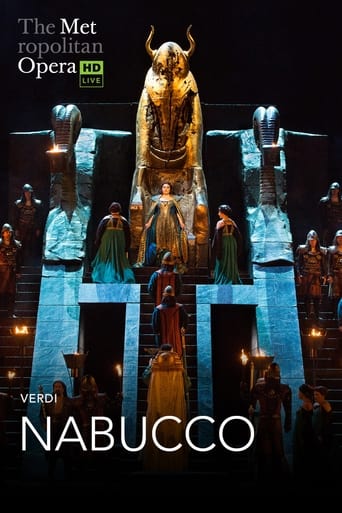
The success of Verdi’s third opera, a stirring drama about the fall of ancient Jerusalem at the hands of Nebuchadnezzar (Nabucco), catapulted the 28-year-old composer to international fame. The music and Verdi himself were subsumed into a surge of patriotic fervor culminating in the foundation of the modern nation of Italy. Specifically, the Chorus of the Hebrew Slaves ('Va, pensiero'), in which the Israelites express their longing for their homeland, came to stand for the country’s aspirations for unity and that exciting era in Italian history, the Risorgimento, or 'Resurgence'.

Mozart's Marriage of Figaro is a comedy whose dark undertones explore the blurred boundaries between dying feudalism and emerging Enlightenment. Herman Prey's Figaro is admirably sung in a firm baritone and aptly characterized. So too, is his antagonist, Dietrich Fischer-Dieskau as the Count perpetually frustrated by the scheming wiles of Figaro and Susanna, here the perky Mirella Freni, who sings and acts like a dream. The Countess is creamy-voiced Kiri Te Kanawa, and the Cherubino, Maria Ewing, looks just like the horny, teenaged page she's supposed to be. The all-star leads are complemented by worthy supporting singers, the Vienna Philharmonic at the top of its form, and the experienced Mozartian, Karl Böhm conducting a stylishly fleet performance.
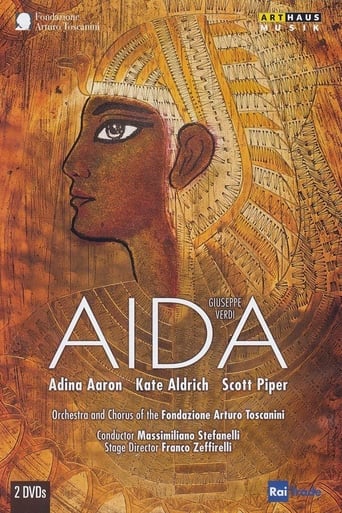
Verdi’s grand opera “Aida” is given an intimate treatment in Busetto, Italy, in 2001, in a staging with young singers, all coached by the legendary tenor Carlo Bergonzi and staged by Franco Zeffirelli. The result is an astonishing musical and dramatic piece of theater, proving that with the right mix of ingredients, an opera can be staged in a small theater and still achieve a thrilling and moving effect.