

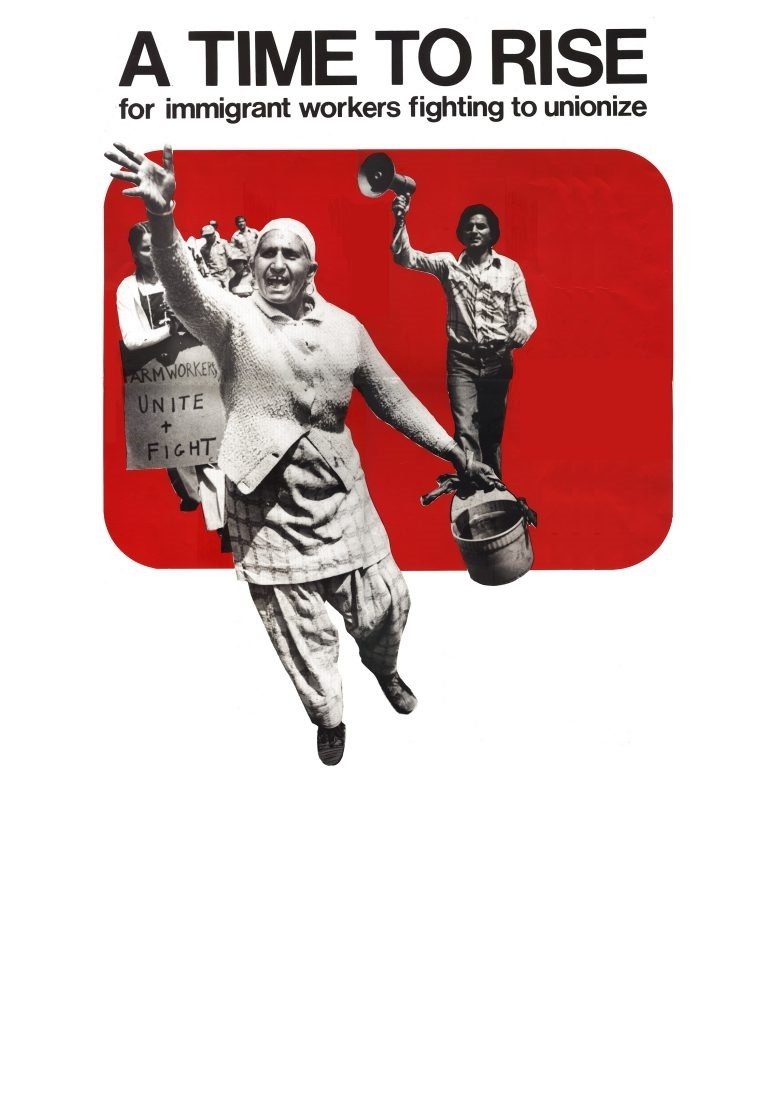
A Time To Rise
Documentary
Overview
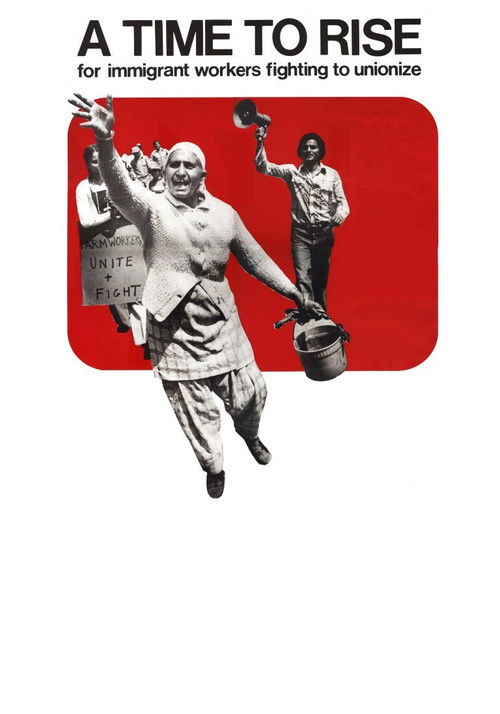
On April 6, 1980, the Canadian Farmworkers Union came into existence. This film documents the conditions among Chinese and East Indian immigrant workers in British Columbia that provoked the formation of the union, and the response of growers and labor contractors to the threat of unionization. Made over a period of two years, the film is eloquent testimony to the progress of the workers’ movement from the first stirrings of militancy to the energetic canvassing of union members.




No cast information.
Similar Movies
Allonias decides that enough is enough. He works 12-13 hours driving his taxi every day and still has no money left to pay for rent and clothes for their three children. He begins a battle against Sweden’s largest taxi company owned by billionaire Rolf Karlsson. It leads to Rolf Karlsson selling the entire empire for around 2-3 billion SEK. But for Allonias it has a high price…

This film documents the coal miners' strike against the Brookside Mine of the Eastover Mining Company in Harlan County, Kentucky in June, 1973. Eastover's refusal to sign a contract (when the miners joined with the United Mine Workers of America) led to the strike, which lasted more than a year and included violent battles between gun-toting company thugs/scabs and the picketing miners and their supportive women-folk. Director Barbara Kopple puts the strike into perspective by giving us some background on the historical plight of the miners and some history of the UMWA. Preserved by the Academy Film Archive in partnership with New York Women in Film & Television in 2004.
Stanley Kubrick’s first color film, commissioned by the Seafarers International Union to promote the benefits of union membership. Shot inside the union’s Atlantic and Gulf Coast District facilities, it features scenes of ships, machinery, cafeteria life, and meetings, highlighting the daily routines and camaraderie of seafarers. Thought lost for decades, the film was rediscovered in 1973 and preserved by the Library of Congress.
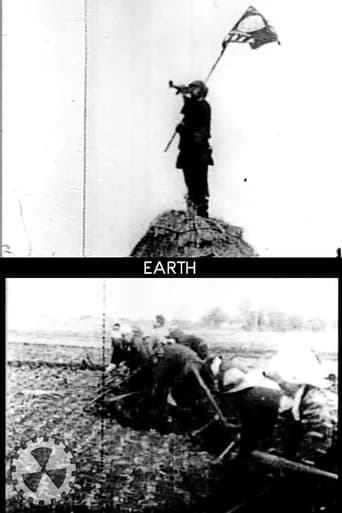
A main agenda of the prewar farmer's movement was struggle against landowners. Prokino also considered this as their prime concern. The main title sequence and the latter part of the film have unfortunately been lost. While we cannot see its entire structure, we can still get a glimpse of it from this surviving short.
Finland’s education system has consistently ranked among the best in the world for more than a decade. The puzzle is, why Finland? Documentary filmmaker, Bob Compton, along with Harvard researcher, Dr. Tony Wagner, decided to find out. The result of their research is captured in a new film, "The Finland Phenomenon: Inside the World’s Most Surprising School System". In the 60-minute film, Dr. Wagner guides the viewer through an inside look at the world’s finest secondary education system. A life-long educator and author of the best-selling book "The Global Achievement Gap," Dr. Wagner is uniquely qualified to explore and explain Finland’s success. From within classrooms and through interviews with students, teachers, parents, administrators and government officials, Dr. Wagner reveals the surprising factors accounting for Finland’s rank as the #1 education system in the world.
In 2008 French filmmaker Julie Gali traveled to the US to film the election of Barack Obama. In spite of this victory for civil rights, it soon became apparent that the rights of another minority were under threat. In California the passing of Proposition 8 marked the only time in U.S. history that a civil right was actually taken away after it had been granted. Upon seeing this, Ms. Gali decided to immerse herself in the growing grassroots struggle of the gay community, which culminated in the October 11, 2009 March for Equality in Washington DC.
Juan “Accidentes” Dominguez is on his biggest case ever. On behalf of twelve Nicaraguan banana workers he is tackling Dole Food in a ground-breaking legal battle for their use of a banned pesticide that was known by the company to cause sterility. Can he beat the giant, or will the corporation get away with it?
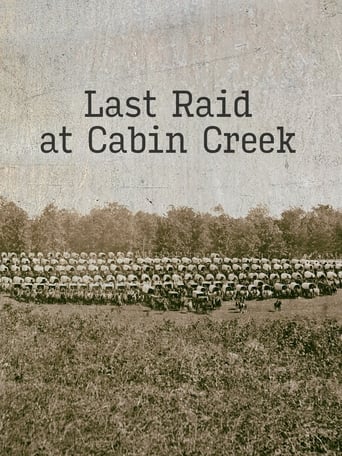
This award-winning documentary tells the true story of the final Confederate raid into what is now northeastern Oklahoma. The raid culminated in the capture of more than 300 Federal supply wagons at Cabin Creek in the Cherokee Nation. Now streaming on TUBI, PRIME VIDEO, TRUETVPLUS, and HISTORYFIX.
On May 20, 2017, Jérôme Laronze, a 37-year-old cattle farmer, was shot dead by gendarmes at the end of a nine-day run. In conflict with government services, the organic farmer, spokesman for the Confédération paysanne de Saône-et-Loire, had evaded yet another health inspection and, during his escape, had tried to alert people to the malaise in his profession. The news of his death came as a bombshell in a farming world already plunged into mourning by a wave of suicides. How did it come to this? While their incomes depend almost exclusively on European subsidies - which favor large farms - farmers must, in return, comply with very strict standards.

Farrebique, the first feature-length effort of French documentary filmmaker Georges Rouqier, is widely regarded as his finest film. Rouqier concentrates on a single French farm family, following them through the four seasons. As in the works of Robert Flaherty, the human characters and the land surrounding them are "one", and Rouqier never misses an opportunity to parallel their lives with the eons-old phases of nature. The final symbolic images of Spring, achieved through time-lapse photography, are almost unbearably beautiful. The winner of several festival awards, Farrebique nonetheless did not immediately result in an outpouring of financing for Rouqier's follow-up films (this was a common problem in the financially strapped French film industry of the 1940s). Perhaps as a result, Rouqier did not make his sequel, Biquefarre (filmed in the same region, with some of the same "actors"), until 1983.