

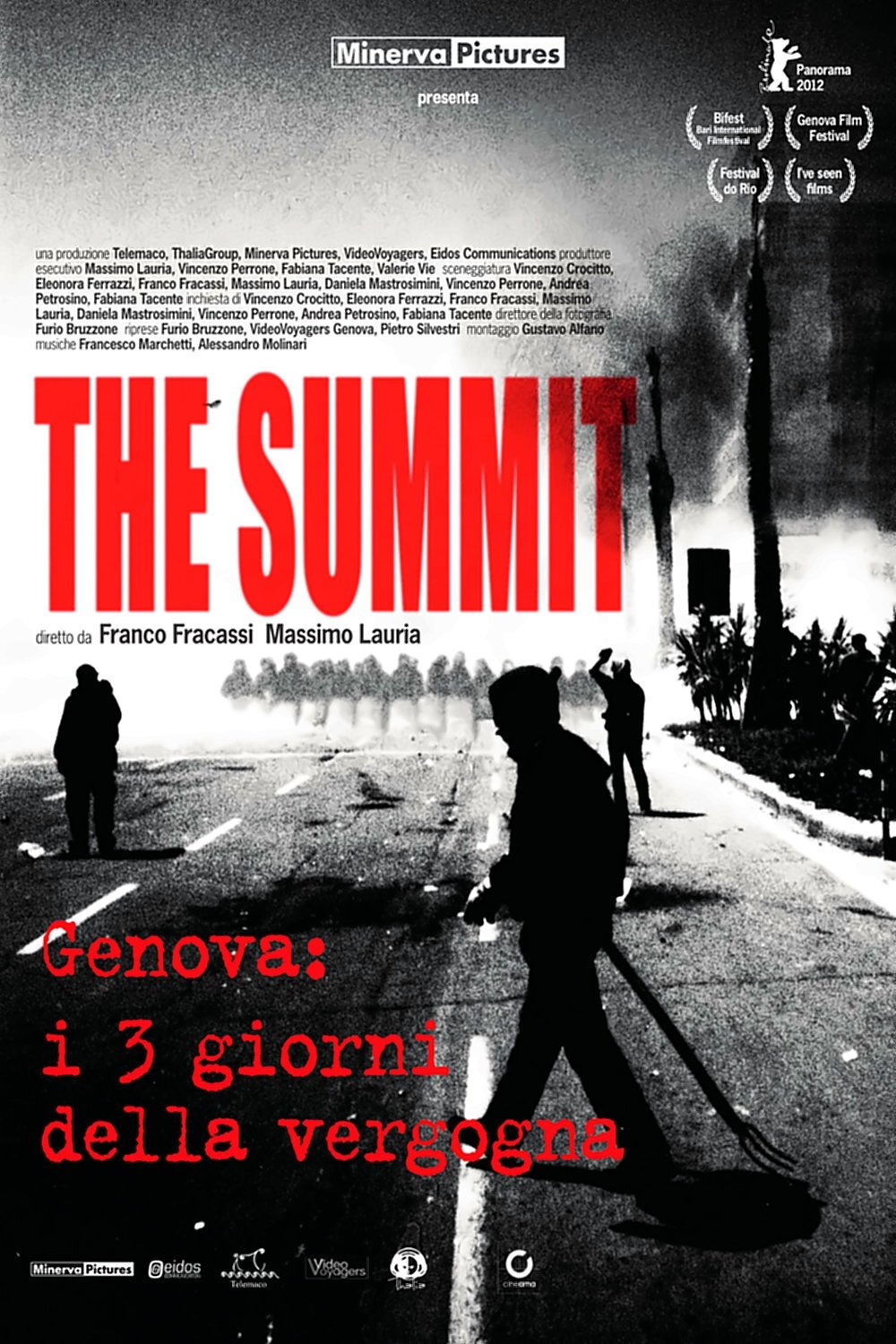
The Summit
Documentary
Overview
The actions of the Italian police against peaceful demonstrators durign G8 in Genua in 2001, one of whom died and a hundred of whom sustained serious injuries, was described by Amnesty International as one of the most severe breaches of democratic rights in a European country since the SecondWorld War. Under the pretext of wanting to arrest members of the anarchistic Black Bloc, police stormed into the Diaz school complex which at the time housed journalists covering the event, and spent over two hours raining blows on defenceless women and men.



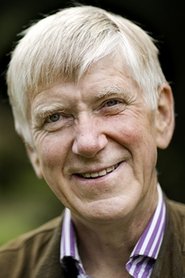
Hans Abrahamsson
Hans Abrahamsson
Himself
Hans Abrahamsson
Himself
Vittorio Agnoletto
Vittorio Agnoletto
Himself
Vittorio Agnoletto
Himself
Giovanni Aliquo
Giovanni Aliquo
Himself
Giovanni Aliquo
Himself
Paolo Bellino
Paolo Bellino
Himself
Paolo Bellino
Himself
Mauro Bulgarelli
Mauro Bulgarelli
Himself
Mauro Bulgarelli
Himself
Valerio Calieri
Valerio Calieri
Himself
Valerio Calieri
Himself
Vincenzo Canterini
Vincenzo Canterini
Himself
Vincenzo Canterini
Himself
Similar Movies
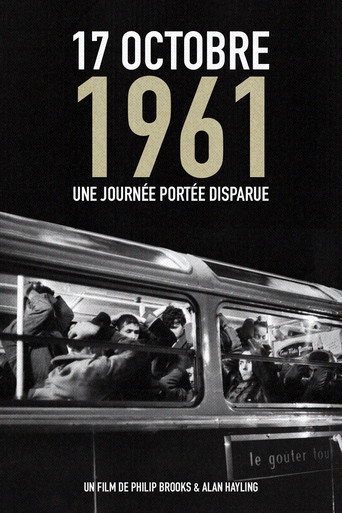
This documentary bears witness to the events that took place more than thirty years before the filming of this movie, on October 17, 1961, in Paris, during the Algerian War. It is a work not only about historical truth but also about memory. Constructed primarily from interviews conducted with those involved in the events, along with archival footage, photographs, and radio broadcasts from the time, our investigation proves that nearly 200 Algerians were killed (drowned, tortured) that night and in the days that followed by the French police. "A Missing Day" seeks to ask two key questions: how could such events have unfolded in the capital of a Western democracy barely thirty years ago? And why have they been silenced ever since?
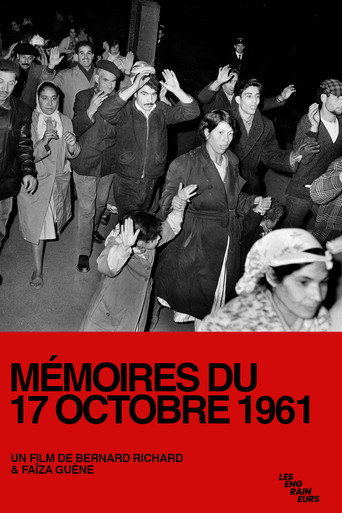
Three demonstrators from October 17, 1961, and a journalist recount the peaceful success of the demonstration and its brutal repression in the streets of Paris. Five months before the end of the Algerian War, the Gaullist government violently suppressed (40 to 300 deaths in a single evening, according to various sources) a peaceful demonstration by the entire Algerian civilian population of the Paris region, protesting the curfew imposed solely on this population (all participants held French citizenship). The government long denied this state crime; the official version: 3 deaths! In 1962, these events were granted amnesty by a simple decree (later enacted into law) issued by the same Gaullist government.
On October 17, 1961, 30,000 Algerians demonstrated peacefully in Paris to protest the discriminatory curfew imposed upon them and to demand Algerian independence. Under the authority of the then Prefect of Police, Maurice Papon, the demonstration was brutally repressed, resulting in the deaths of dozens of Algerians. Historians cite eleven thousand arrests, dozens of murders, demonstrators thrown into the Seine, hundreds of expulsions, and just as many complaints that went unanswered; all for a night that would become a blind spot in the national narrative. No investigation, no trial, and certainly no commemoration. The day after the demonstration, Jacques Panijel began filming *October in Paris* to alert the public to the massacre that had just taken place in the streets of Paris. The film was banned by the French authorities. It obtained a distribution license in 1973. It was first shown in theaters in October 2011.
In response to the call of the Front de libération nationale (F.L.N., the National Liberation Front), thousands of Algerians from Paris and its surroundings march on October 17, 1961, to protest against the curfew imposed on them. This peaceful demonstration will be violently put down by the police. 50 years on, the filmmaker sheds light on this still taboo subject. Blending testimony and unseen archive footage, history and memory, past and present, the film relates the different stages in these events and reveals the strategy and methods applied at the highest level of the French state: manipulation of public opinion, the systematic challenge of every accusation, the censoring of information in order to prevent investigation.
The true history of Japanese Unit 731, from its beginnings in the 1930s to its demise in 1945, and the subsequent trials in Khabarovsk, USSR, of many of the Japanese doctors from Unit 731. The facts are told, and previously unknown evidence is revealed by an eyewitness to these events, former doctor and military translator, Anatoly Protasov.
An amusing look at lives of cats who make their owners lives hell! Cats are loveable, often hilarious but sometimes... complete psychopaths! Inter-cut with hilarious cat clips and with analyses from a vet and a cat behaviourist, we see cats in all their bonkers glory. In the UK alone, there’s a whopping 11 million felines lounging around our homes, but for some owners having a cat is a bit like sharing your sofa with a serial killer!