

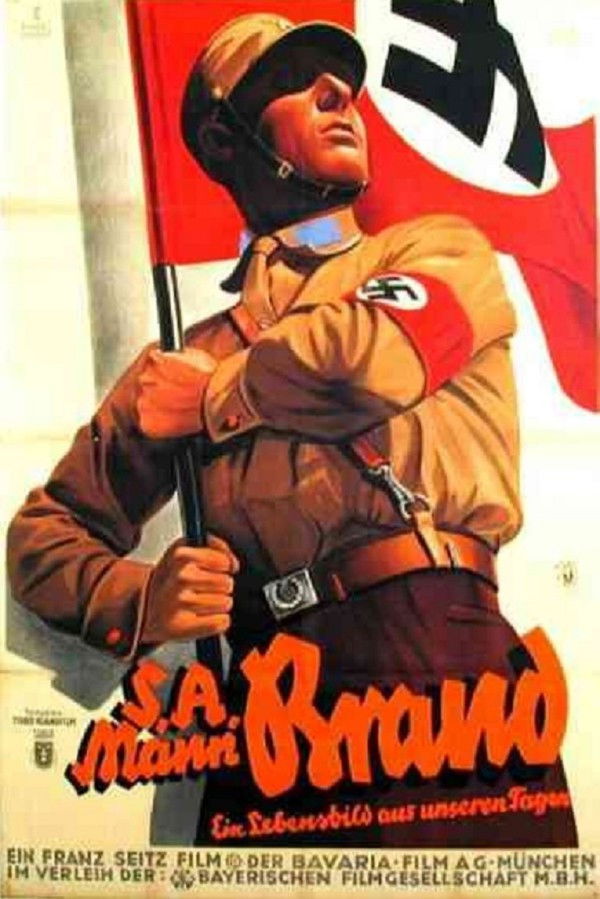
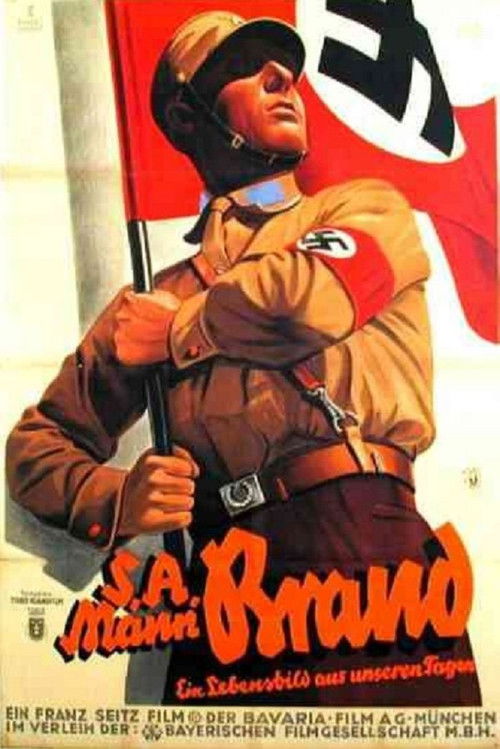
S.A. Mann Brand
Drama
Overview
This Nazi propaganda film tells the story of a young truck driver who is having trouble making ends meet until he is exposed to the teachings of Adolf Hitler, and he joins the S.A., aka Storm Troopers, and manages to convert his father--a former soldier with Marxist leanings--and his girlfriend of the rightness of the Nazi cause.
Top Cast







Heinz Klingenberg
Heinz Klingenberg
Fritz Brand
Heinz Klingenberg
Fritz Brand
Wera Liessem
Wera Liessem
Anni Baumann
Wera Liessem
Anni Baumann
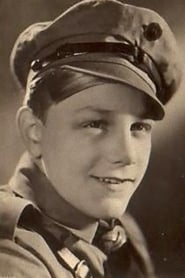
Rolf Wenkhaus
Rolf Wenkhaus
Erich Lohner
Rolf Wenkhaus
Erich Lohner
Hedda Lembach
Hedda Lembach
Margaret Lohner
Hedda Lembach
Margaret Lohner
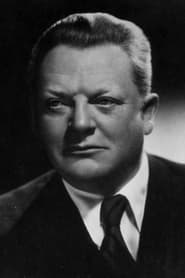
Otto Wernicke
Otto Wernicke
Herr Brand
Otto Wernicke
Herr Brand
Elise Aulinger
Elise Aulinger
Frau Brand
Elise Aulinger
Frau Brand

Joe Stöckel
Joe Stöckel
Anton Huber
Joe Stöckel
Anton Huber
Helma Rückert
Helma Rückert
Genoveva Huber
Helma Rückert
Genoveva Huber
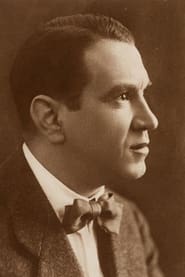
Fritz Greiner
Fritz Greiner
Der alte Baumann
Fritz Greiner
Der alte Baumann
Magda Lena
Magda Lena
Frau Baumann
Magda Lena
Frau Baumann
Similar Movies
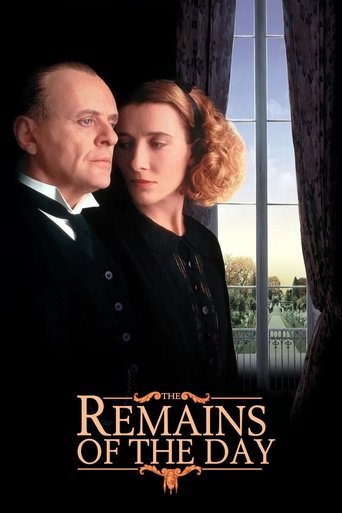
A rule-bound head butler's world of manners and decorum in the household he maintains is tested by the arrival of a housekeeper who falls in love with him in post-WWI Britain. The possibility of romance and his master's cultivation of ties with the Nazi cause challenge his carefully maintained veneer of servitude.
Budapest in the 1930s. Restaurant owner Laszlo hires pianist András to play in his restaurant. Both men fall in love with the beautiful waitress Ilona who inspires András to his only composition. His song of Gloomy Sunday is, at first, loved and then feared, for its melancholic melody sets off a chain of suicides. The fragile balance of the erotic ménage à trois is sent off kilter when the German Hans falls in love with Ilona as well.
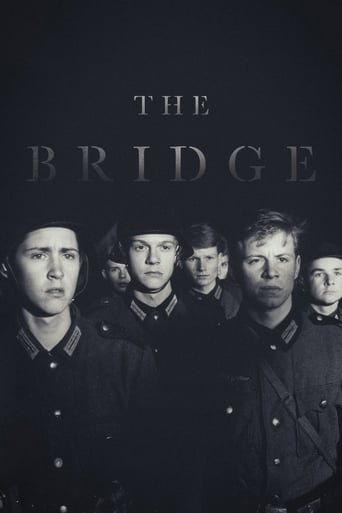
A group of German boys are ordered to protect a small bridge in their home village during the waning months of the second world war. Truckloads of defeated, cynical Wehrmacht soldiers flee the approaching American troops, but the boys, full of enthusiasm for the "blood and honor" Nazi ideology, stay to defend the useless bridge. The film is based on a West German anti-war novel of the same name, written by Gregor Dorfmeister.
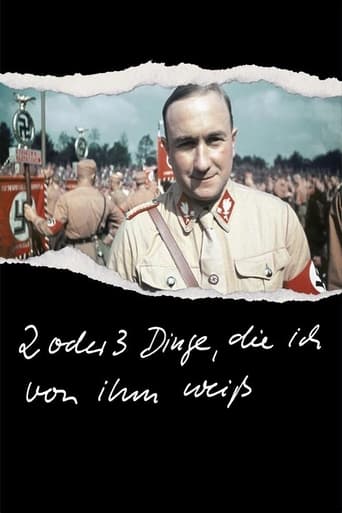
What would your family reminiscences about dad sound like if he had been an early supporter of Hitler’s, a leader of the notorious SA and the Third Reich’s minister in charge of Slovakia, including its Final Solution? Executed as a war criminal in 1947, Hanns Ludin left behind a grieving widow and six young children, the youngest of whom became a filmmaker. It's a fascinating, maddening, sometimes even humorous look at what the director calls "a typical German story." (Film Forum)
In this classic German thriller, Hans Beckert, a serial killer who preys on children, becomes the focus of a massive Berlin police manhunt. Beckert's heinous crimes are so repellant and disruptive to city life that he is even targeted by others in the seedy underworld network. With both cops and criminals in pursuit, the murderer soon realizes that people are on his trail, sending him into a tense, panicked attempt to escape justice.
The attractive Oberleutnant Paul Wendlandt is stationed in North Africa as a fighter pilot. While in Berlin to deliver a report he is given a day's leave, and on the stage of the cabaret theatre "Skala" sees the popular Danish singer Hanna Holberg. For Paul it is love at first sight. When Hanna visits friends after the end of the performance, he follows her, and speaks to her in the U-Bahn. After the party in her friends' flat, he accompanies her home and chance throws them further together when an air raid warning forces them to take cover in the air raid shelter. Hanna reciprocates Paul's feelings, but after a night spent together Paul has to return immediately to the front. There now follows a whole series of misunderstandings, and one missed opportunity after another. While Hanna waits in vain for some sign of life from Paul, he is flying on missions in North Africa. When he tries to visit her in her Berlin flat, she is giving a Christmas concert in Paris.
The true story of pianist Władysław Szpilman's experiences in Warsaw during the Nazi occupation. When the Jews of the city find themselves forced into a ghetto, Szpilman finds work playing in a café; and when his family is deported in 1942, he stays behind, works for a while as a laborer, and eventually goes into hiding in the ruins of the war-torn city.