

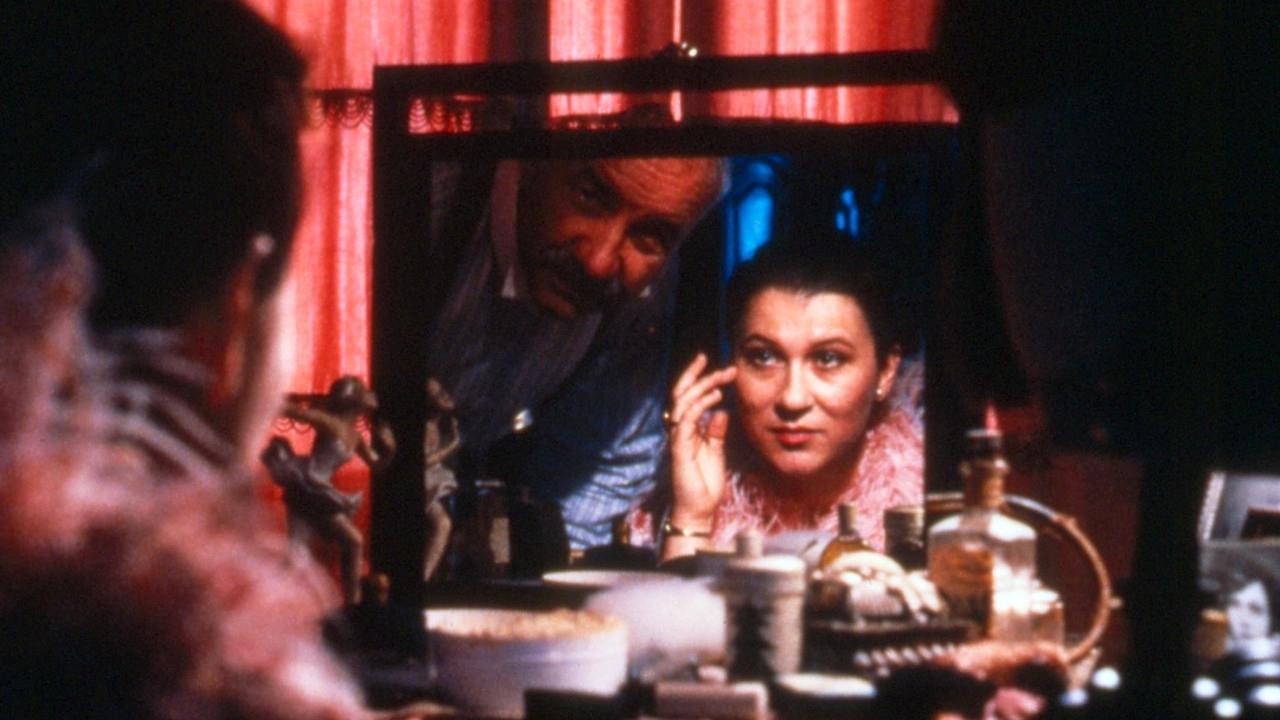

The Film Narrator
Drama
Overview
Germany in the Thirties. A movie teller realizes that his profession is not longer needed. Silent movies are not produced any longer. Telling stories is the only thing the man was ever good in, so he does not know what to do now. As political circumstances are changing dramatically these days in Germany, he gets new hope that things will again be going better for him...

















Armin Mueller-Stahl
Armin Mueller-Stahl
Kinoerzähler
Armin Mueller-Stahl
Kinoerzähler

Martin Benrath
Martin Benrath
Herr Theilhaber
Martin Benrath
Herr Theilhaber
Andrej Jautze
Andrej Jautze
Paul
Andrej Jautze
Paul

Tina Engel
Tina Engel
Marie
Tina Engel
Marie

Udo Samel
Udo Samel
Herr Lange
Udo Samel
Herr Lange

Eva Mattes
Eva Mattes
Frau Fritzsche
Eva Mattes
Frau Fritzsche
Katharina Tanner
Katharina Tanner
Klara
Katharina Tanner
Klara

Otto Sander
Otto Sander
Salzmann
Otto Sander
Salzmann
Sophie Loewe
Sophie Loewe
Anna
Sophie Loewe
Anna

Harry Baer
Harry Baer
Herr Kunze
Harry Baer
Herr Kunze
Similar Movies
The attractive Oberleutnant Paul Wendlandt is stationed in North Africa as a fighter pilot. While in Berlin to deliver a report he is given a day's leave, and on the stage of the cabaret theatre "Skala" sees the popular Danish singer Hanna Holberg. For Paul it is love at first sight. When Hanna visits friends after the end of the performance, he follows her, and speaks to her in the U-Bahn. After the party in her friends' flat, he accompanies her home and chance throws them further together when an air raid warning forces them to take cover in the air raid shelter. Hanna reciprocates Paul's feelings, but after a night spent together Paul has to return immediately to the front. There now follows a whole series of misunderstandings, and one missed opportunity after another. While Hanna waits in vain for some sign of life from Paul, he is flying on missions in North Africa. When he tries to visit her in her Berlin flat, she is giving a Christmas concert in Paris.
In 1947, four German judges who served on the bench during the Nazi regime face a military tribunal to answer charges of crimes against humanity. Chief Justice Haywood hears evidence and testimony not only from lead defendant Ernst Janning and his defense attorney Hans Rolfe, but also from the widow of a Nazi general, an idealistic U.S. Army captain and reluctant witness Irene Wallner.
Kuhle Wampe takes place in early-1930s Berlin. The film begins with a montage of newspaper headlines describing steadily-rising unemployment figures. This is followed by scenes of a young man looking for work in the city and the family discussing the unpaid back rent. The young man, brother of the protagonist Anni, removes his wristwatch and throws himself from a window out of despair. Shortly thereafter his family is evicted from their apartment. Now homeless, the family moves into a garden colony of sorts with the name “Kuhle Wampe.”
Eyal, an Israeli Mossad agent, is given the mission to track down and kill the very old Alfred Himmelman, an ex-Nazi officer, who might still be alive. Pretending to be a tourist guide, he befriends his grandson Axel, in Israel to visit his sister Pia. The two men set out on a tour of the country, during which Axel challenges Eyal's values.
Derek Vineyard is paroled after serving 3 years in prison for killing two African-American men. Through his brother, Danny Vineyard's narration, we learn that before going to prison, Derek was a skinhead and the leader of a violent white supremacist gang that committed acts of racial crime throughout L.A. and his actions greatly influenced Danny. Reformed and fresh out of prison, Derek severs contact with the gang and becomes determined to keep Danny from going down the same violent path as he did.
An American journalist arrives in Berlin just after the end of World War Two. He becomes involved in a murder mystery surrounding a dead GI who washes up at a lakeside mansion during the Potsdam negotiations between the Allied powers. Soon his investigation connects with his search for his married pre-war German lover.
The name "Voss" is given to a high-ranking Nazi criminal who flees from Germany to South America after the end of the Second World War, like hundreds of thousands of other people. The escape route leads across the Alps and South Tyrol to Genoa and from there by ship to a supposedly better world in South America. Most of these refugees were "displaced persons", i.e. people who had become homeless. Many Nazi criminals also used the same escape route to reach safety. The film depicts the conflicts that arise during the flight, but also in South America, where perpetrators and victims meet again. The main characters of the film, he a murderer, she a survivor of Nazi terror, help each other on the run and experience for the first time what it means to love. Only gradually does it become clear who has which past and whether their love can still endure.
When allied troops liberate a small battle-scarred Belgium town in 1944 the American and British commanders do all they can to help the war-weary people back on their feet. There are mental and physical wounds to heal, fields to plough, the church to rebuild. But a top Nazi, knowing the War is lost, has infiltrated the town and is fostering dissent and disunity.