

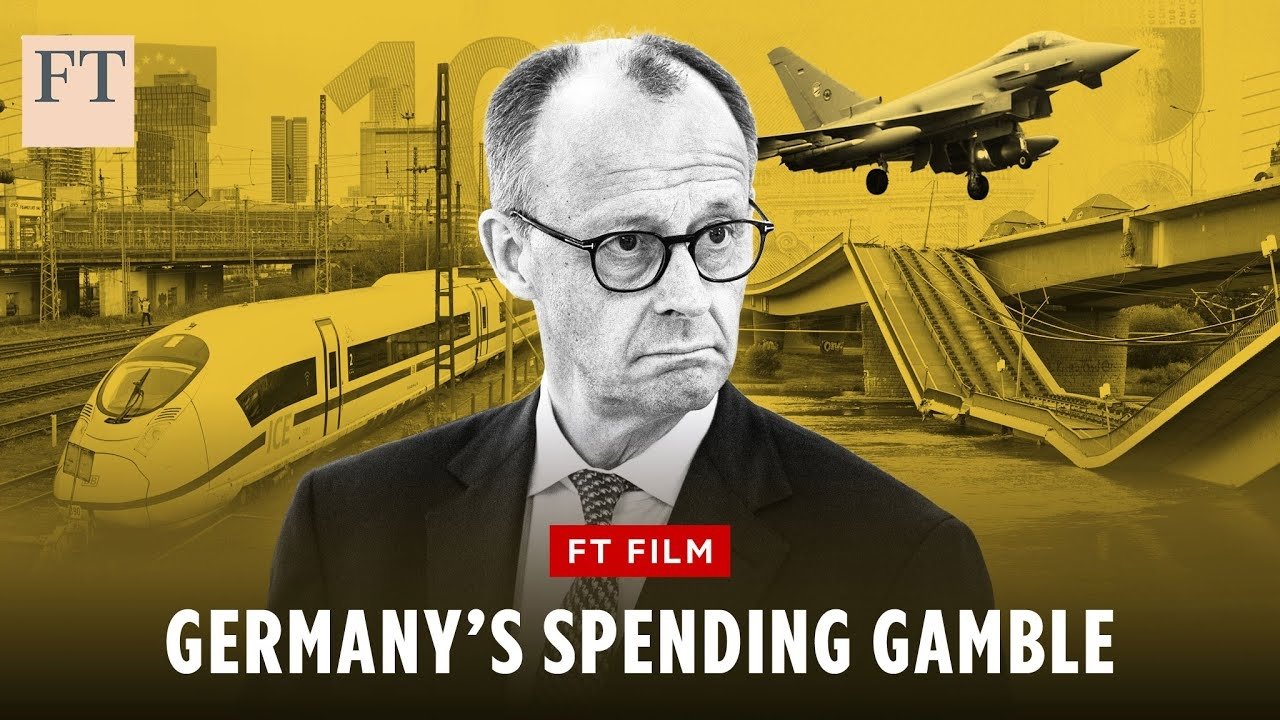
Germany’s Spending Gamble
Documentary
Overview
For decades Germany was allergic to debt. But new chancellor Friedrich Merz has - unexpectedly - loosened the country’s constitutional debt brake, injecting hundreds of billions of euros into the armed forces and infrastructure. The move, he hopes, will revive Europe’s largest economy and build up its military as Donald Trump’s US administration dismantles the transatlantic relations that underpinned Germany’s postwar recovery. The FT travels to Frankfurt and Berlin to examine why investment in crumbling schools, roads and rail infrastructure - and defence - is needed and to ask if the spending gamble will kickstart Germany's economic engine.



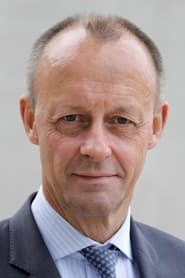
Friedrich Merz
Friedrich Merz
Self
Friedrich Merz
Self
Olaf Storbeck
Olaf Storbeck
Self
Olaf Storbeck
Self
Armin Steinbach
Armin Steinbach
Self
Armin Steinbach
Self
Martin Wolf
Martin Wolf
Self
Martin Wolf
Self
Philippa Sigl-Glöckner
Philippa Sigl-Glöckner
Self
Philippa Sigl-Glöckner
Self
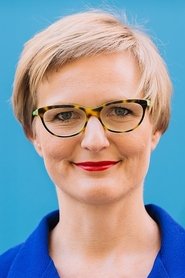
Franziska Brantner
Franziska Brantner
Self
Franziska Brantner
Self
Anja Bröker
Anja Bröker
Self
Anja Bröker
Self
Christian Böttger
Christian Böttger
Self
Christian Böttger
Self
Uwe Gehrmann
Uwe Gehrmann
Self
Uwe Gehrmann
Self
Katrin Oestreich
Katrin Oestreich
Self
Katrin Oestreich
Self
Similar Movies
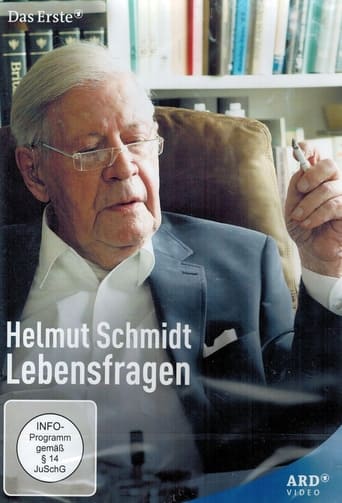
On December 23, 2013, former Federal Chancellor Helmut Schmidt will be 95 years old. As the second Social Democratic head of government in the Federal Republic of Germany, he shaped the country like few other chancellors. Even 30 years after the end of his time in government, he is still a highly esteemed expert whose advice and opinions are in demand. He is one of the most popular chancellors among the population and is held in the highest esteem by his party; even his political opponents at the time pay him the greatest respect.
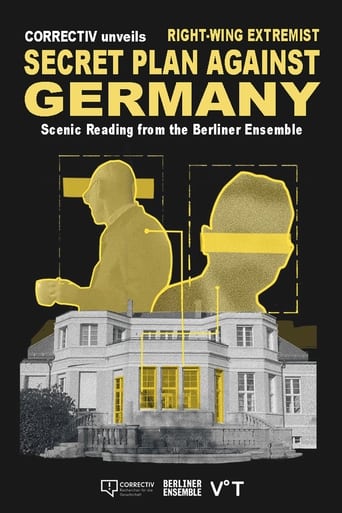
On January 10th, the investigative editorial team of CORRECTIV published research into a secret meeting of right-wing extremists, which no one was supposed to know about and which led to demonstrations and protests all over Germany. AfD politicians, CDU politicians, members of the WerteUnion, neo-Nazis and financially strong entrepreneurs came together in November 2023 in a hotel near Potsdam near the Villa on Wannsee, where the “final solution to the Jewish question” was once decided. They met to debate to expel millions of people from Germany, including non-German citizens with a migration background, as well as German citizens with a migration background and German citizens without a migration background who do not want to adapt to the ideological worldviews of those present. On January 17, 2024, the research premiered in the Berliner Ensemble as a staged reading with a political satirical character.
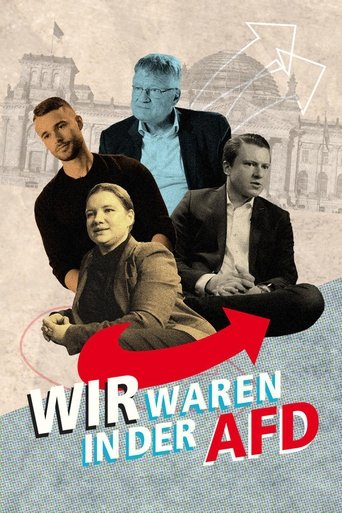
The AfD, founded in 2013, is a right-wing party that has become increasingly radicalized in recent years. To illustrate this, only those who enthusiastically joined the party in its early years are heard. They describe what they looked for and found in the party, but also how and why they left, disillusioned and frightened by the AfD's developments. How did they experience the party's radicalization process? How did friends and family react? When and why did they decide to turn their back on the party? How difficult was the exit process? The documentary provides an illuminating inside view of this party, which has been driving the established parties and the political establishment ahead of it for over ten years, gives viewers a unique look into the AfD's chronicle and world of thought and is at the same time a film about the mechanisms of political radicalization.
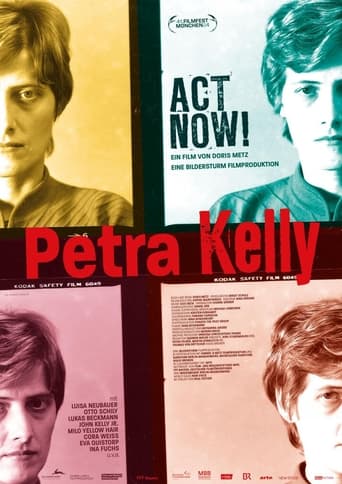
The German documentary is dedicated to an influential figure of the 20th century: Petra Kelly spent her life campaigning for feminism, environmental activism, human rights and peace. She was a political co-founder of the Green Party in the 1970s and 80s and protested against nuclear missiles in West Germany at the height of the Cold War. Above all, however, she believed that one person could very well change the world and thus rose to become an icon of the peace movement.
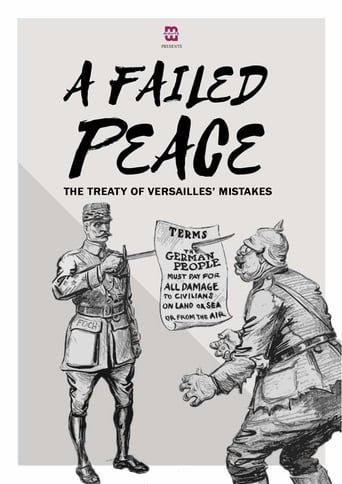
At the end of WWI, the treaty of Versailles established the conditions for peace in Europe. The aim for the victorious powers was to make Germany pay reparations, and to guarantee a future without war. Yet a decade later, the denunciation of 'Versailles' became a powerful lever for the nazis to obtain power as these reparations would mark the beginning of the humiliation of the German people, and nurture a feeling of having been bestowed a hopeless future. In the 20 years that follow the end of WWI, the issue of reparations and responsibility will effectively poison international relationship. The treaty negative impact goes well beyond WWII as the new European borders it implemented led to many conflicts during the twentieth century. This documentary shines a light on the causality between the decisions taken with the treaty of Versailles, and the ensuing events of the century.