

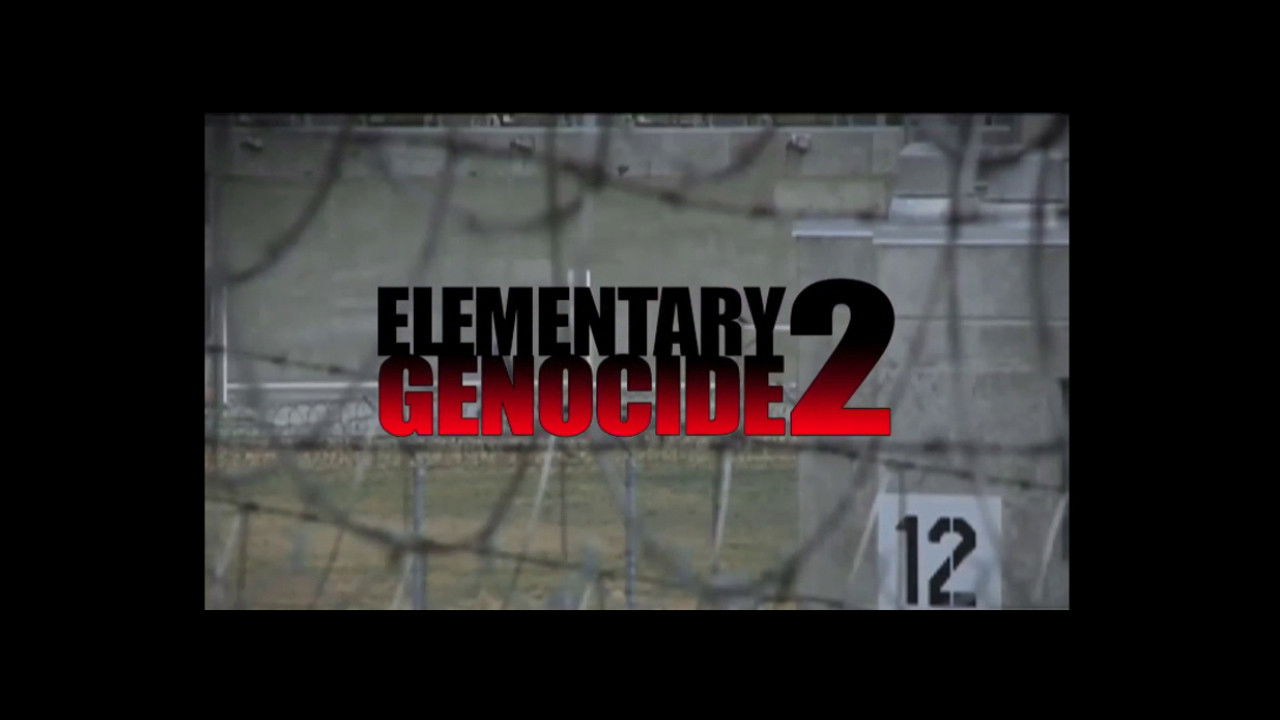

Elementary Genocide 2
Documentary
Overview
Rahiem Shabazz continues the conscience-raising dialogue generated by his acclaimed documentary Elementary Genocide: The School To Prison Pipeline with his equally hard-hitting Elementary Genocide 2: The Board of Education vs The Board of Incarceration. The Board of Education vs The Board of Incarceration uncovers the true purpose of today’s educational system and how it’s failing the African child. Going beyond the school-to-prison pipeline headlines and conspiracy theories, The Board of Education Vs. The Board of Incarceration proves that something sinister is afloat by digging deep to explore its origin, its existence and how to plot its destruction to save every Black child.






Dr. Umar Johnson
Dr. Umar Johnson
Himself
Dr. Umar Johnson
Himself

Boyce Watkins
Boyce Watkins
Himself
Boyce Watkins
Himself
Tracey D. Syphax
Tracey D. Syphax
Himself
Tracey D. Syphax
Himself
Ed Garnes
Ed Garnes
Himself
Ed Garnes
Himself
Similar Movies

“The Walkout” is a new documentary that brings to light a pivotal but often overlooked moment in Texas history: the 1968 student walkout at Edgewood High School in San Antonio’s Westside. Fed up with underfunded classrooms, uncertified teachers, and crumbling facilities, a group of young Mexican American students and their families organized a bold protest that would become a catalyst for statewide education reform. Told through the voices of the original students, community leaders, and historians, The Walkout weaves together personal testimony, historical footage, and present-day reflections to honor the legacy of resistance born in San Antonio’s Westside. This film doesn’t just revisit the past; it also draws a direct line to today’s struggles over school funding and equity in Texas.

The documentary's title translates as "to be and to have", the two auxiliary verbs in the French language. It is about a primary school in the commune of Saint-Étienne-sur-Usson, Puy-de-Dôme, France, the population of which is just over 200. The school has one small class of mixed ages (from four to twelve years), with a dedicated teacher, Georges Lopez, who shows patience and respect for the children as we follow their story through a single school year.

As a young father, watching his daughter go through her life experiences, film director Alexandre Mourot discovered the Montessori approach and decided to set his camera up in a children's house (3 to 6 years of age) in the oldest Montessori school in France. Alexandre was warmly welcomed in a surprisingly calm and peaceful environment, filled with flowers, fruits and Montessori materials. He met happy children, who were free to move about, working alone or in small groups. The teacher remained very discreet. Some children were reading, others were making bread, doing division, laughing or sleeping. The children guided the film director throughout the whole school year, helping him to understand the magic of their autonomy and self-esteem - the seeds of a new society of peace and freedom, which Maria Montessori dedicated her life work to.

Discovering your womanhood at 33 when you're a feminist is like exploring a new continent as an adventurer. It sparks a desire to embark on a journey, to understand the world around us, to search for ourselves, over and over again. To engage in the new sexual revolution and trace the roots of sexism and gender, questioning whether sexual education in France can prevent future generations from the patriarchy. But are we ready to deconstruct everything?
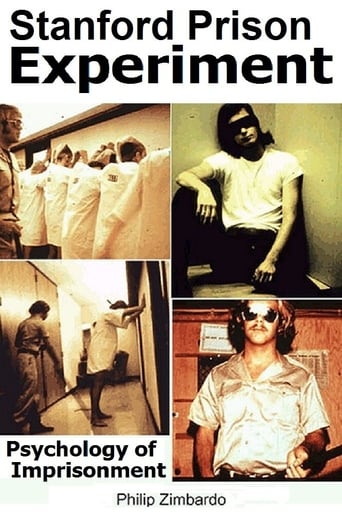
The Stanford prison experiment was a landmark psychological study of the human response to captivity, in particular, to the real world circumstances of prison life, and the effects of imposed social roles on behaviour. It was conducted in 1971 by a team of researchers led by Philip Zimbardo of Stanford University.
The purpose of Rise Above the Mark, narrated by Peter Coyote, is to educate the general public about the “corporate takeover” of Indiana public schools and what parents, community members and educators can do to protect their local public schools. Legislators are calling the shots and putting public schools in an ever-shrinking box. WLCSC Board of School Trustees and Superintendent of Schools, Rocky Killion, want to secure resources and legislative relief necessary to achieve the school district’s mission of creating a world-class educational system for all children. The school district’s strategic plan will introduce a model of education that puts decision making back into the hands of local communities and public school teachers, rather than leaving it in the hands of legislators and ultimately lining the pockets of corporations.
The war on drugs has been going on for more than three decades. Today, nearly 500,000 Americans are imprisoned on drug charges. In 1980 the number was 50,000. Last year $40 billion in taxpayer dollars were spent in fighting the war on drugs. As a result of the incarceration obsession, the United States operates the largest prison system on the planet. Today, 89 percent of police departments have paramilitary units, and 46 percent have been trained by active duty armed forces. The most common use of paramilitary units is serving drug-related search warrants, which usually involve no-knock entries into private homes.

Do humans have the right to judge and kill other humans? This program includes a history of capital punishment around the world through documentary footage and commentary. The electric chair, firing squad, hanging, poison gas, beating to death, slow execution, crotch-splitting, iron maiden, guillotine, execution by running, and beheading... It features a military execution in a South American country, obtained from a former prison officer. It also includes footage of the reality of life in Japanese prisons, death row inmates facing death, the parents of death row inmates, the families of their victims, and the gallows.
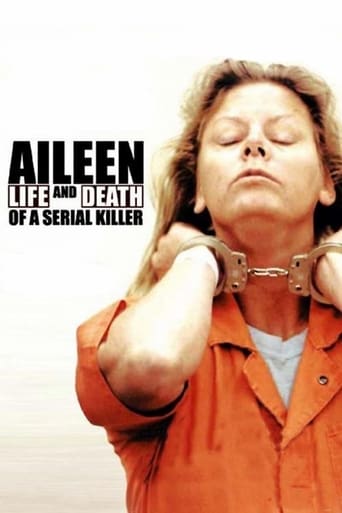
British documentarian Nick Broomfield creates a follow-up piece to his 1992 documentary of the serial killer Aileen Wuornos, a highway prostitute who was convicted of killing six men in Florida between 1989 and 1990. Interviewing an increasingly mentally unstable Wuornos, Broomfield captures the distorted mind of a murderer whom the state of Florida deems of sound mind -- and therefore fit to execute. Throughout the film, Broomfield includes footage of his testimony at Wuornos' trial.