

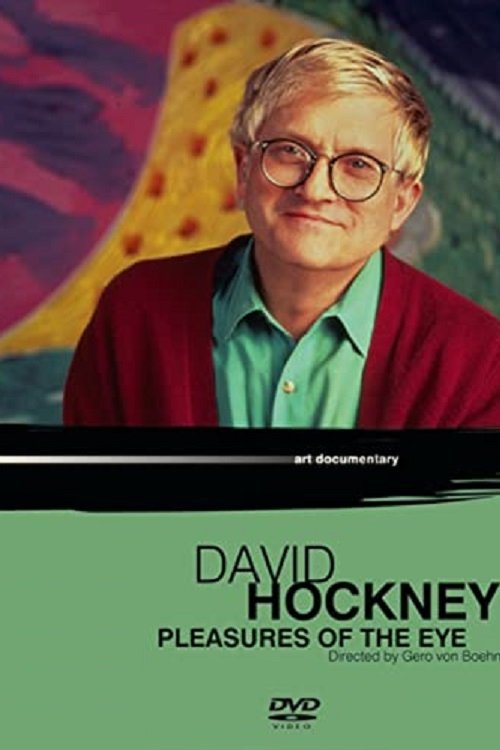
David Hockney: Pleasures of the Eye
Documentary
Overview
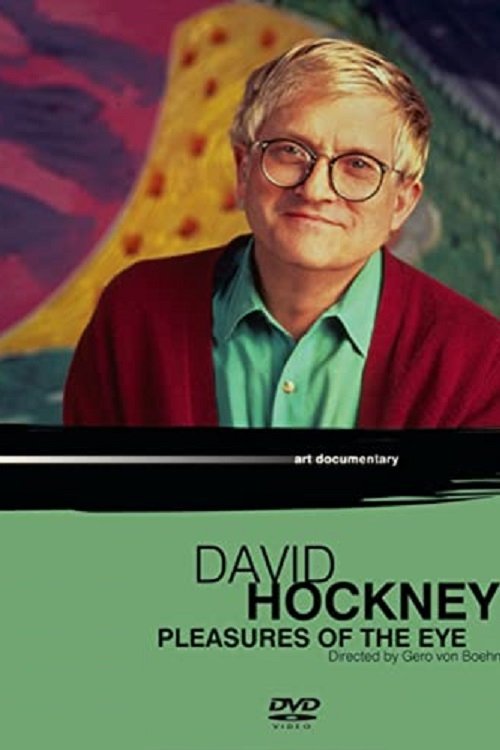
Pleasures of the eye, David Hockney’s work has shown him to be one of the most versatile and influential artists of our time. The British artist invites the observer to take a visual stroll through his paintings and explore the dimensions of time and space. In communicating a new sense of the spacetime continuum, he injects the medium of photography with entirely new and living components. His sensuous theatre sets make us hear music with our eyes and see colours with our ears. The documentary filmmaker Gero von Böhm paints a memorable portrait of a fascinating artist, whose work allows all of us to see the magic in the small and seemingly insignificant details of everyday life.
Top Cast






Philip Hurd-Wood
Philip Hurd-Wood
Narrator
Philip Hurd-Wood
Narrator
Similar Movies
This is the legendary meeting between a young filmmaker and one of the masters of surrealism: the spanish painter Óscar Domínguez, born in La Laguna, Tenerife, in 1906, died in Paris in 1957. In the "Visite," the artist -admirer of Picasso, rebellious disciple of Breton- is presented in solitude, far from the tumult of the exhibitions and parisian circles. An austere approach, almost “povera”, with no audio, nor flashy camera movements, but rarely attractive. Why Resnais could not finish his movie? Hope one of our experts help us to solve the mystery.
Stuck in a creative rut, filmmaker Gilda Pourjabar returns to Iran, her homeland, to talk with her brother Siamak, an illustrator based in Tehran. This encounter raises questions about their relationship to Western popular art, as they grew up in a culture that the current political regime describes as “westoxicated.” This documentary uses playful animations by Siamak, inspired by Franco-Belgian comics and rock concert posters, superimposed on archival footage of the most recent popular uprisings in Iran to become a logical collaboration for these artists who shared a record collection as children. Together, they examine how art slips through the cracks of repression to light the rebellious sparks in the hearts of young people.
The decision to move to Holland doesn't sound like a wise idea. Why move to a country that could be flooded at any moment? For the last 25 years, the political climate has shifted. The public debate on migration has become harsher, more heated, and polarized. What would have been considered right-wing xenophobia back then, is now considered mainstream. Populists simplify complex realities into good and evil, victims and perpetrators: ‘us’ versus ‘them’. Their rhetoric often consists of dehumanizing words and metaphors. One of these is ‘water’. In reality, water is not an immediate threat to the average Dutch person; but it is a huge threat to the thousands trying to reach the Netherlands. People trying to survive the Mediterranean Sea in rubber boats. Trying to survive winter on the Aegean coast in primitive tents. To them, water really is deadly.
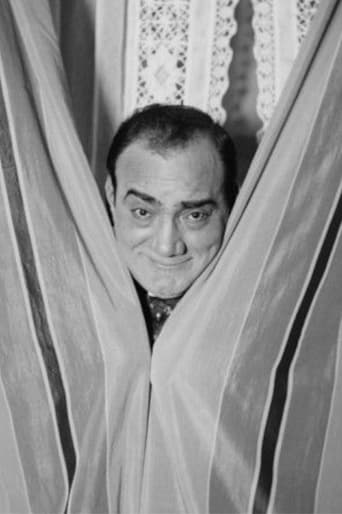
Born in 1873 in a poor neighbourhood in Naples, Enrico Caruso conquered the world with his singing voice. At the age of 27 he got a contract at the Scala in Milan, and his already considerable popularity skyrocketed thanks to the invention of the gramophone. He sold millions of records, and garnered international acclaim. In 1903 he moved to New York to perform at the prestigious Metropolitan Opera, in the role of Radames. But his riches and fame attracted the attention of the Mafia, who started blackmailing him. He felt trapped by his fame and died at just 48 years old. Biographer Francesco Canessa, the music critic Jürgen Kesting and the composer Micha Hamel explain the ups and downs of the man behind the timeless Italian voice.
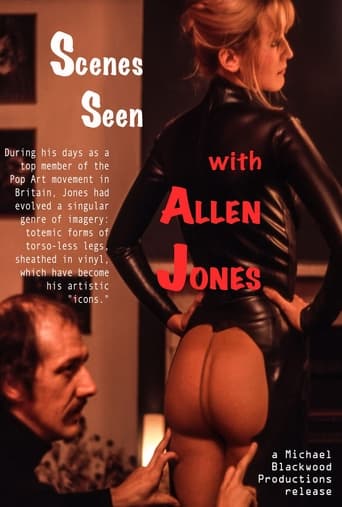
Scenes Seen with Allen Jones explores the motive of the artist's famed graphic works,, paintings and sculptures. The erotic overtones of Jones's work are both controversial and exciting, drawing the public's attention towards a new sector of the avant-garde. Jones is introduced in his London studio, where he is developing an idea for a new painting as he meticulously studies his model. During his days as a top member of the Pop Art movement in Britain, Jones evolved a singular genre of imagery: totemic forms of torso-less legs, sheathed in vinyl, which have become his artistic "signature."