

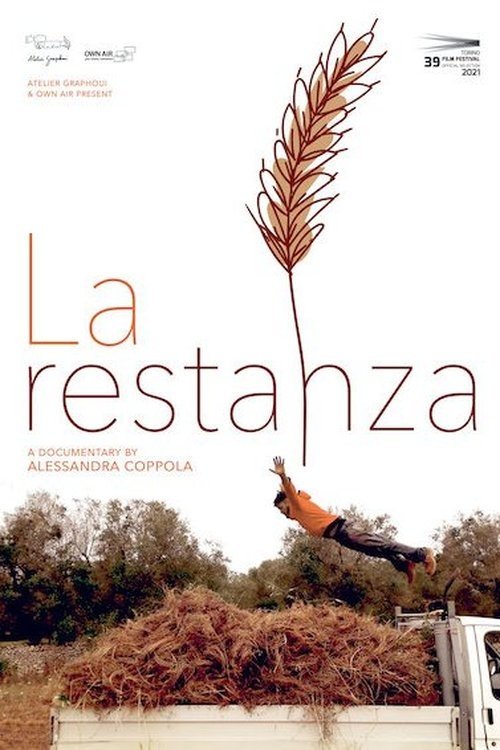
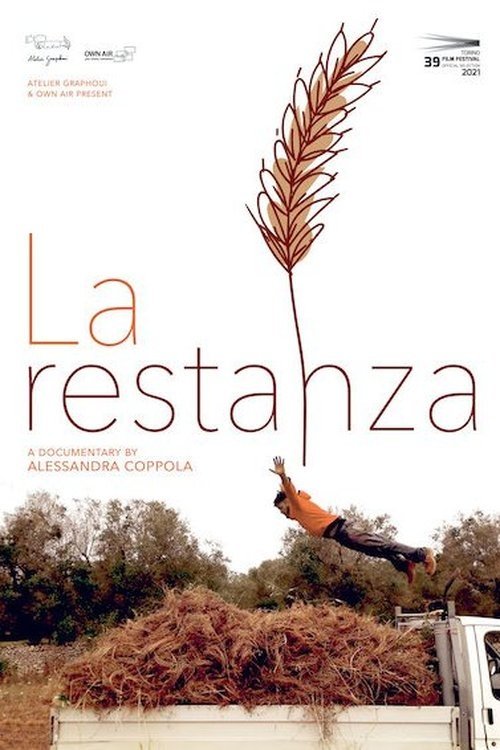
La restanza
Documentary
Overview
Castiglione d'Otranto, in the South of Italy. A group of thirty-year-olds no longer accept that the solution to the economic, ecological and political problems of the territory is always "to leave". They propose to the villagers who own pieces of uncultivated land, often felt as a burden, to put them in common. They decide to stay, to link their lives to the land and to invest in a value: being together. Castiglione becomes the village of restance. They cultivate ancient seeds and local biodiversity, they make decisions together, they develop a local economy. Accepting the shadows of the past, another potential of the place is rediscovered.

No cast information.
Similar Movies
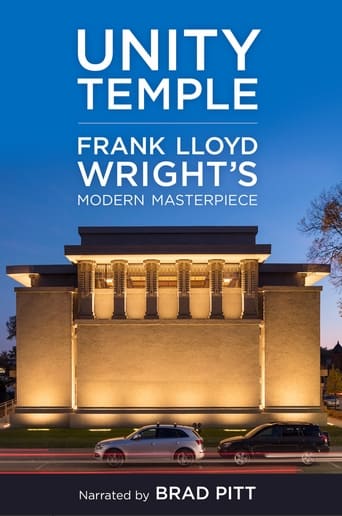
Frank Lloyd Wright’s Modern Masterpiece, Unity Temple is an homage to America’s most renowned architect. The film pulls back the curtain on Wright’s first public commission in the early 1900’s to the painstaking efforts to restore the 100 year old building back to its original beauty. The dedicated team of historians, craftspeople, members of the Unitarian congregation and Unity Temple Restoration Foundation reveal the history of one of Wright’s most innovative buildings that merged his love of architecture with his own spiritual values. The film intersperses the architect’s philosophies with quotes narrated by Brad Pitt.
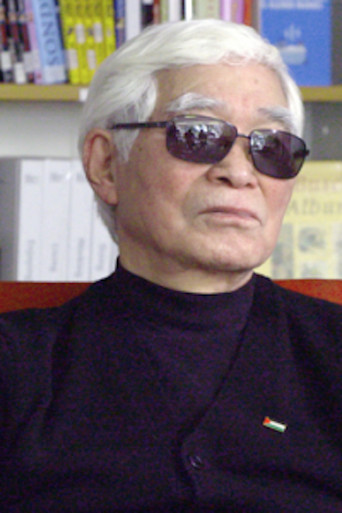
Masao Adachi, the author and director of experimental works and pinku-eiga in the 1960s, was a member of the Japanese New Left that shifted from being a filmmaker to a guerrilla fighter. In 1974, he joined the Japanese Red Army in Lebanon, which worked closely with the Popular Front for the Liberation of Palestine. Filmmaker Lutz Dammbeck met Adachi in Tokyo in 2018 and talked with him about a wide range of topics, including art, revolution, the influence of western avant-garde art and American underground; the Japanese Red Army; collaboration with secret services; the role of the Left after 1968; and the reasons for failures of leftist ideas and strategies.
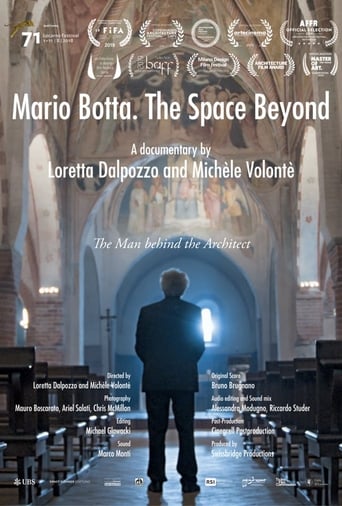
A rare, in-depth artistic journey into the work of internationally acclaimed Swiss architect Mario Botta. The film explores Botta's ever growing curiosity and reflections on the contractions of society through his sacred spaces, a subject very dear to him. Why does globalized society feel the urge to build such spaces? The directors traveled to China, South Korea, Israel, Italy, and Switzerland to discover a passionate and tireless artist, his buildings, and part of his creative process. Botta is one of the few architects who has built places of prayer for three main monotheistic religions. After building many churches, chapels, and synagogue, he is now working on a mosque in China. Through his thoughts and his interaction with artists, colleagues, clients, and family members, the viewers have a glimpse of the man behind the Architect.
"Africa Light" - as white local citizens call Namibia. The name suggests romance, the beauty of nature and promises a life without any problems in a country where the difference between rich and poor could hardly be greater. Namibia does not give that impression of it. If you look at its surface it seems like Africa in its most innocent and civilized form. It is a country that is so inviting to dream by its spectacular landscape, stunning scenery and fascinating wildlife. It has a very strong tourism structure and the government gets a lot of money with its magical attraction. But despite its grandiose splendor it is an endless gray zone as well. It oscillates between tradition and modernity, between the cattle in the country and the slums in the city. It shuttles from colonial times, land property reform to minimum wage for everyone. It fluctuates between socialism and cold calculated market economy.
What does it mean to be Black in America in the 21st century? The recently formed Black American film group TNEG™ has set out to elucidate this very question. Hearing from the likes of fine artist Kara Walker and musical artist Flying Lotus, the film is based on a deceptively simple approach -- asking a refined list of black 'specialists' as well as 'uncommon folks' questions about what they think, and more importantly as lead director Arthur Jafa states, 'What they KNOW' -- the film is an unprecedented 'stream of the black consciousness' and a strikingly original and rarefied look at black intellectual and emotional life. What's so unorthodox about this simple approach is that the interviews were recorded separately from the images in the film. What results is a breathtaking, kaleidoscopic look of American black life from the dawn of three original filmmakers.
Poème Électronique is an 8-minute piece of electronic music by composer Edgard Varèse, written for the Philips Pavilion at the 1958 Brussels World’s Fair. The Philips corporation commissioned Le Corbusier to design the pavilion, which was intended as a showcase of their engineering progress. The pavilion was shaped like a stomach, with a narrow entrance and exit on either side of a large central space. As the audience entered and exited the pavilion, the electronic composition Concret PH by Iannis Xenakis (who also acted as Le Corbusier's architectural assistant for the pavilion's design) was heard. Poème électronique was synchronized to a film of black and white photographs selected by Le Corbusier which touched on vague themes of human existence.
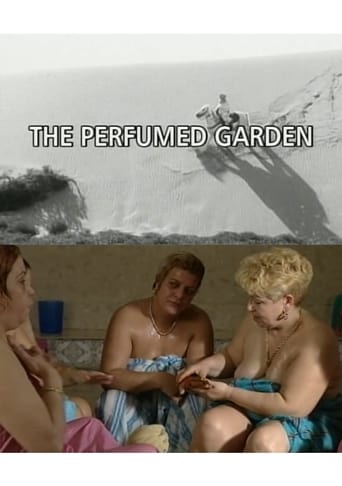
THE PERFUMED GARDEN is an exploration of the myths and realities of sensuality and sexuality in Arab society, a world of taboos and of erotic literature. Through interviews with men and women of all ages, classes, and sexual orientation, the film lifts a corner of the veil that usually shrouds discussion of this subject in the Arab world. Made by an Algerian-French woman director, the film begins by looking at the record of a more permissive history, and ends with the experiences of contemporary lovers from mixed backgrounds. It examines the personal issues raised by the desire for pleasure, amidst societal pressures for chastity and virginity. The film discusses pre-marital sex, courtship and marriage, familial pressures, private vs. public spaces, social taboos (and the desire to break them), and issues of language.
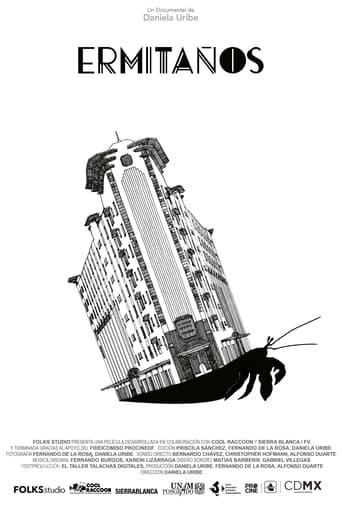
In the midst of the chaos of México City, a group of eight bachelor millennials who call themselves ´The Hermits´, open the doors to their tiny apartments in the historic Ermita Building, in the yet-to-be gentrified neighborhood of Tacubaya, and share their life experiences in a time when precarity changes the way in which we love, feel and relate to each other. As we explore the homes of these eight neighbors, we also witness their personalities intersect in a Whatsapp chat, a virtual space that functions as a supporting system that helps them face the adversities that living alone in this city brings.
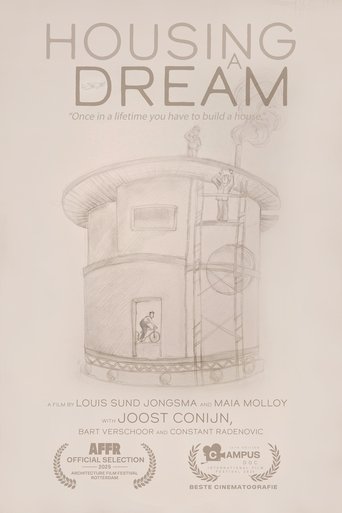
Housing a Dream follows Dutch visionary artist Joost Conijn as he builds his dream home—an unconventional, rotating house that turns with the help of a red bicycle mounted to its floor. By pedaling, Joost can orient the house to follow the sunlight, reflecting his work's delicate balance between function and poetry. Through his process, the film explores the philosophies shaped by a lifetime of craftsmanship, revealing how building a home can become a profound act of artistic creation.