

Ehon Taikōki - Amagasaki Kankyo
Drama · History
Overview
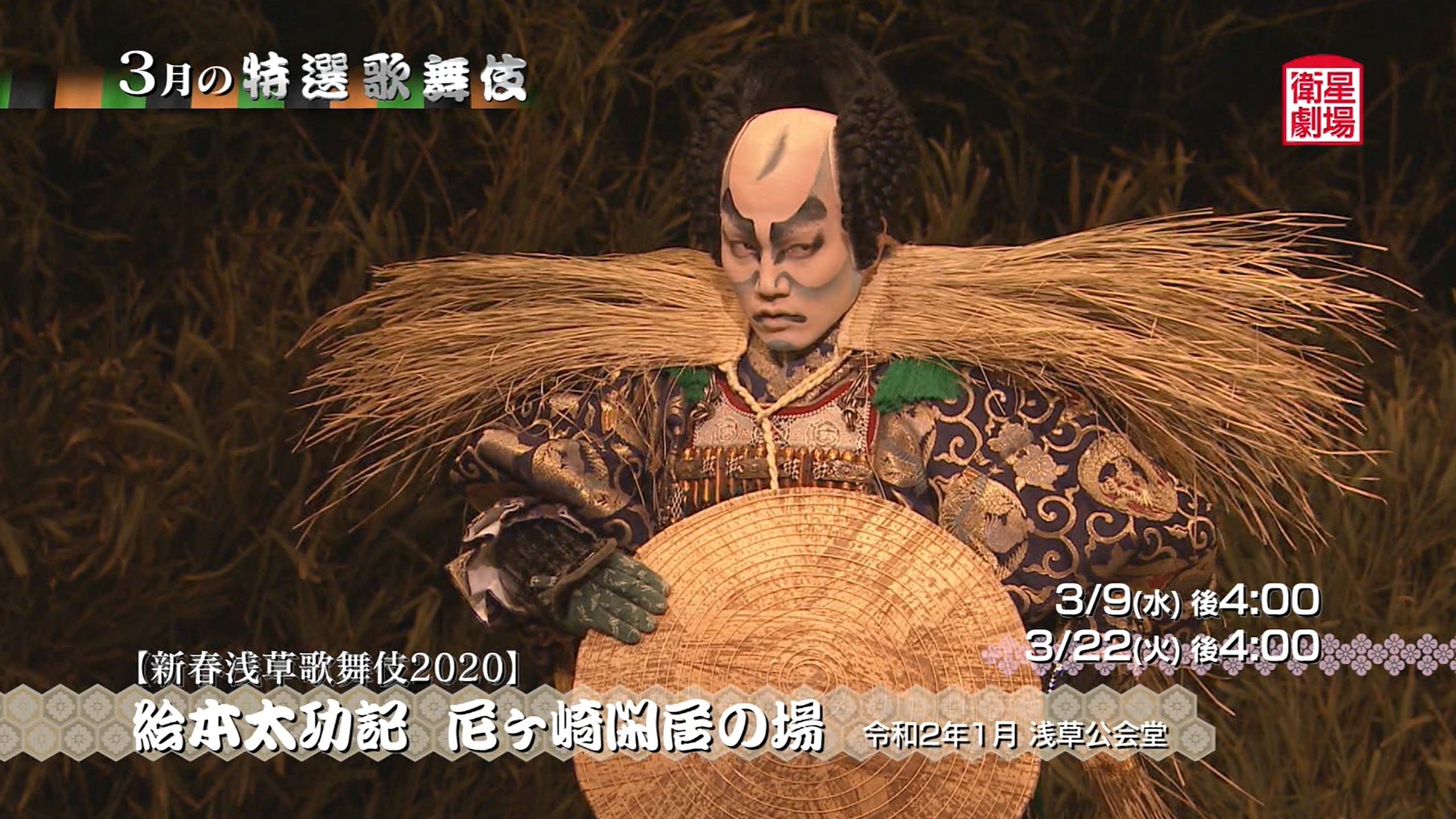
The play "Ehon Taikōki" was originally written for the puppet theater (Bunraku) and staged for the first time in 1799 in Ōsaka at the Toyotakeza. It was adapted for Kabuki the next year by Nagawa Tokusuke I. The play consisted originally of thirteen acts, one act for each day that passed between Akechi Mitsuhide's murder of Oda Nobunaga and his death at the hand of Toyotomi Hideyoshi. The tenth act is the only one which has survived. This act tells of an incident during the battle in which Mitsuhide was finally defeated.

Kasho Nakamura II
Kasho Nakamura II
Kasho Nakamura II
Yonekichi Nakamura V
Yonekichi Nakamura V
Yonekichi Nakamura V
Baika Nakamura
Baika Nakamura
Baika Nakamura
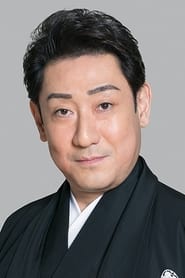
Shikan Nakamura VIII
Shikan Nakamura VIII
Shikan Nakamura VIII
Shingo Bando
Shingo Bando
Shingo Bando
Kinnosuke Nakamura II
Kinnosuke Nakamura II
Kinnosuke Nakamura II

Hayato Nakamura
Hayato Nakamura
Hayato Nakamura
Similar Movies
Nagasaki, 1964: Following the death of his Yakuza father, 15-year-old Kikuo is taken under the wings of a famous Kabuki actor. Alongside Shunsuke, the actor’s only son, he decides to dedicate himself to this traditional form of theatre. For decades, the two young men grow and evolve together – and one will become the greatest Japanese master of the art of Kabuki.
Set in a small Nagano village in the 1930s, the film follows Hanji, a young boy captivated by a local kabuki performance. Inspired by Yukio, Hanji learns kabuki with Utako. As they grow, they become skilled actors, performing in a final kabuki before World War II. After the war, Hanji returns to revive kabuki and restore the community’s spirit. In the 1980s, as he nears death, the villagers organise a final performance in his honour, where he performs “Tenryu Koishibuki” for Yukio.
Based on the novel by Shofu Muramatsu, the film is dedicated to the actors of the renowned Japanese Kabuki theatre. Set in Japan in 1885, the story follows Kikunosuke Onoe, the adopted son of a famous Kabuki actor. Kikunosuke’s father teaches him professional acting skills, preparing him to become his successor and continue the acting dynasty. However, Kikunosuke leaves his family, much to his father’s dismay, to hone his craft outside of Tokyo and moves to Osaka.
In Edo-era Japan, a ukiyo-e artist languishes in his master’s shadow. Creatively stifled, he finds consolation in the company of a prostitute, and becomes entangled in a love triangle. A mystery emerges involving two portraits and the sudden disappearance of the artist Sharaku. Helmed by Cannes-selected director Tatsuji Yamazaki, the film employs kabuki-inspired sequences and stylised sets.
Air Force Major Lloyd Gruver is reassigned to a Japanese air base and is confronted with US racial prejudice against the Japanese people. The issue is compounded because a number of the soldiers become romantically involved with Japanese women, in defiance of US military policy. Ordinarily, a by-the-book officer, Gruver must take a position when a buddy of his, an enlisted man, Joe Kelly, falls in love with a Japanese woman, Katsumi, and marries her. Gruver risks his position by serving as best man at the wedding ceremony.
In late 19th-century Tokyo, Kikunosuke Onoue, the adopted son of a legendary actor, himself an actor specializing in female roles, discovers that the praise he receives is only due to his status as his father's heir. Devastated, he turns to Otoku, a servant of his family, for comfort, and they fall in love. Kikunosuke becomes determined to leave home and develop as an actor on his own merits, and Otoku faithfully joins him.
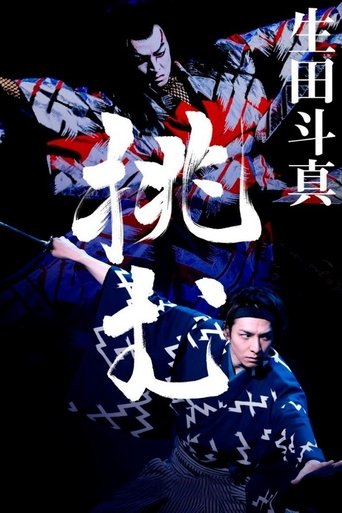
Two young swordsmen, Akado Suzunosuke and Tatsumaki Rainoshin, arrive at the city of Edo in their quest to test and improve their skills. Soon they become involved in a conflict against a mysterious group of demonic criminals led by the king of hell, Taira no Masakado — a strugle to which both were destined since the moment they were born.