

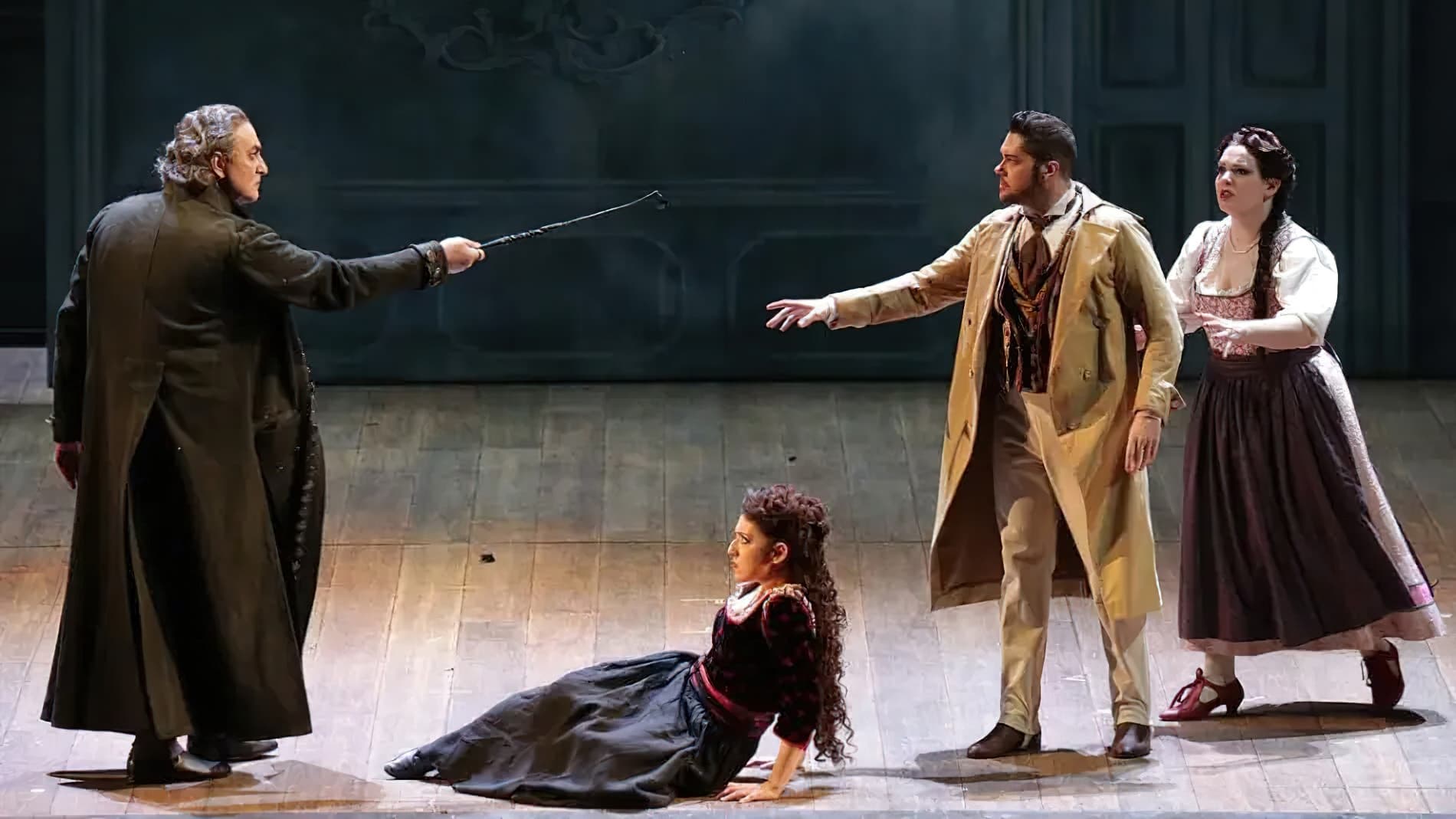
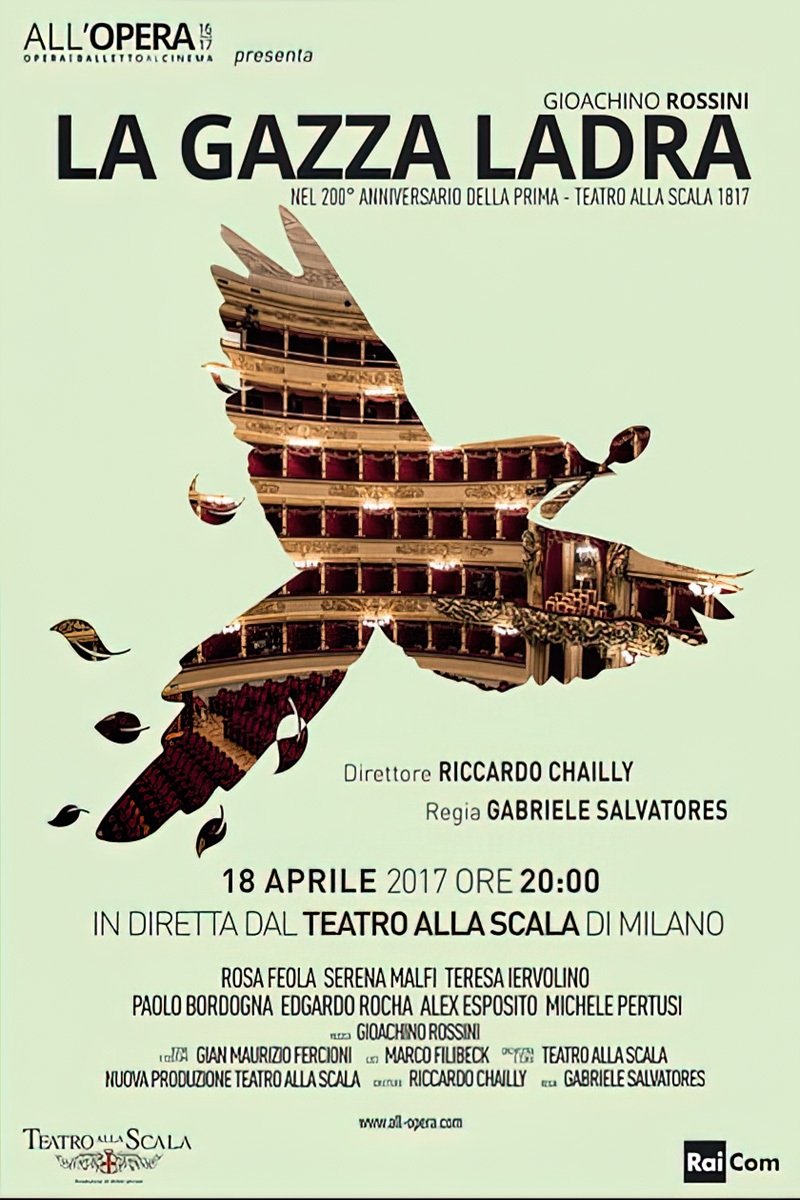
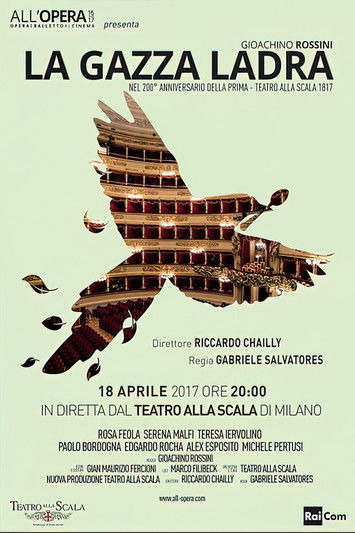
Rossini: La Gazza Ladra - Teatro alla Scala
Music · Romance · Comedy


Rosa Feola
Rosa Feola
Ninetta
Rosa Feola
Ninetta
Serena Malfi
Serena Malfi
Pippo
Serena Malfi
Pippo

Teresa Iervolino
Teresa Iervolino
Lucia
Teresa Iervolino
Lucia

Paolo Bordogna
Paolo Bordogna
Fabrizio Vingradito
Paolo Bordogna
Fabrizio Vingradito
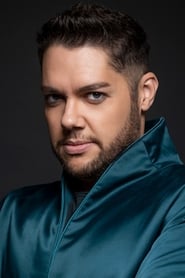
Edgardo Rocha
Edgardo Rocha
Giannetto
Edgardo Rocha
Giannetto
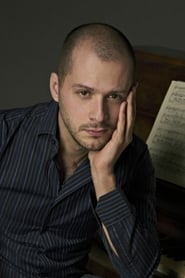
Alex Esposito
Alex Esposito
Ferrando Villabella
Alex Esposito
Ferrando Villabella
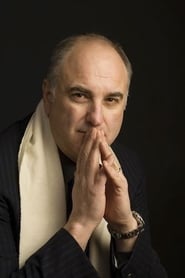
Michele Pertusi
Michele Pertusi
Gottardo
Michele Pertusi
Gottardo
Marko Mimica
Marko Mimica
Ernesto
Marko Mimica
Ernesto
Similar Movies
Behind the Hollywood Bowl stage which is playing the opera The Barber of Seville, Bugs Bunny flees into the backstage area with Elmer Fudd in close pursuit. Seeing his opportunity to fight on his terms, Bugs raises the curtain on Elmer, trapping him on stage. As the orchestra begins playing, Bugs comes into play as the barber who is going to make sure that Elmer is going to get a grooming he will never forget.
In late 18th-century Italy, in the mansion of Don Magnifico, the young and pretty Angelina works as a maid. Teased by her two frivolous half-sisters, Clorinda and Tisby, Angelina believes she is in love with a young valet and goes to the ball. Dressed in her finest finery, she meets the man who is in fact the Prince and flees from him after giving him a bracelet that will allow him to recognise her a little later. The masks come off, and kindness and love triumph! ‘La Cenerentola’ is the last opera buffa composed by Gioachino Rossini for an Italian audience. A dramma giocoso in two acts, with a libretto by Jacopo Ferretti, freely adapted from Charles Perrault’s fairy tale ‘Cinderella’ (1697), omitting the magic in favour of a realism tinged with humour and social criticism. Premiered for the Rome Carnival at the Teatro Valle in Rome on 28 January 1817. Recorded live at Glyndebourne Opera, Lewes, East Sussex, on 2 and 4 June 2005.
Figaro uses every trick he can muster to outwit Dr Bartolo and ensure his master wins his chosen bride. He meets his match in the would-be-bride Rosina, who has schemes of her own. Glyndebourne favourite Danielle de Niese adds the crafty Rosina to her growing list of bel canto heroines. Directed by Annabel Arden with playful energy springing from Rossini’s joyous music, this new production heralds the welcome return of a masterpiece not seen at Glyndebourne Festival since 1982.
Isabella is a strong, independent woman who has no intention of giving in to the clumsy advances of the powerful Mustafà. In this production by Mosh Leiser and Patrice Caurier, which plays on preconceptions about culture clash, Mustafà is no longer a handsome Ottoman, but a shady gangster who traffics in electronic goods in the port of Algiers. Make of it what you will...
In 15th-century Venice, Jacopo Foscari, son of the Doge of Venice Francesco Foscari, is to be tried by the Council of Ten for a crime of which he claims to be innocent. The Foscari family’s sworn enemy, the vindictive Jacopo Loredano, treacherously secures his sentence of exile. Despite the pleas of Lucrezia, Jacopo’s wife, the unfortunate father is forced to sign his son’s banishment order, even though he is convinced of his innocence. The young man dies of despair just before the real murderer comes forward. Loredano secures the removal of Francesco Foscari, who collapses, lifeless. "I due Foscari" is an opera in three acts by Giuseppe Verdi, with a libretto by Francesco Maria Piave, which premiered at the Teatro Argentina in Rome on 3 November 1844.
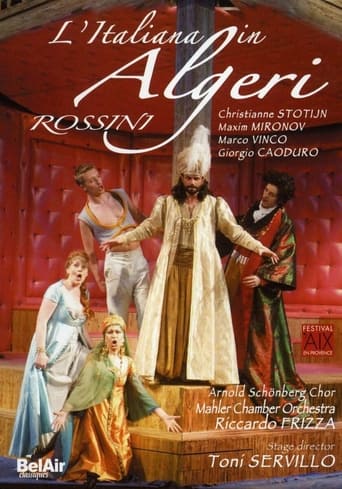
Live performance, Festival d'Aix-en-Provence, July 2006. 'L'italiana in Algeri' (English: 'The Italian Girl in Algiers') is an operatic dramma giocoso in two acts by Gioachino Rossini to an Italian libretto by Angelo Anelli, based on his earlier text set by Luigi Mosca. It premiered at the Teatro San Benedetto in Venice on 22 May 1813. The music is characteristic of Rossini's style, remarkable for its fusion of sustained, manic energy with elegant, pristine melodies.
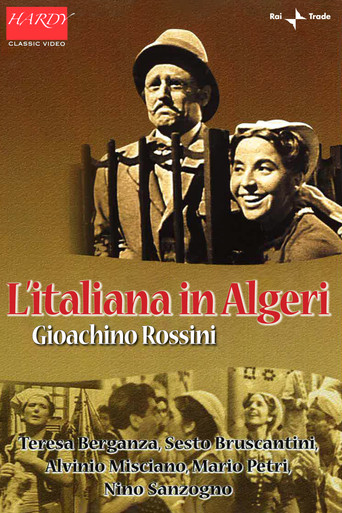
In 1810, Mustafà, Bey of Algiers and thoroughly fed up with his wife, the docile Elvira, orders the captain of the corsairs to find him one of those feisty Italian women. It turns out to be Isabella, an Italian woman of unparalleled beauty searching for her fiancé Lindoro, whom Mustafà happens to be holding captive in his seraglio. The Bey intends to give Lindoro to his wife Elvira, hoping to get rid of him once and for all. Isabella, accompanied by her annoying suitor Taddeo—whom she passes off as her uncle to save him from the gallows—relies on her powers of seduction. “L’italiana in Algeri” (The Italian Girl in Algiers) is a two-act dramma giocoso (opera buffa) by Gioachino Rossini, with a libretto by Angelo Anelli. It premiered at the Teatro San Benedetto in Venice on May 22, 1813. Recorded in the studios of Radiotelevisione Italiana (RAI) in Milan on July 10, 1957.
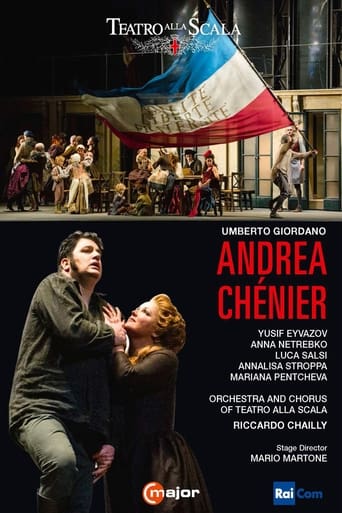
Andrea Chénier, Umberto Giordano's masterpiece, a title that opens the Piermarini's 2017/2018 opera season, returns to La Scala in Milan after a 32-year absence. A highly anticipated event, not only because of the debut in the role of Magdalena by superstar soprano Anna Netrebko (thus marking her third season opener at La Scala, following 2011's Don Giovanni and 2015's Giovanna d'Arco) but also because of the La Scala debut of Yusif Eyvazov (Mrs. Netrebko's spouse, who has been keeping the Piermarini's gallery apprehensive for months now) and for the new direction signed by Mario Martone, who with Margherita Palli (composer of the sets) return to La Scala's handling of an opera by Umberto Giordano, after the success in May 2016 of their Cena delle Beffe.