

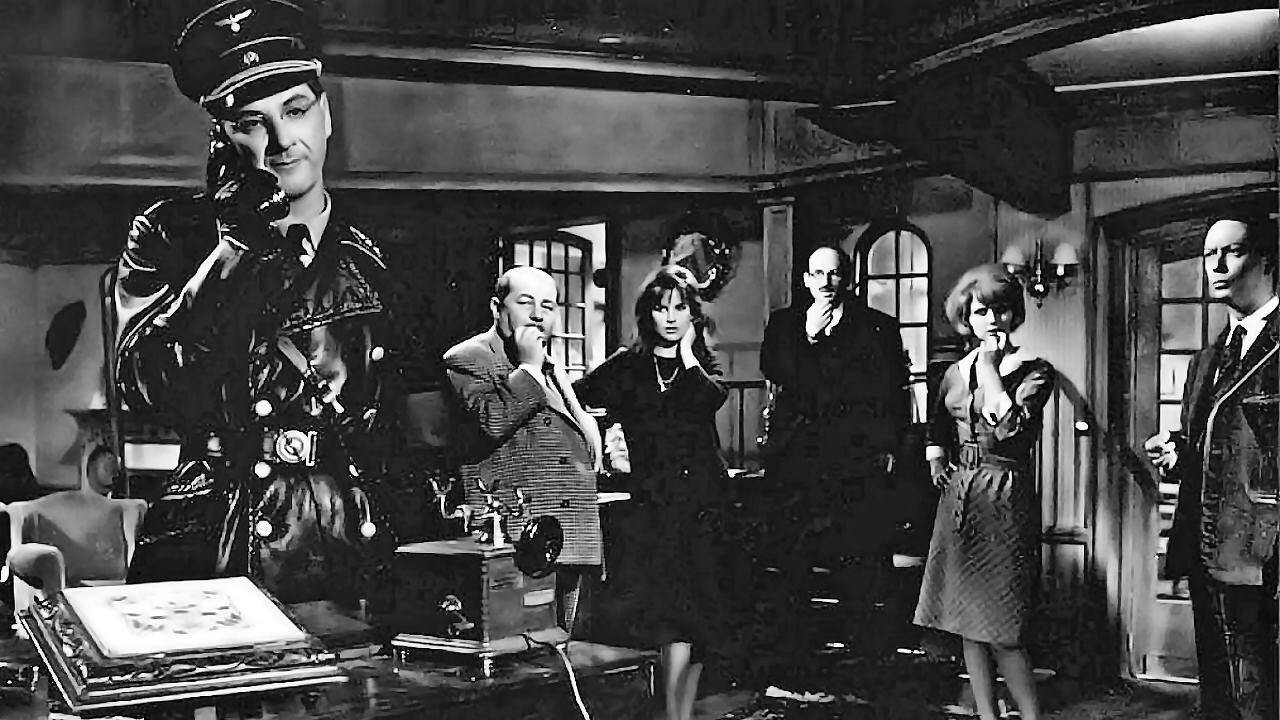

Champagne for Savages
Drama · War
Overview
A diverse group of friends gather to celebrate a witless woman's birthday in this comedy drama set in France during World War II. The guests include an uncle who is a Nazi collaborator, a blind war veteran, a simpering physician, an arrogant educator, a patriotic girl, and the husband of the guest of honor. When some German soldiers are killed outside the house, the group is told by the Gestapo that they must choose among themselves two who will be shot if the killer is not caught. If two victims are not chosen, all seven at the party will be captured. Things sound pretty grim, but the black comedy begins when all seven try to save themselves by any means possible.














France Anglade
France Anglade
Sophie
France Anglade
Sophie

Francis Blanche
Francis Blanche
Francis
Francis Blanche
Francis

Antonella Lualdi
Antonella Lualdi
Françoise
Antonella Lualdi
Françoise

Claude Rich
Claude Rich
Claude
Claude Rich
Claude

Adolfo Marsillach
Adolfo Marsillach
le docteur
Adolfo Marsillach
le docteur

Dominique Paturel
Dominique Paturel
Jean-Louis
Dominique Paturel
Jean-Louis

Claude Nicot
Claude Nicot
Victor
Claude Nicot
Victor
Boy Gobert
Boy Gobert
Kaubach
Boy Gobert
Kaubach
Jean Maurice
Jean Maurice
Jean Maurice
Carlos Ronda
Carlos Ronda
Carlos Ronda
Similar Movies
Houses, now abandoned and empty, are being boarded up in Besence of the Ormányság. "Only-childism" is in fashion, due to the law that provides for the way in which landed properties are inherited. The birth of children that are "not desirable" is being prevented through illegal medical intervention, which is often responsible for the death of pregnant women. The happiness of János and Julis are also the victims of this attitude: their parents would not hear of another child.

The tranquility of a remote Armenian mountain community is disrupted when a group of shepherds affected by the pangs of an evening hunger, decide to butcher and barbecue the sheep of another's that have strayed into their herd. An official inquiry by the city police complicates matters, and questions of law, morality and community only seem to lead to further entanglements.
The bells of the Calvinist church in Garabó have been silent for years, and people prefer to go the Rumanian church. Returning from his studies in Utrecht, Simándy Pál - at his own request - gets a job here, in the alpine village. The young Hungarian minister meets Florica, the educated daughter of Todorescu, the Rumanian pope, whom he knew before. She falls in love with him.
Private inspector Hável happens to travel on the train which is attacked at Biatorbágy. His attention is drawn to a suspicious man, and in the next few days he confirms that it was indeed him who committed the crime. Yet the police accuses not the lunatic Marschalkó but the communists. Summary justice is declared.

Divorced and single bailiff Carla Schön has many problems with her pubescent daughter Eva. However, she cannot use these problems because she has to work in her everyday life. Even in her hobby, orchestral playing, she is absolutely tense. But then she meets the musician Andi Jannings and falls in love with him. He is a dry alcoholic and is in constant dispute with his ex-wife. To make matters worse, he is also a caretaker at Eva's school. Torn between her new love and daughter, Carla soon finds that her next job has to do with Andi. He has money problems and, accordingly, has not made any maintenance payments to his ex-wife.
Catherine is taken to dine at "Eau de la vie" an opulent cafe known for its unusual entertainment. Her business associates Grant and Sarah intend to initiate her into their sordid society and strip her of her innocence. Catherine must choose from a small group of performers who will entertain the diners for the evening. She selects a young attractive man unaware that the finale of the evenings entertainment will end in his dead. To save the young man she has chosen, Catherine is driven to fight for her own life but oblivious to her struggle the other diners believe it is all part of the evening's entertainment Catherine has to stand alone. They say that evil triumphs when good people do nothing. Eau de la vie is a dark tale of hedonism and individual courage.