

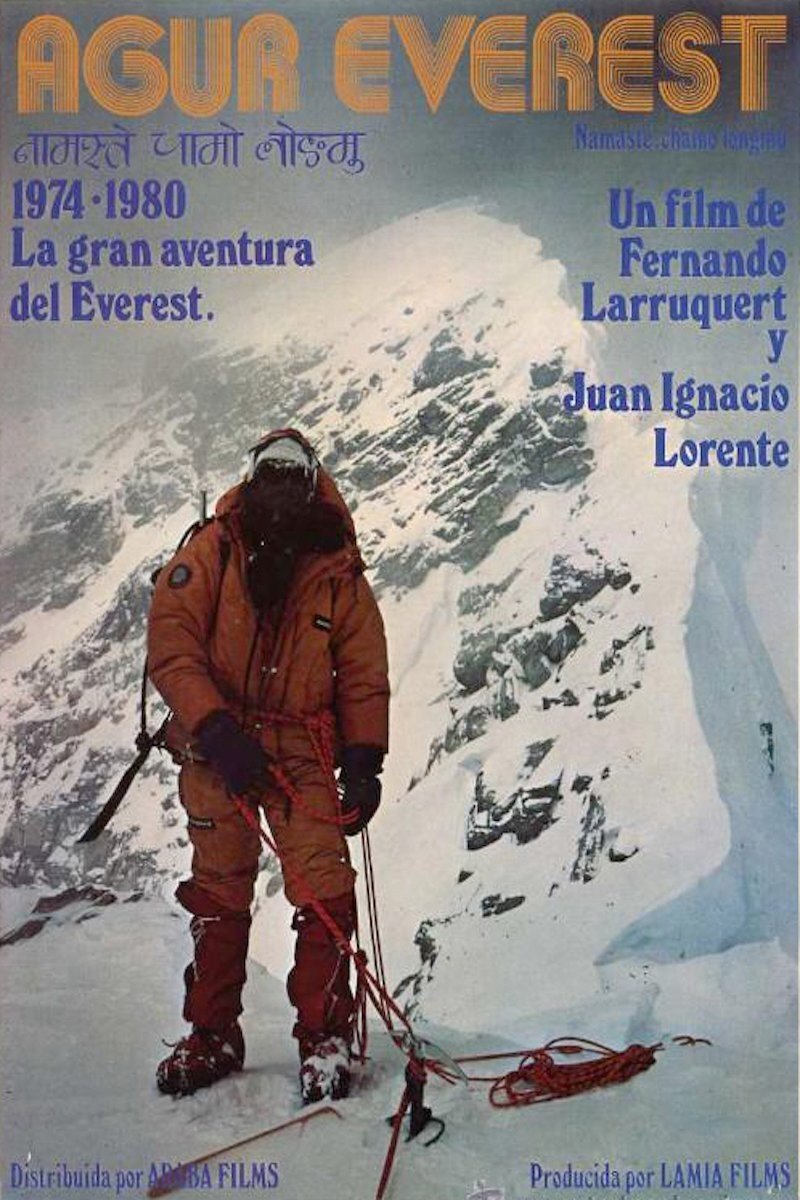
Agur Everest
Documentary
Overview
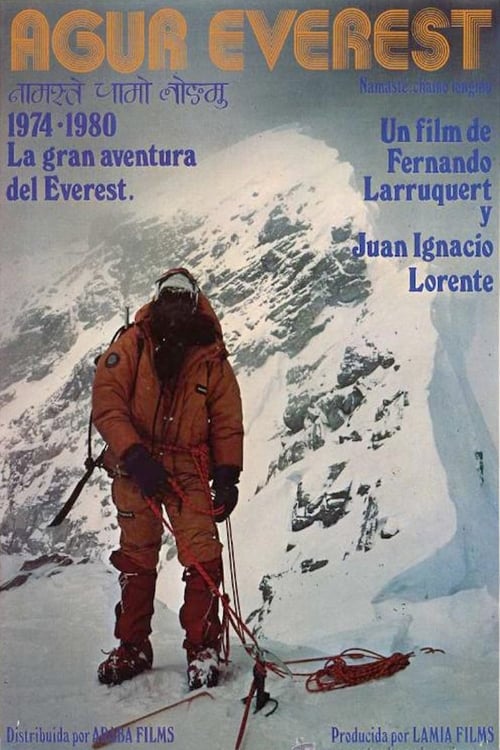
In 1974, a Basque expedition had to withdraw 300 meters from the summit of Everest due to the monsoon. In 1980, another expedition reached the summit to the 'summit of the world.' This film includes images from both expeditions. The first was shot in 35mm by Fernando Larrukert and Angel Lerma, and the second in Super 16mm by Lorente, Martin Zabaleta and other members of the expedition.



No cast information.
Similar Movies
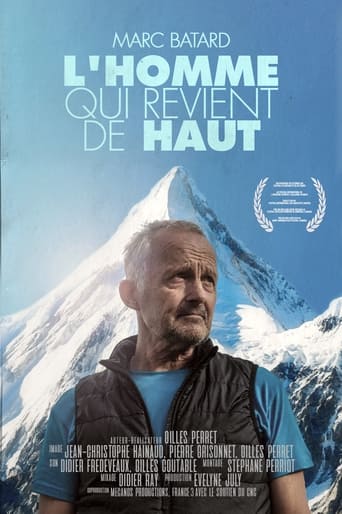
What compels a man to push the limits of what is attainable ever higher? After thirty years of relentless struggle with the highest peaks on earth, Marc Batard has finally found the answers to these questions. He had to reach the summit of Everest twice, once shattering the record for fastest time in 24 hours without oxygen, and climb the most difficult faces of the Alps to glimpse the path to inner healing. It was through physical suffering that he was able to confront the pain of his soul. He was finally able to talk about the violence of his childhood, the shock he carried like a ball and chain for decades. Having completed his summit therapy, Marc Batard tells his story in this documentary by Gilles Perret.
The dramatic story of the British expedition that made the first ascent of Everest. Combining interviews with the surviving members of the 1953 British and 1952 Swiss attempt on Everest with rare archival material, this film tells the story of the race to climb Everest in the early 1950s and its climax in 1953.
Jim Geiger, a retired forest ranger and amateur mountaineer, attempts to become the oldest American and first great grandfather to summit Mt. Everest, aged 68. His transformation from a weekend hiker to attempting one of the most extreme and physically demanding feats known to man is driven by a desire to prove that age is just a number. What ensued, however, forever changed Jim's life.
Transcending cultural barriers and consistently going against the grain, female Nepali climber Pasang Lhamu Sherpa attempted to summit Everest four times in the early nineties. Although she was not allowed to attend school as a child, Pasang did not let that stop her from pursuing her dreams. After founding her own trekking company in Kathmandu, she blazed a trail for Nepali women via her efforts to summit Everest. Proving how big you can dream and how far you can go to achieve those dreams, she left a legacy not only for the family she has left behind, but for the myriad women following in her footsteps.
2006 was one of the deadliest Everest seasons on record. Experienced mountaineer Lincoln Hall was invited to join an expedition as a high altitude cameraman. It was his second attempt to summit the mountain, having turned back just short 22 years earlier. Shortly after reaching the summit, Hall began to behave irrationally, suffering from lack of oxygen. Aided by his loyal Sherpas for over 9 hours, he eventually collapsed and they declared him dead. His family were informed and the news hit headlines. But something happened that night that science cannot explain. The next morning Lincoln Hall was found alive by approaching climbers and his dramatic rescue began. Never before has a man been declared dead so high on Everest and survived. This is the remarkable true story of Lincoln Hall’s extraordinary journey back from beyond.
Sixty snowmobilers, indigenous and non-indigenous, join forces to take part in a huge snowmobiling expedition: a 3500 km journey to be completed in 16 days. The goal: to cross a large swath of Quebec to work towards reconciliation between peoples. In this choral film, which is as much a physical ordeal as a spiritual and psychological one, the participants take on the mission of raising public awareness of the issues dear to their communities. Through the challenges posed by the weather and the long daily journeys that put the group to the test, a powerful bond is forged between the participants, who face enormous adversity. A journey on the land of ancestors that reveals the strength of togetherness.