

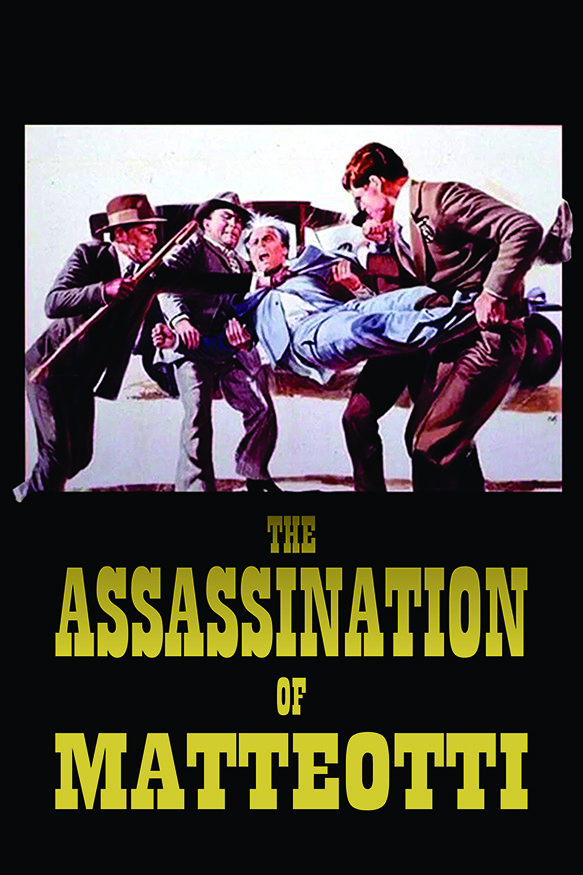
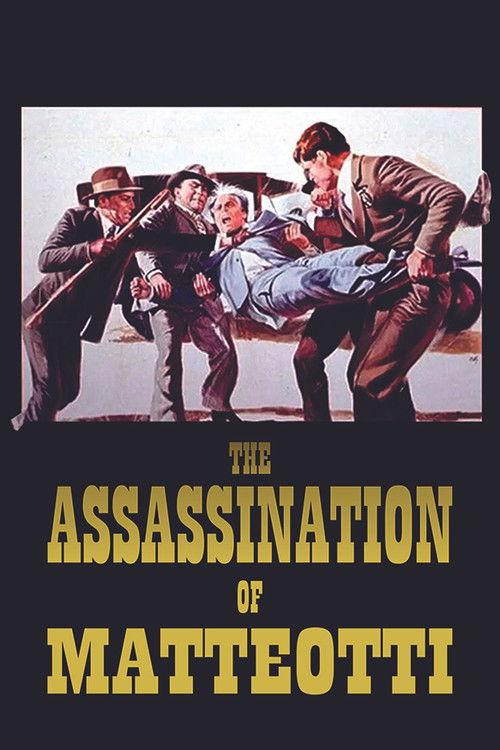
The Assassination of Matteotti
History · Drama
Overview
How the Italian Fascist Party managed to turn the physical elimination of a political enemy into a test of strength fundamental for the ascent into the totalitarian regime.
Top Cast

Franco Nero
Giacomo Matteotti
Mario Adorf
Benito Mussolini

Umberto Orsini
Amerigo Dumini

Vittorio De Sica
Mauro Del Giudice
Renzo Montagnani
Umberto Tancredi
Gastone Moschin
Filippo Turati
Riccardo Cucciolla
Antonio Gramsci
Damiano Damiani
Giovanni Amendola

Stefano Oppedisano
Piero Gobetti
Manuela Kustermann
Ada Gobetti
Giulio Girola
Vittorio Emanuele III
Cesare Barbetti
Cesare Rossi







Franco Nero
Franco Nero
Giacomo Matteotti
Franco Nero
Giacomo Matteotti
Mario Adorf
Mario Adorf
Benito Mussolini
Mario Adorf
Benito Mussolini
Umberto Orsini
Umberto Orsini
Amerigo Dumini
Umberto Orsini
Amerigo Dumini
Vittorio De Sica
Vittorio De Sica
Mauro Del Giudice
Vittorio De Sica
Mauro Del Giudice
Renzo Montagnani
Renzo Montagnani
Umberto Tancredi
Renzo Montagnani
Umberto Tancredi
Gastone Moschin
Gastone Moschin
Filippo Turati
Gastone Moschin
Filippo Turati
Riccardo Cucciolla
Riccardo Cucciolla
Antonio Gramsci
Riccardo Cucciolla
Antonio Gramsci
Damiano Damiani
Damiano Damiani
Giovanni Amendola
Damiano Damiani
Giovanni Amendola
Stefano Oppedisano
Stefano Oppedisano
Piero Gobetti
Stefano Oppedisano
Piero Gobetti
Manuela Kustermann
Manuela Kustermann
Ada Gobetti
Manuela Kustermann
Ada Gobetti
Similar Movies
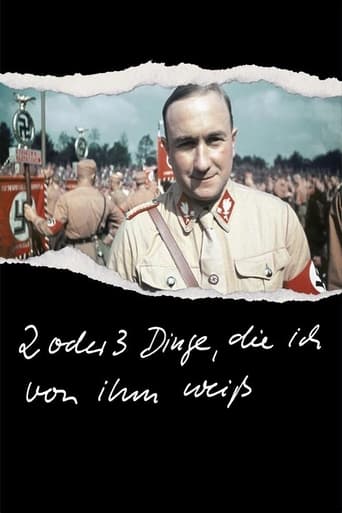
What would your family reminiscences about dad sound like if he had been an early supporter of Hitler’s, a leader of the notorious SA and the Third Reich’s minister in charge of Slovakia, including its Final Solution? Executed as a war criminal in 1947, Hanns Ludin left behind a grieving widow and six young children, the youngest of whom became a filmmaker. It's a fascinating, maddening, sometimes even humorous look at what the director calls "a typical German story." (Film Forum)
Celestine has a new job as a chambermaid for the quirky M. Monteil, his wife and her father. When the father dies, Celestine decides to quit her job and leave, but when a young girl is raped and murdered, Celestine believes that the Monteils' groundskeeper, Joseph, is guilty, and stays on in order to prove it. She uses her sexuality and the promise of marriage to get Joseph to confess -- but things do not go as planned.
The real fate of Jiří Arvéd Smíchovský, a prominent hermeticist, occultist, believer in black magic and an exceptionally well-educated person with a brilliant memory. This avid book lover had doctorates in law, theology and philosophy and was fluent in five languages. He was interested in occult teachings, practiced magical ceremonies, was in contact with the Freemasons, but at the same time he was a member of the National Fascist Community while being homosexual. During the war he cooperated with the Nazis, after the war with the communist StB.
Although released anonymously, as was the custom with all films produced by the Italian Navy, La Nave Bianca is the first feature-length effort directed by Roberto Rossellini; it is also very much the work of its co-writer and supervisor Francesco De Robertis. The film combines a documentary look at the Italian Navy during World War II with newsreel combat footage and a scripted love story performed by non-professional actors.
Stockholm in the 1920s. Young Roland lives with his socialist father, Jewish mother and a boxing brother. His mother sells condoms illegally, and from them, Roland makes slingshots which he sells. His rebellious ways has gotten him the special attention of his school teacher, who always makes sure that Roland is punished. Roland also tries to make extra money by repairing bicycles, a successful business that in the end lands him in hot water.
Aldo Piscitello, a minor government clerk, is forced in 1934 to join the Fascist party. When the war comes, he finds himself able only to talk ineffectually in secret against Mussolini, even as his own son Giovanni is sent into battle. By the end of the war, Aldo has found the courage to stand up for his beliefs, but by then it is too late.
In 1919, at the end of the Great War, Don Giovanni Minzoni returns to his parish in Argenta, in the province of Ferrara, wants to reorganize the social and cultural life of the community and tries to bring the rural children together into the old recreation center. The socialists, led by Natale Gaiba, the city councilor, openly show their disdain for Don Minzoni and his Church. After some time, anyhow, the relations with the socialists seem to begin, starting a relationship based on understanding and collaboration. At the same time another political force, modern and unexpected, makes its entrance into history and into the small village of Argenta. Fascism is taking hold in the cities and in the countryside throughout Italy, and even in Argenta the first riots and attacks begin…