

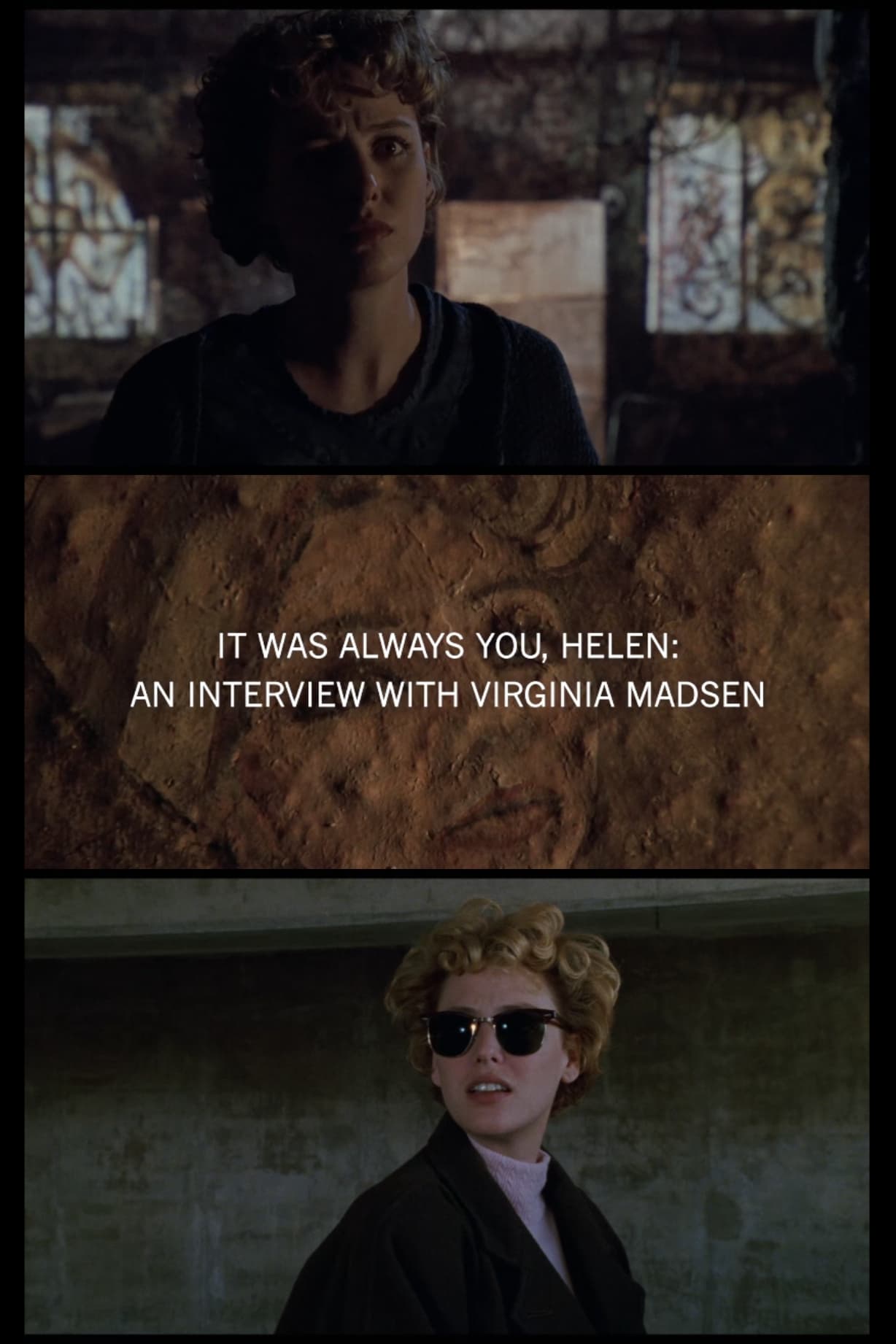
It Was Always You, Helen
Documentary
Overview
An interview with actor Virginia Madsen about her work in Candyman (1992).
Top Cast





Virginia Madsen
Virginia Madsen
Herself
Virginia Madsen
Herself
Similar Movies

"With characteristic wit and rigor, experimental filmmaker Larry Gottheim here applies his impressionistic editing style to footage collected during his travels in the Dominican Republic. Gottheim’s formal emphasis on repetition and fissures between sound and image resonates here as a mode of sociological reflection (with the fragmentary montage mirroring elements of ritual while also destabilizing the ethnographic gaze). A largely overlooked antecedent to the contemporary blending of avant-garde and ethnographic filmmaking, MACHETTE GILLETTE… MAMA still poses a potent challenge to documentary convention." - Max Goldberg
[Here] Pollet made a work that is the very definition of what French critics like to call an ovni or ufo (as in ‘unidentified filmic object’). [It] has been described as being ‘like a comet in the sky of French cinema,’ an ‘unknown masterpiece,’ and an ‘unprecedented’ work that refuses interpretation even as it has provoked reams of critical writing. Its rhythmic collage of images – a girl on a gurney, a fisherman, Greek ruins, a Sicilian garden, a Spanish corrida – is accompanied by an abstract commentary written by Sollers, and only the somber lyricism of Antoine Duhamel’s score holds the film’s elements together. At first viewing, you fear that [it] might fly apart into incoherent fragments. Instead, over the course of its 45 minutes it invents its own rules, and you realize you’re watching something like the filmic channeling of an ancient ritual.
Homeo is a mental construction made from visual reality, just as music is made from auditive reality. I put in this film no personal intentions. All my intentions are personal. I’ve made this film thinking of what the audience would have liked to see, not something specific that I wanted to say: what the film depicts is above all reality, not fiction. Homeo is, for me, the search for an autonomous cinematographic language, which doesn't owe anything to traditional narrative, or maybe everything. Cinema is, above all, part of a way of life which will become more and more self-assured in the years and century to come. We are part of this change, and that’s why I tried in Homeo to establish a series of perpetual changes, in constant evolution or regress, which tries, above all, to focus on things.