


Who’s Behind the Wall?
Documentary
Overview
The near future. A fantastic experiment using the test of the mathematician Alan Turing, in which an examiner, a human, and a robot take part. During the test, the examiner must determine who is behind the wall: a person or a thinking machine. The experiment is conducted with one goal: to find out whether a machine can think.










Anatoli Grachyov
Anatoli Grachyov
Anatoli Grachyov

Irina Kalinovskaya
Irina Kalinovskaya
Irina Kalinovskaya

Evgeniy Lazarev
Evgeniy Lazarev
Evgeniy Lazarev

Phelix Ivanov
Phelix Ivanov
Phelix Ivanov
Viktor Vlasov
Viktor Vlasov
Viktor Vlasov

Aleksandr Kotov
Aleksandr Kotov
Aleksandr Kotov
Elmira Chormanova
Elmira Chormanova
Elmira Chormanova
Similar Movies
A very human tech doc, uncovers the real costs of the platform economy through the lives of workers from around the world for companies including Uber, Amazon and Deliveroo. From delivering food and driving ride shares to tagging images for AI, millions of people around the world are finding work task by task online. The gig economy is worth over 5 trillion USD globally, and growing. And yet the stories of the workers behind this tech revolution have gone largely neglected. Who are the people in this shadow workforce? It brings their stories into the light. Lured by the promise of flexible work hours, independence, and control over time and money, workers from around the world have found a very different reality. Work conditions are often dangerous, pay often changes without notice, and workers can effectively be fired through deactivation or a bad rating. Through an engaging global cast of characters, it reveals how the magic of technology we are being sold might not be magic at all.
Comprehensive survey of robotics filmed in the leading labs of the world (primarily the United States and Japan) and featuring experts such as Rodney Brooks of MIT and William “Red” Whittaker of Carnegie Mellon University. Incorporates pop culture robots with the less glamorous real world and delves into the ultimate issues of what constitutes life and whether consciousness is a product of intelligence.
The ancient Chinese game of Go has long been considered a grand challenge for artificial intelligence. Yet in 2016, Google's DeepMind team announced that they would be taking on Lee Sedol, the world's most elite Go champion. AlphaGo chronicles the team as it prepares to test the limits of its rapidly-evolving AI technology. The film pits man against machine, and reveals as much about the workings of the human mind as it does the future of AI.
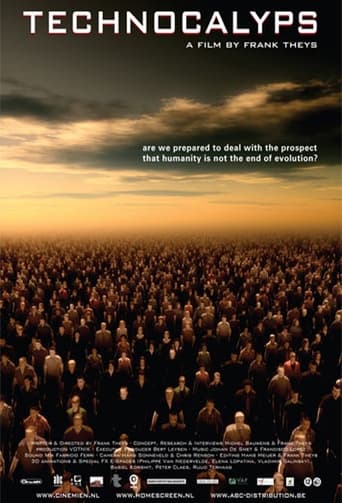
Are we prepared for dealing with the prospect that humanity is not the end of evolution? Technocalyps is an intriguing three-part documentary on the notion of transhumanism by Belgian visual artist and filmmaker Frank Theys. The latest findings in genetics, robotics, artificial intelligence, bionics and nanotechnology appear in the media every day, but with no analysis of their common aim: that of exceeding human limitations. The director conducts his enquiry into the scientific, ethical and metaphysical dimensions of technological development.
In 1772, Englishwoman Mary Delany wrote to her niece: “I have found a new way of imitating flowers.” The imitation in question was the art form called decoupage, based on cut-outs and reshuffling of pictures. The charm and botanical precision of these works attracts attention of even today’s artists, among others by an anonymous programmer who is trying to invent a way of capturing the flowers’ vivacity in pictures. With this aim in mind, she has created an algorithm, which would combine science and beauty, similarly to Delaney’s efforts, whose illustrations it is meant to animate.
With the rapid advancements in artificial intelligence, the line between humans and machines continues to blur, and everything is evolving at an astonishing pace as this technology offers tantalizing promises. However, some researchers, including 2024 Nobel Prize in Physics laureate Geoffrey Hinton, warn about its exponential power. A deep dive into the dizzying complexities of AI.