

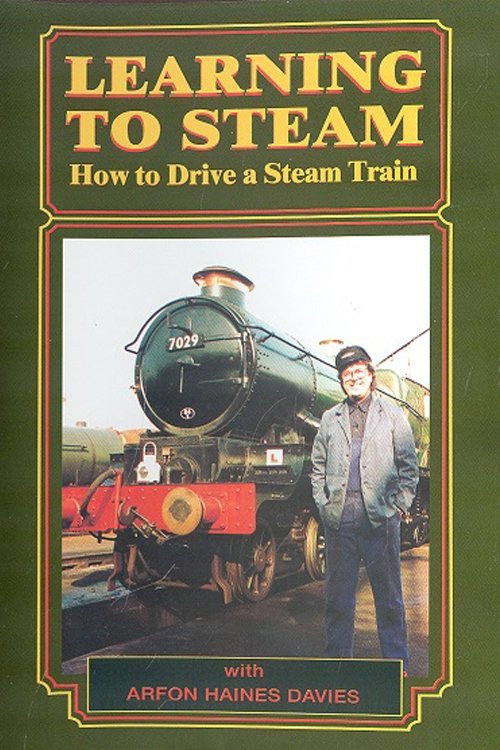
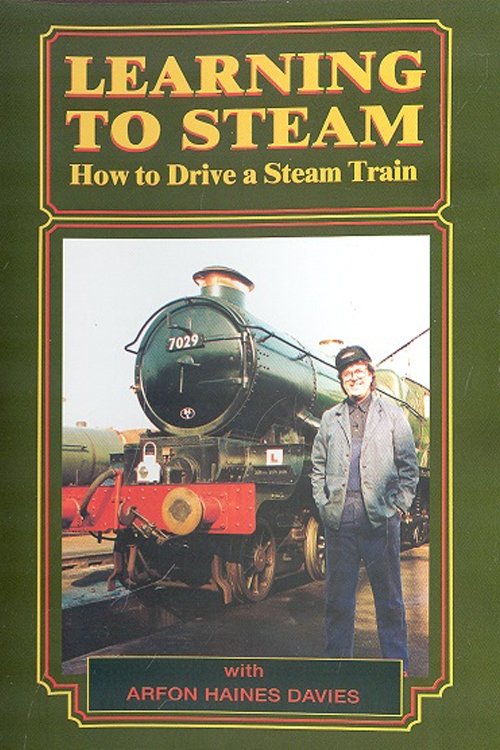
Learning to Steam
Documentary
Overview
Arfon spent a week on the Great Central Railway finding out everything a trainee footplate member needs to know. Starting at the bottom, just as a real trainee would have done on BR, Arfon first becomes a cleaner then gradually progresses up the ladder with ex-Fireman Ray Martin teaching him the art of firing. Ex-BR Driver Bill Gwilt then takes over to explain how to oil and prepare the loco followed by how to drive. Arfon then takes the controls of Clun Castle in charge of a seven coach “express” running from Loughborough Central to Rothley. If you have ever wondered how a steam engine works or how they are maintained or driven, this best selling video is for you.



No cast information.
Similar Movies
Vignettes of the New England Steam features the films of noted rail photographers Albert Michaud and William P. Price, as they document the handsome steam power (and the occasional pesky diesel) of the Grand Trump, Central Vermont, Boston & Maine, and New York, New Haven & Hartford Railroads. The mostly color and mostly 16mm production begins with the Grand Trunk in New Hampshire, then moves to the Central Vermont in the White River Jct vicinity, and the Boston & Maine and New Haven, primarily around Boston. Many wheel arrangements are featured, as is the passenger and freight rolling stock of the era ...including truss-rodded clerestory-roofed wooden maroon passenger cars on the B&M! So come along with Clear Block Productions as we journey back to the late 1940's and early 1950's to witness Steam's Final Stand in the Northeast in Vignettes of the New England Steam.
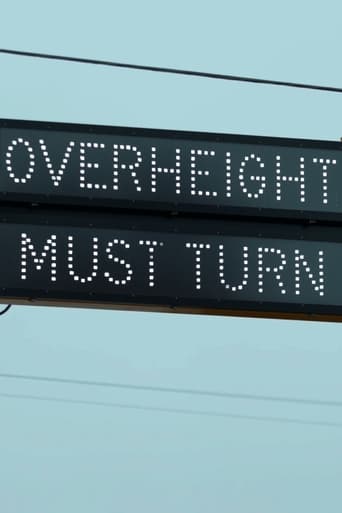
For the past ten years, Jürgen Henn has filmed over-height trucks crashing into the 11foot8 train bridge affectionately nicknamed the "Can Opener." In that time, millions have viewed the crashes online. Regional, national, and international news organizations have dined out on the story and the goofy crash reels. But why do motorists continue to crash despite the many warnings, sensors, and signs? And what is it about these crashes that holds our attention? In this piece, we look for the humanity in human error.
The German railroad has been in operation since 1835, but the darkest chapter in German railroad history is often forgotten. Extensive original film material from the Nazi era shows the dubious role played by the Deutsche Reichsbahn during the Second World War and how little resistance there was among the railroad workers.
Discover the "character" of one of Missouri's oldest tie and lumber operations through this archival black-and-white film that documents one of the last railroad tie drives on the Black River made by the T.J. Moss Tie Company of St. Louis in the 1920s. Thanks to release of the film by the Kerr-McGee Chemical Corporation, the rare footage in "Stamp of Character" takes us through the entire process of making railroad ties, at a time when forests covered almost two-thirds of the state. The original silent motion picture was shown in movie theaters as an advertisement by the T.J. Moss Tie Company. Using digitally edited narration and realistic sound effects, this video makes the past live again.
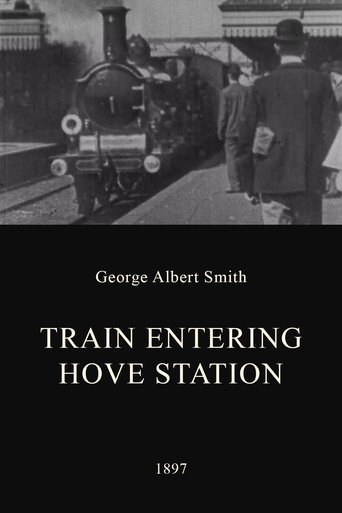
Most movie fans know that the first filmmakers liked to shoot trains entering stations. This example by Sussex film pioneer George Albert Smith illustrates why. The train's rush towards the audience brings movement and visual drama. The flurry of human activity offers plenty for the audience to engage with - who are these people and where are they going? And the time pressure exerted by the fact that the train must soon depart adds narrative tension - will everyone get on and off in time?
A travelogue, this film provides a guided tour of pre-World War II Utah and of course does not pretend to cinematic greatness. Recommended viewing for those in search of introductory Utah history. Also valuable for persons seeking insight into the state as it would have looked during this time period. Especially informative for those desiring a window into the past for a view of how Utah was in the days of their pre-World War II progenitors living in the state. Those whose Utah ancestors were involved in mining, railroading, sugar beets, and other featured industries; featured towns, sights, recreational attractions, and industries may find this otherwise banal travelogue a quite valuable addition to their family history.