


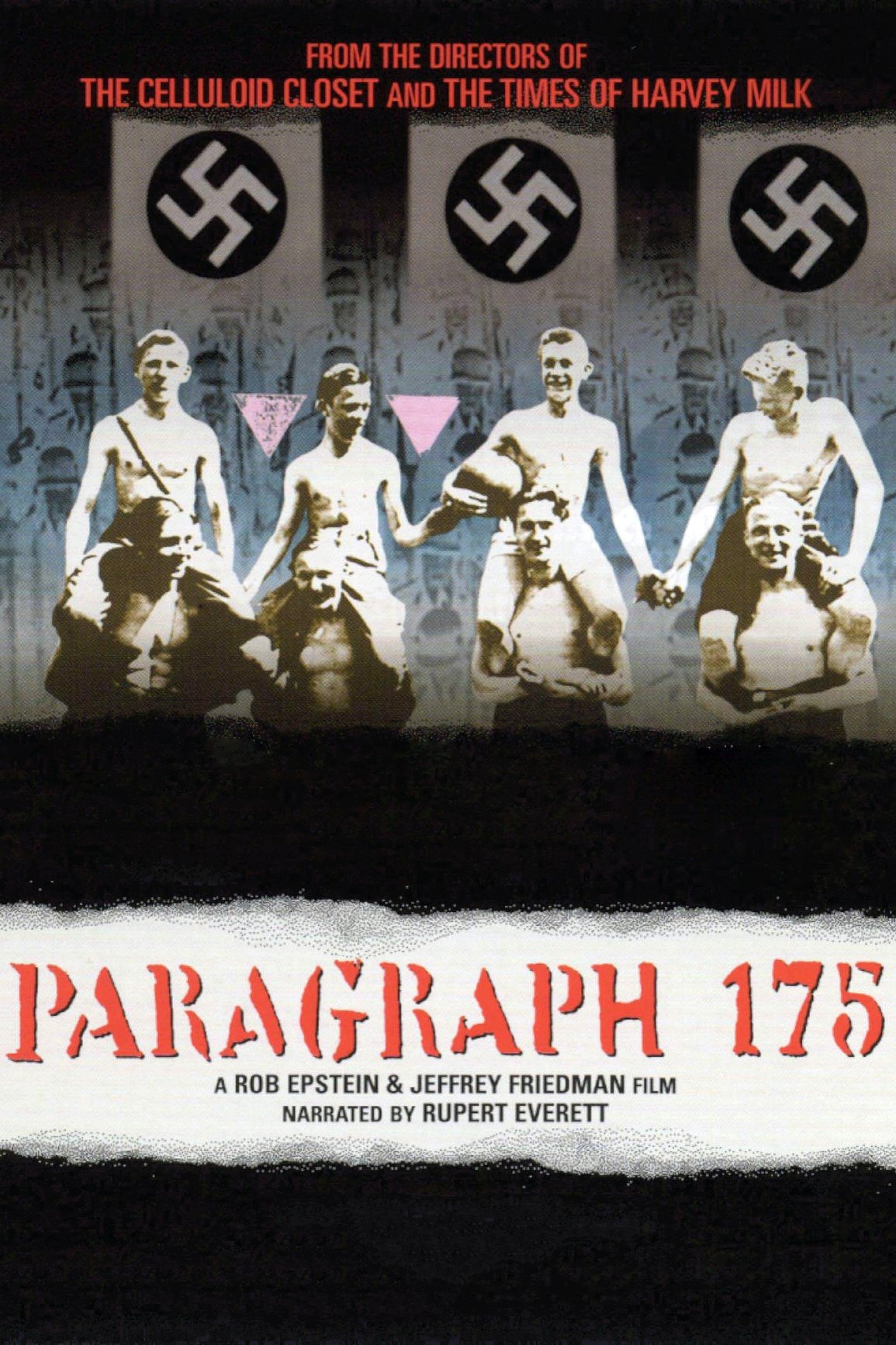
Paragraph 175
History · Documentary
Overview
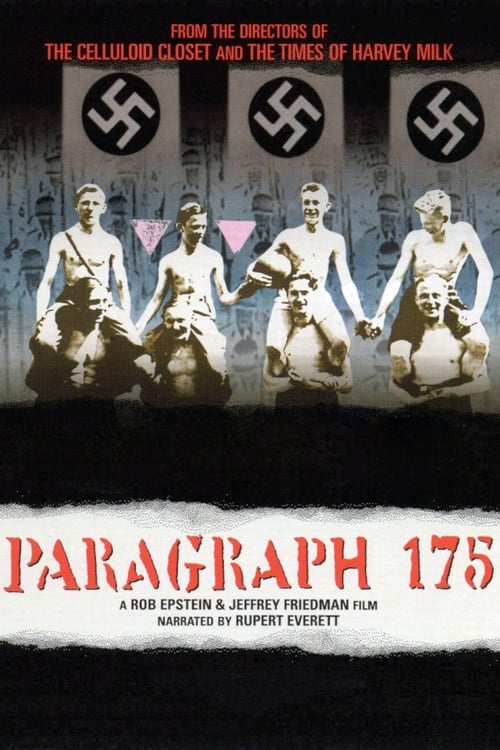
During the Nazi regime, there was widespread persecution of homosexual men, which started in 1871 with the Paragraph 175 of the German Penal Code. Thousands were murdered in concentration camps. This powerful and disturbing documentary, narrated by Rupert Everett, presents for the first time the largely untold testimonies of some of those who survived.






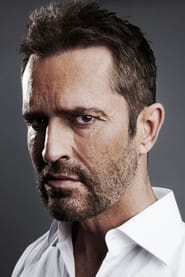
Rupert Everett
Rupert Everett
Narrator (voice)
Rupert Everett
Narrator (voice)
Heinz Dörmer
Heinz Dörmer
Self
Heinz Dörmer
Self
Annette Eick
Annette Eick
Self
Annette Eick
Self
Albrecht Becker
Albrecht Becker
Self
Albrecht Becker
Self
Gad Beck
Gad Beck
Self
Gad Beck
Self
Pierre Seel
Pierre Seel
Self
Pierre Seel
Self
Heinz F.
Heinz F.
Self
Heinz F.
Self
Klaus Müller
Klaus Müller
Self
Klaus Müller
Self
Karl Gorath
Karl Gorath
Self
Karl Gorath
Self
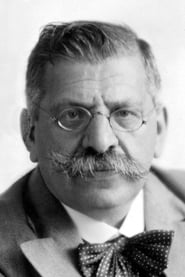
Magnus Hirschfeld
Magnus Hirschfeld
Self (archive footage)
Magnus Hirschfeld
Self (archive footage)
Similar Movies
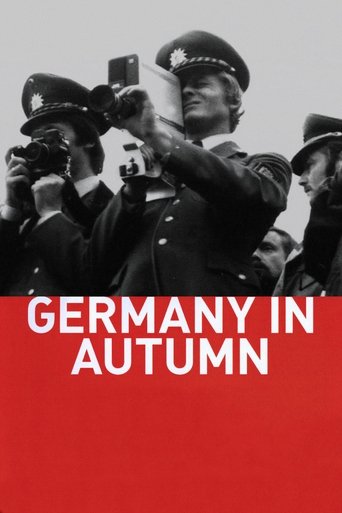
Nine fictitious documentaries and films reflect the mood of late 1970s Germany, particularly the two-month period in 1977 when a businessman was kidnapped by the RAF (Red Army Faction). The kidnap had been made to orchestrate the release of the original leaders of the RAF, aka the Baader-Meinhof.

A heartfelt and uplifting portrayal about one young remarkable drag queen from Leith who, despite suffering from cystic fibrosis, lives life to the max. At 24 years of age, Jordan McKinley knows he is on borrowed time. This Leith-born-and-bred drama teacher, DJ and top Edinburgh drag artist faces his medical condition head-on and lives his life at 100 miles an hour.
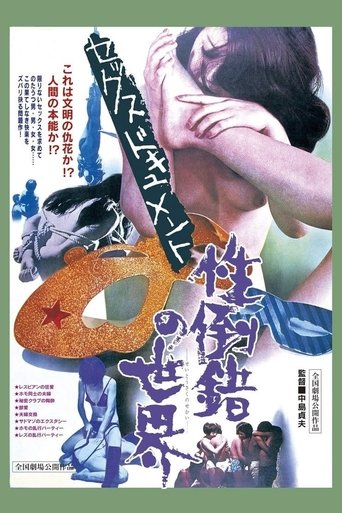
A look at sex in Japan, that covers underground gay life, transvestites, sex change operations, tattoos, and S&M. What does it mean to live an individualistic life in the modern age? By capturing the seemingly bizarre customs of men in drag and women in men's clothing seen on the streets, and examining the world of sexual perversion in an attempt to unravel the mysteries of our homogenized modern society, we explore whether it represents the pinnacle of pleasure, or a world of endless hell.

In the mid-1960s, wealthy debutant Edie Sedgwick meets artist Andy Warhol. She joins Warhol's famous Factory and becomes his muse. Although she seems to have it all, Edie cannot have the love she craves from Andy, and she has an affair with a charismatic musician, who pushes her to seek independence from the artist and the milieu.

Montage film by Aymeric Caron, broadcast at the French National Assembly on May 29, 2024. “Is it a dream or a reality? » demands a little girl stunned by her injuries. It is a nightmare, without a doubt, and nothing can justify it, neither the crimes of October 7 nor the detention of Israeli hostages by Hamas. Condemning all the crimes of October 7, before and after, condemning anti-Semitism and all forms of racism is common sense. However, it seems that this needs to be clarified. Everyone present normally wishes that the surviving hostages can one day be reunited with their families and that the massacre in Gaza stops immediately. But to follow through with the process is to see things face to face, to see what has been happening in Gaza since October 7, what the Israeli army is doing, what the television channels are not showing.

The Polish city of Łódź was under Nazi occupation for nearly the entirety of WWII. The segregation of the Jewish population into the ghetto, and the subsequent horrors are vividly chronicled via newsreels and photographs. The narration is taken almost entirely from journals and diaries of those who lived–and died–through the course of the occupation, with the number of different narrators diminishing as the film progresses, symbolic of the death of each narrator.
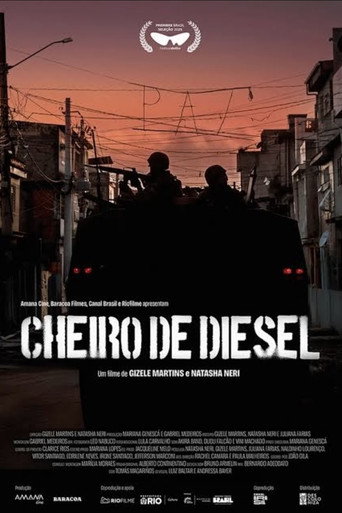
The documentary portrays the collective traumas of the militarization of Rio de Janeiro’s favelas occupied by the Armed Forces during the mega sporting events. Through voices from within the favelas, the film documents the struggle for justice and reparation for victims of human rights violations.
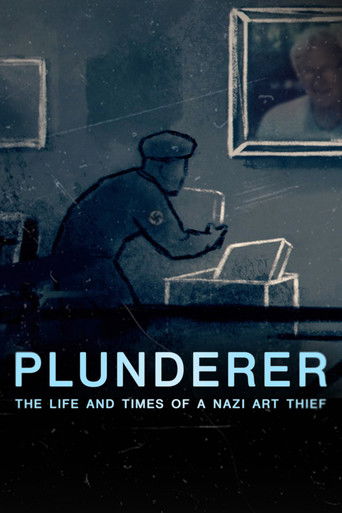
“It’s not every day that you meet an old Nazi.” So begins American historian Jonathan Petropoulos, recalling the day in 1998 when he met Bruno Lohse, who was Hermann Göring’s art agent in Paris during World War II. In this riveting account, Petropoulos details Lohse’s role in stealing countless masterpieces from prominent French and Dutch families, while evading meaningful punishment, and continuing to deal art profitably for most of the rest of his life. This explosively compelling tale calls the international art market to task for its continuing lack of regulation.