

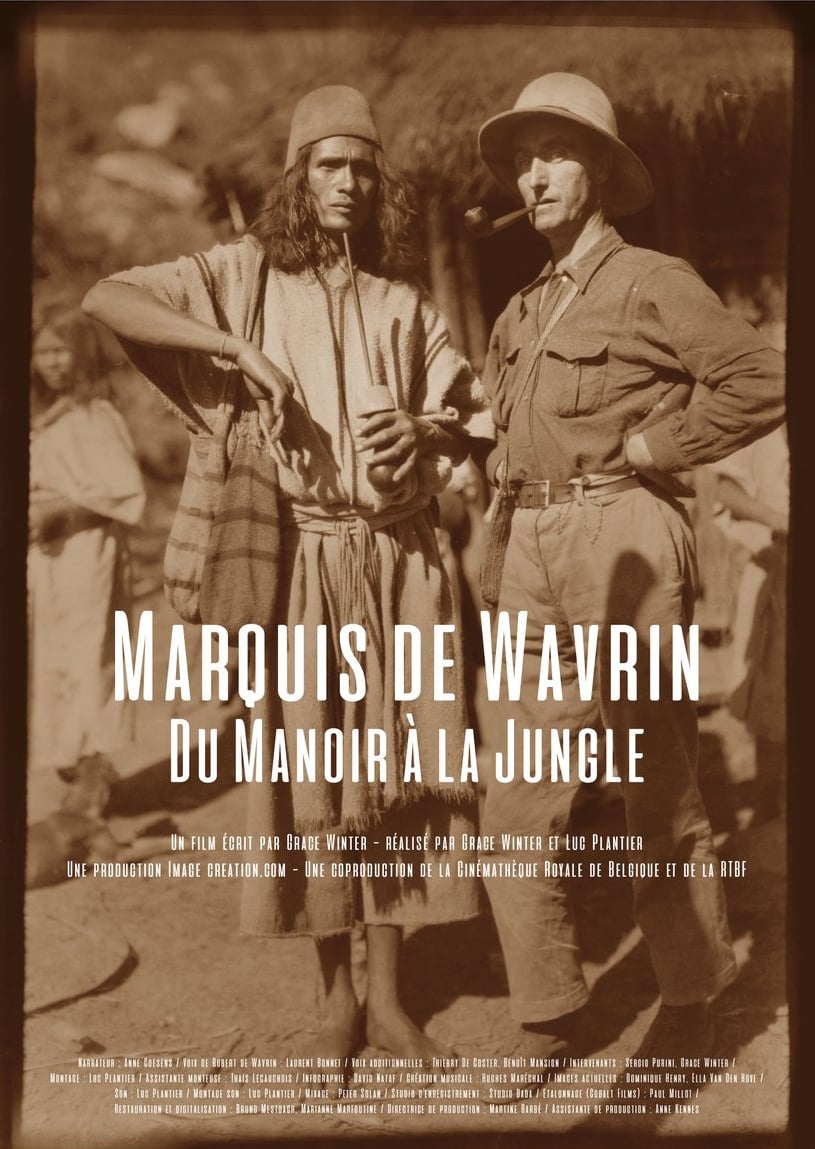
Marquis de Wavrin, from the Manor to the Jungle
Documentary
Overview
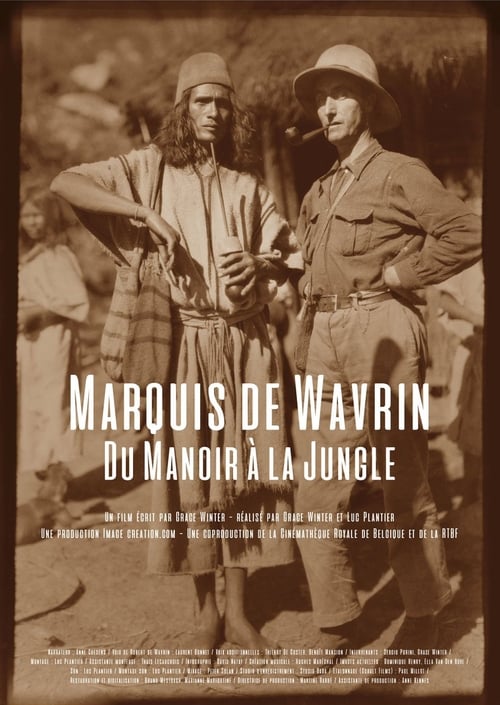
A documentary that invites us to discover the strange path led by the explorer-ethnographer Marquis de Wavrin who, in the 1920s and 1930s, made ethnographic films in several countries of Latin America.



Grace Winter
Grace Winter
Self
Grace Winter
Self
Sergio Purini
Sergio Purini
Self
Sergio Purini
Self
Robert de Wavrin
Robert de Wavrin
Self (archive footage)
Robert de Wavrin
Self (archive footage)

Anne Coesens
Anne Coesens
Narrator
Anne Coesens
Narrator

Laurent Bonnet
Laurent Bonnet
Narrator
Laurent Bonnet
Narrator
Thierry de Coster
Thierry de Coster
Narrator
Thierry de Coster
Narrator

Benoit Mansion
Benoit Mansion
Narrator
Benoit Mansion
Narrator
Similar Movies
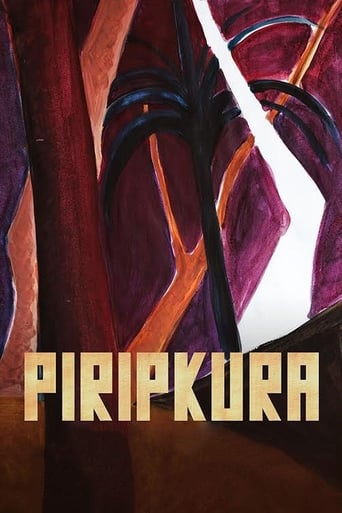
The last two surviving members of the Piripkura people, a nomadic tribe in the Mato Grosso region of Brazil, struggle to maintain their indigenous way of life amidst the region's massive deforestation. Living deep in the rainforest, Pakyî and Tamandua live off the land relying on a machete, an ax, and a torch lit in 1998.

A whimsical blend of live action and animation, "Saludos Amigos" is a colorful kaleidoscope of art, adventure and music set to a toe-tapping samba beat. From high Andes peaks and Argentina's pampas to the sights and sounds of Rio de Janeiro, your international traveling companions are none other than those famous funny friends, Donald Duck and Goofy. They keep things lively as Donald encounters a stubborn llama and "El Gaucho" Goofy tries on the cowboy way of life....South American-style.
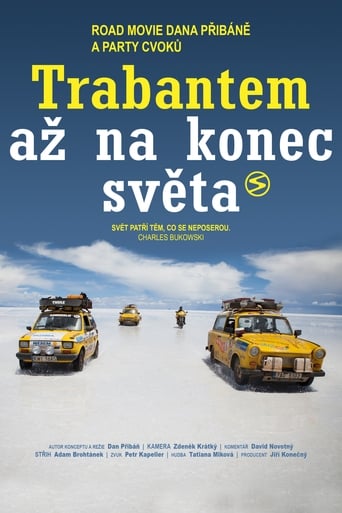
The third installment in Dan Přibáň's series of travel documentaries describes the author's journey with his friends across South America in vehicles that are often notorious but cult in their own way. The charming dynamics of the group on screen are further enhanced by the high-quality craftsmanship.

Florian Hartung and Dirk Pohlmann have reconstructed a previously unknown dimension of the collaboration between Nazis and the CIA in the Cold War. Drawing upon recently released documents, the film exposes for the first time a perfidious, worldwide net that reaches deep into the power structures of the Federal Republic of Germany. Lending their authority to the fact-finders’ mission are high-ranking statesmen, journalists and historians.

The ocean contains the history of all humanity. The sea holds all the voices of the earth and those that come from outer space. Water receives impetus from the stars and transmits it to living creatures. Water, the longest border in Chile, also holds the secret of two mysterious buttons which were found on its ocean floor. Chile, with its 2,670 miles of coastline and the largest archipelago in the world, presents a supernatural landscape. In it are volcanoes, mountains and glaciers. In it are the voices of the Patagonian Indigenous people, the first English sailors and also those of its political prisoners. Some say that water has memory. This film shows that it also has a voice.
The words of the women and the rhythm of their lives in the seclusion of family compounds suggests both the satisfying and the limiting aspects of a woman's role in a rural Afghan community. Filmed in the Balkh Province, an area inhabited by Tajik and other Central Asian peoples. The town of Aq Kupruk is approximately 320 miles northwest of Kabul. The theme of the film focuses on women. The film and accompanying instructor notes examine the economic, political, religious, and educational status of women, their legal and customary rights, and the degree of change in their actual and perceived roles.
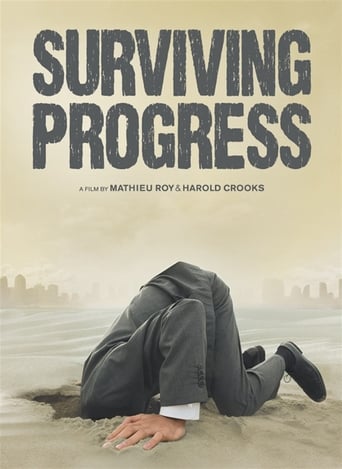
Humanity’s ascent is often measured by the speed of progress. But what if progress is actually spiraling us downwards, towards collapse? Ronald Wright, whose best-seller, “A Short History Of Progress” inspired “Surviving Progress”, shows how past civilizations were destroyed by “progress traps”—alluring technologies and belief systems that serve immediate needs, but ransom the future. As pressure on the world’s resources accelerates and financial elites bankrupt nations, can our globally-entwined civilization escape a final, catastrophic progress trap? With potent images and illuminating insights from thinkers who have probed our genes, our brains, and our social behaviour, this requiem to progress-as-usual also poses a challenge: to prove that making apes smarter isn’t an evolutionary dead-end.
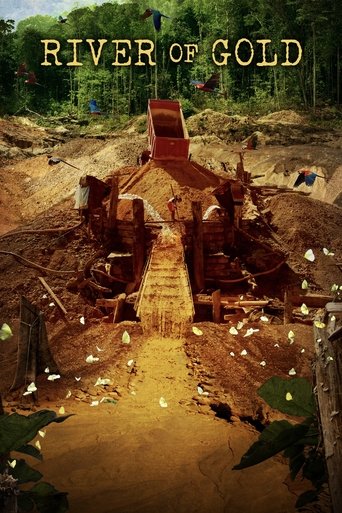
Narrated by Academy Award winners Sissy Spacek and Herbie Hancock, River of Gold is the disturbing account of a clandestine journey into Peru's Amazon rainforest to uncover the savage unraveling of pristine jungle. What will be the fate of this critical region of priceless biodiversity as these extraordinarily beautiful forests are turned into a hellish wasteland?
In the Formative Period 4,000 years before the Incas and the arrival of the Conquistadors, Peru’s earliest civilizations - the Chavín, Caral, Ventarrón, Sechin, Cupisnique, and Cajamarca cultures - built centers of learning and technological achievements, including the largest work of hydrological engineering in the ancient Americas: the Cumbemayo canals.
The Andes Mountains travel the western side of South America. Unlike many other mountain ranges of their altitude, the Andes do support human life on their high altitude slopes. Modern life is slowly making its way to the high altitude Andes, but the natives for the most part continue with the traditional ways of their ancestors, growing limited crops such as beans and potatoes - where the crop originated - raising sheep and pigs, and living in crude huts. The llama is the most useful of their work animals. The most conspicuous aspect of the native dress is their derby hats, the origins which are unknown. Further down the slopes, agriculture and ranching is more productive and is carried out by descendants of the Spanish settlers. There is a famous lake district in the Chilean part of the Andes, where resort hotels are located.