

The Singularity
Documentary
Overview
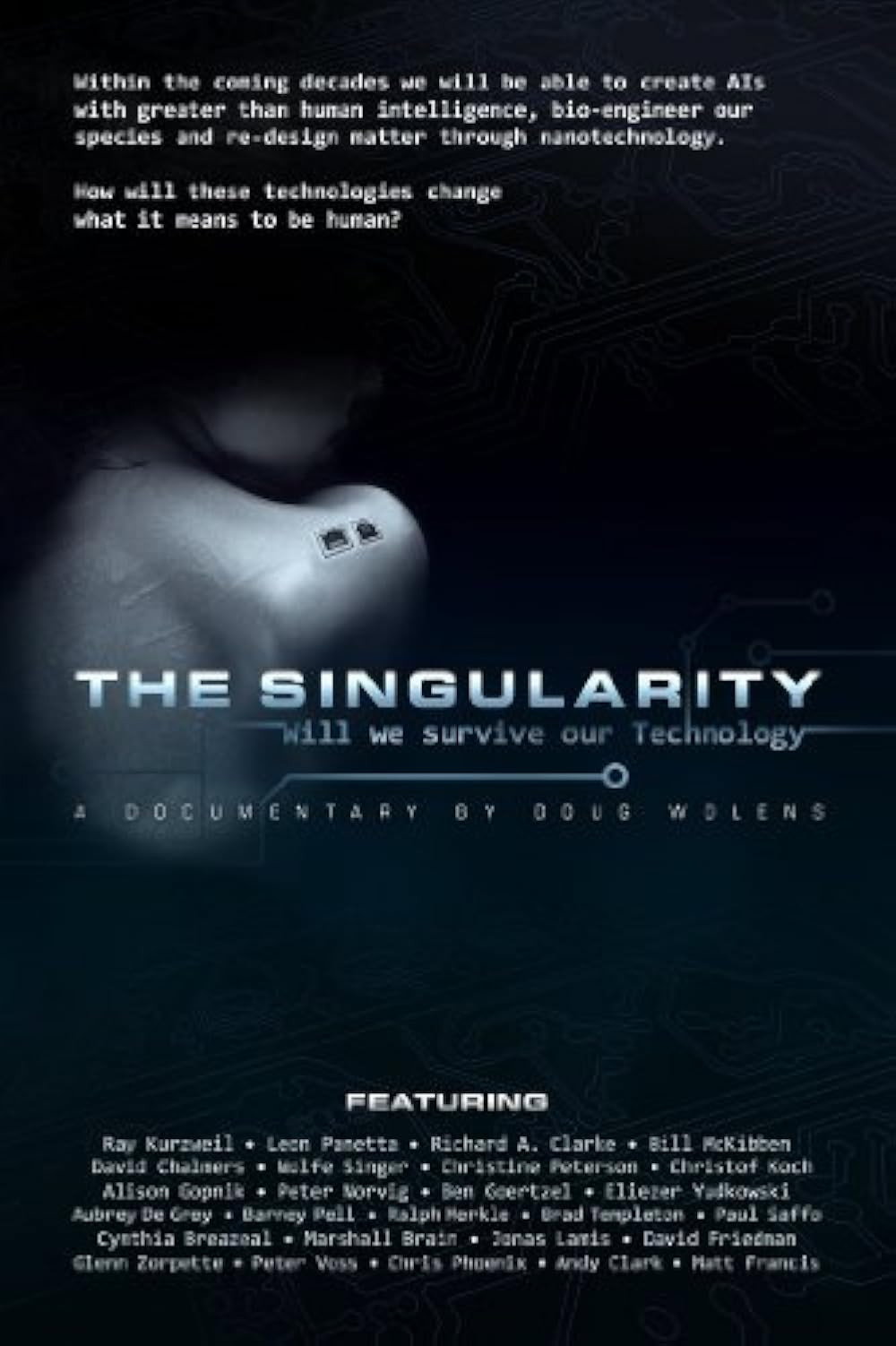
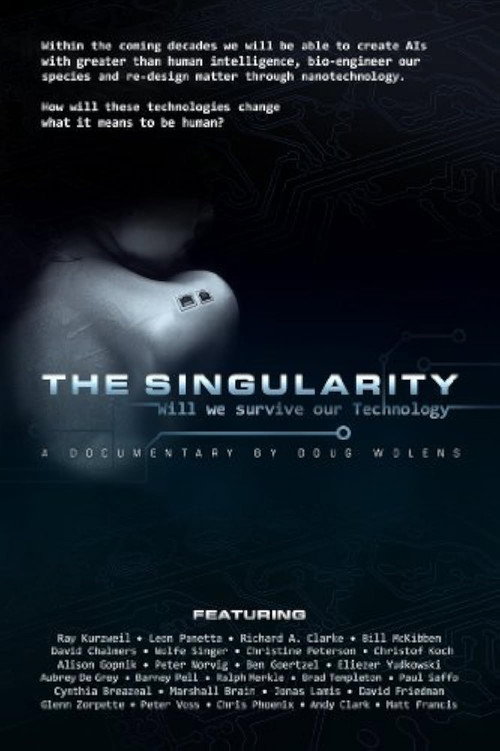
Within the coming decades we will be able to create AIs with greater than human intelligence, bio-engineer our species and re-design matter through nanotechnology. How will these technologies change what it means to be human? Director Doug Wolens speaks with leading futurists, computer scientists, artificial intelligence experts, and philosophers who turn over the question like a Rubik’s Cube. Ultimately, if we become more machine-like, and machines more like us, will we sacrifice our humanity to gain something greater? Or will we engineer our own demise? THE SINGULARITY is a comprehensive and insightful documentary film that examines technology’s accelerating rate, and deftly addresses the resulting moral questions.







Ray Kurzweil
Ray Kurzweil
Himself
Ray Kurzweil
Himself
Leon Panetta
Leon Panetta
Himself
Leon Panetta
Himself
Richard A. Clarke
Richard A. Clarke
Himself
Richard A. Clarke
Himself
Bill McKibben
Bill McKibben
Himself
Bill McKibben
Himself
David Chalmers
David Chalmers
Himself
David Chalmers
Himself
Wolfe Singer
Wolfe Singer
Himself
Wolfe Singer
Himself
Christine Peterson
Christine Peterson
Herself
Christine Peterson
Herself
Christof Koch
Christof Koch
Himself
Christof Koch
Himself
Alison Gopnik
Alison Gopnik
Herself
Alison Gopnik
Herself
Peter Norvig
Peter Norvig
Himself
Peter Norvig
Himself
Similar Movies
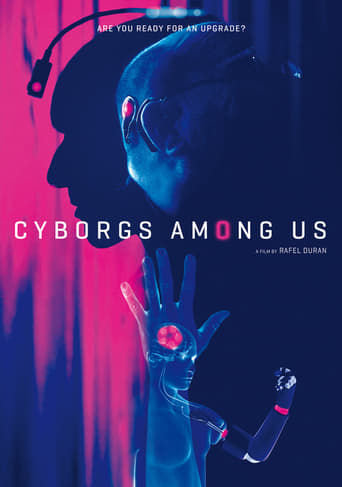
In a few years, technology will merge with our bodies in ways that today seem unimaginable, and will redefine the limits of what is a human being. There are already people who, driven by the desire to experiment, have crossed the biological limits by introducing electronic devices that provide them with capabilities that go beyond what is "normal." They are the first hybrids, and they face the reaction of society, which goes from malignancy to enthusiasm. Today they are only a small minority, and many people consider them as disrupted experimenters, but in the near future we may recognize them as pioneers.
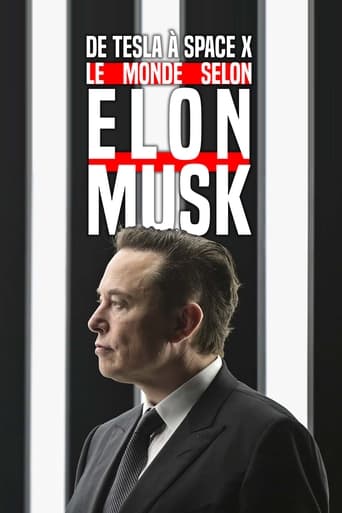
In just a few years, Elon Musk has become one of the most influential and wealthy men on the planet. Although the Tesla brand has revolutionized the image of the electric car, Elon Musk remains a great innovator in the business world. For him, there are no limits: satellites, houses, urban tunnels... But what attracts Elon Musk the most is space, which remains his favorite playground. Recently, he developed reusable rockets that have transformed space travel.

Familiar radio voice Ben Grauer leads the viewer on a behind the scenes tour of the National Broadcasting Company studios -- both radio and television -- in Rockefeller Center and Hollywood. The original 25-minute film previewed by network execs and affiliates in the fall of 1948 was cut down to 20 minutes before its first broadcast, reportedly to excise high-profile stars and programs such as Amos 'n' Andy, Jack Benny, and Edgar Bergen that had since left NBC for other networks.
Apple. Intel. Genentech. Atari. Google. Cisco. Stratospheric successes with high stakes all around. Behind some of the world's most revolutionary companies are a handful of men who (through timing, foresight, a keen ability to size up other people, and a lot of luck) saw opportunity where others did not: these are the original venture capitalists. All were backing and building companies before the term 'venture capital' had been coined: companies that led to the birth of biotechnology and the spectacular growth in microprocessors, personal computers and the web. SOMETHING VENTURED uncovers the ups and downs of the building of some of the greatest companies of the twentieth century, and the hidden dramas behind some of the most famous names in business.

Focusing on the vulnerability of digital data, Digital Amnesia ponders the sustainability of modern artifacts that have no material state. Notable archivists share their perspectives on the Digital Age and whether it poses great promise or threat to the longevity of digital information and our collective memory.
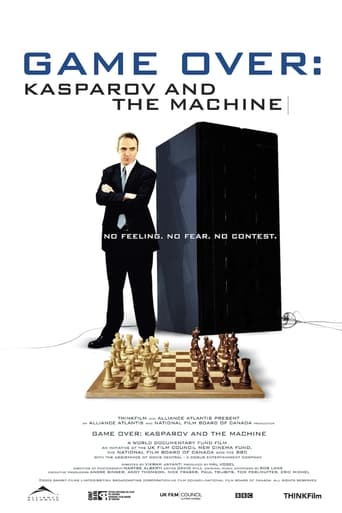
Garry Kasparov is possibly the greatest chess player who has ever lived. In 1997, he played a match against the greatest chess computer: IBM's Deep Blue. He lost. This film depicts the drama that happened away from the chess board from Kasparov's perspective. It explores the psychological aspects of the game and the paranoia surrounding IBM's ultimate chess machine.

The Hypergaussian Wars is an AI-generated feature-length audiovisual work exploring algorithmic warfare, obsolete media and the transformation of images through repetition, saturation and collapse. Built from thousands of generated images, synthetic landscapes and references to 14th–16th century painting, the film stages a continuous conflict between historical visual culture and contemporary computational systems. Fragments of obsolete video games, ruined architectures, military simulations and post-human figures circulate through increasingly unstable environments. Rather than telling a linear story, the film operates as an image system in which visual excess progressively erodes meaning. The Hypergaussian Wars reflects on memory, obsolescence, artificial intelligence and the persistence of images after their original function has disappeared.