

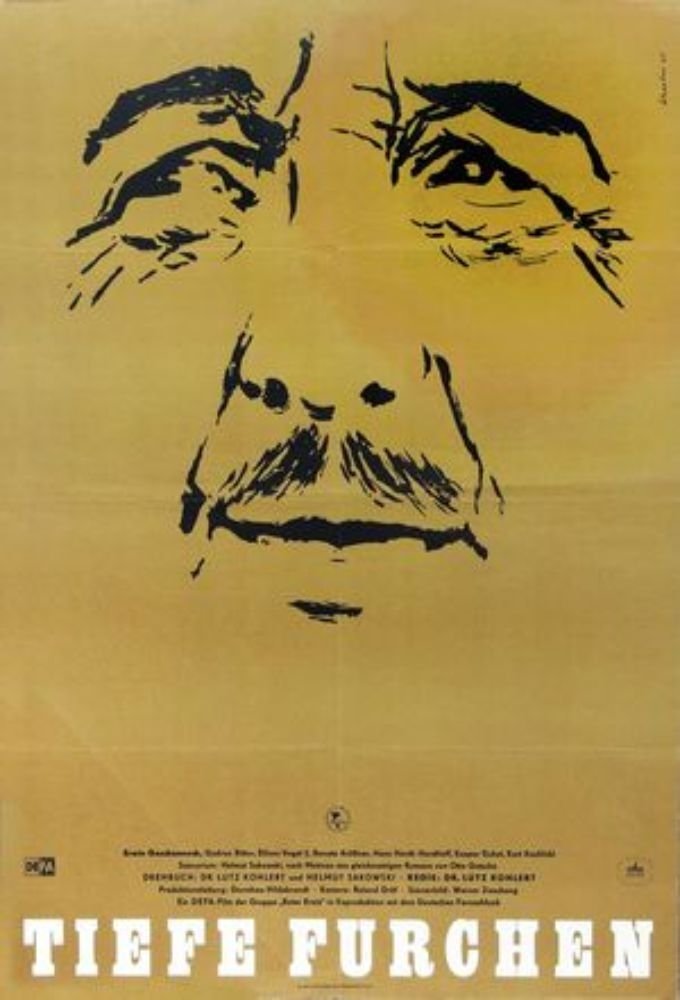
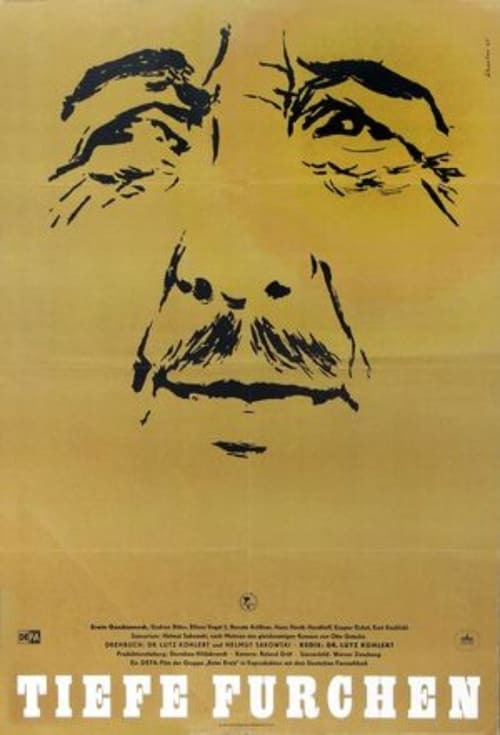
Tiefe Furchen
Drama
Overview
Germany in May 1945: the war is over, men are returning home and a new life begins in the villages. After 12 years in a concentration camp, the "Red Shoemaker" also returns to his home village. His wife is dead and others live in his house: Gebhardt, an employee on the farm of the large farmer Winter, and his family. The "Red Shoemaker" comes to stay with Hübner and his daughter Agnes. Over the past terrible years, he had repeatedly felt the hatred within him and wanted to take revenge on those who had sent him to the concentration camp. But now he wants to look to the future and takes on the position of mayor here in the village. He works to ensure that the village is supplied with food and tries to ensure that the fascist ideology disappears from people's minds. In doing so, he also makes enemies.
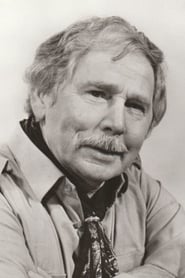







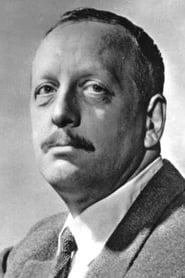
Erwin Geschonneck
Erwin Geschonneck
Roter Schuster
Erwin Geschonneck
Roter Schuster

Karl Kendzia
Karl Kendzia
Hübner
Karl Kendzia
Hübner

Gudrun Ritter
Gudrun Ritter
Agnes
Gudrun Ritter
Agnes
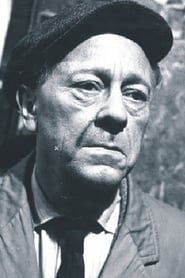
Hans Hardt-Hardtloff
Hans Hardt-Hardtloff
Gebhardt
Hans Hardt-Hardtloff
Gebhardt
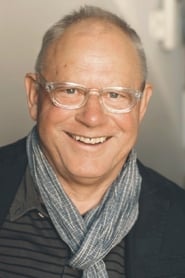
Kaspar Eichel
Kaspar Eichel
Georg
Kaspar Eichel
Georg
Ellinor Vogel
Ellinor Vogel
Frau Winter
Ellinor Vogel
Frau Winter
Kurt Kachlicki
Kurt Kachlicki
Arthur
Kurt Kachlicki
Arthur
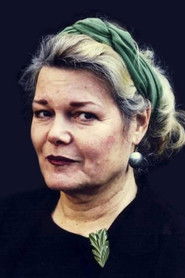
Katja Paryla
Katja Paryla
Edith
Katja Paryla
Edith

Lissy Tempelhof
Lissy Tempelhof
Gräfin von Waalen
Lissy Tempelhof
Gräfin von Waalen
Katja Kuhl
Katja Kuhl
Frau Wirsing
Katja Kuhl
Frau Wirsing
Similar Movies
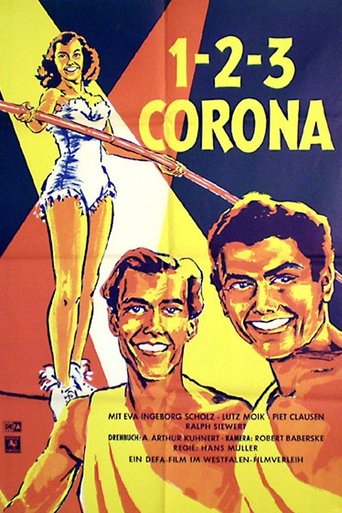
Post-war Germany 1945: Two rival gangs of uprooted boys fight each other in the ruins of Berlin, whose business is the black market out of necessity in order to survive. Their respective leaders are Gerhard and Dietrich. A pretty young circus artist named Corona comes to the destroyed city with a traveling circus. She immediately caught the boys' attention. When the latter notice that the circus director is abusing the girl, the two gangs join forces and plot an act of revenge against the tyrant. But with the hustle and bustle caused by this, Corona falls from the trapeze and is seriously injured. When the circus moves on, the boys organize a doctor for the sick artist who has been left behind. Their collectively concern for the blonde beauty makes them forget their enmity. This welds the troops closer together and sets the course for a common, meaningful future.
45,000 sections of reinforced concrete - three tons each. Nearly 300 watchtowers., over 250 dog runs, twenty bunkers. Sixty-five miles of anti-vehicle trenches—signal wire, barbed wire, beds of nails. Over 11,000 armed guards. A death strip of sand, well-raked to reveal footprints. 200 ordinary people shot dead following attempts to escape the communist regime. 96 miles of concrete wall. Families divided, loved ones lost…
Uwe Polzin, a highly talented biologist publicly stands the defence of his doctorate and this crucial day prompts him to look back on his life so far. These reminiscences are not altogether positive and he and his family still face almost unsolvable problems. For; while Ruth, Uwe's sister, consciously goes without family life and private happiness in order to devote herself fully to her vocation as a doctor; he tries to reconcile career and family. He has found in Alla, his wife - an interpreter - not only a truly loving partner but also someone who shares his basic view of life. Still, their marriage is undergoing a crisis. Uwe's job has become so demanding that he expects her to cope with a great deal of domestic problems. Alla senses that her husband is exploiting her love towards him and that he expects her only to make sacrifices for him. This is why she is contemplating divorce.
In this German political drama, an ex-Stasi agent encounters an old friend whom he may have betrayed after his friend tried to escape East Germany. The former East German agent is Otto Skrodt who after many years is about to be promoted in the highest government ranks. He is anxious to maintain a squeaky clean image. His daughter is Isabelle. The young and friendly Kalle returns after spending many years in jail for his escape attempts. He doesn't know exactly who blew the whistle, but his friend Skrodt is definitely under suspicion. Kalle returns to ostensibly renew the friendship and to see Isabelle whom he loves. The duplicitous friendship between the two men becomes the main focus of the story which features interesting plot twists at the end.
Based on a true story, Miguel Alexandre's two-part drama focuses on an East German woman and the fight for her children. Spring 1982: Sara Bender, living with her daughters Silvia and Sabine in the East German town of Erfurt, wants to marry her colleague Peter, but shortly before the wedding, her father is killed in a road accident. As the funeral takes place in West Germany, she isn't allowed to got there, so she starts planning to leave her communist home country forever. Trying to flee via Romania, she is caught by the secret service. After years in jail, Sara is ransomed by the West German government, but without her daughters. To draw the world's attention on her desperate situation, she starts demonstrating at the Berlin border crossing Checkpoint Charlie
Germany in the autumn of 1957: Lola, a seductive cabaret singer-prostitute exults in her power as a temptress of men, but she wants out—she wants money, property, and love. Pitting a corrupt building contractor against the new straight-arrow building commissioner, Lola launches an outrageous plan to elevate herself in a world where everything, and everyone, is for sale. Shot in childlike candy colors, Fassbinder’s homage to Josef von Sternberg’s classic The Blue Angel stands as a satiric tribute to capitalism.