

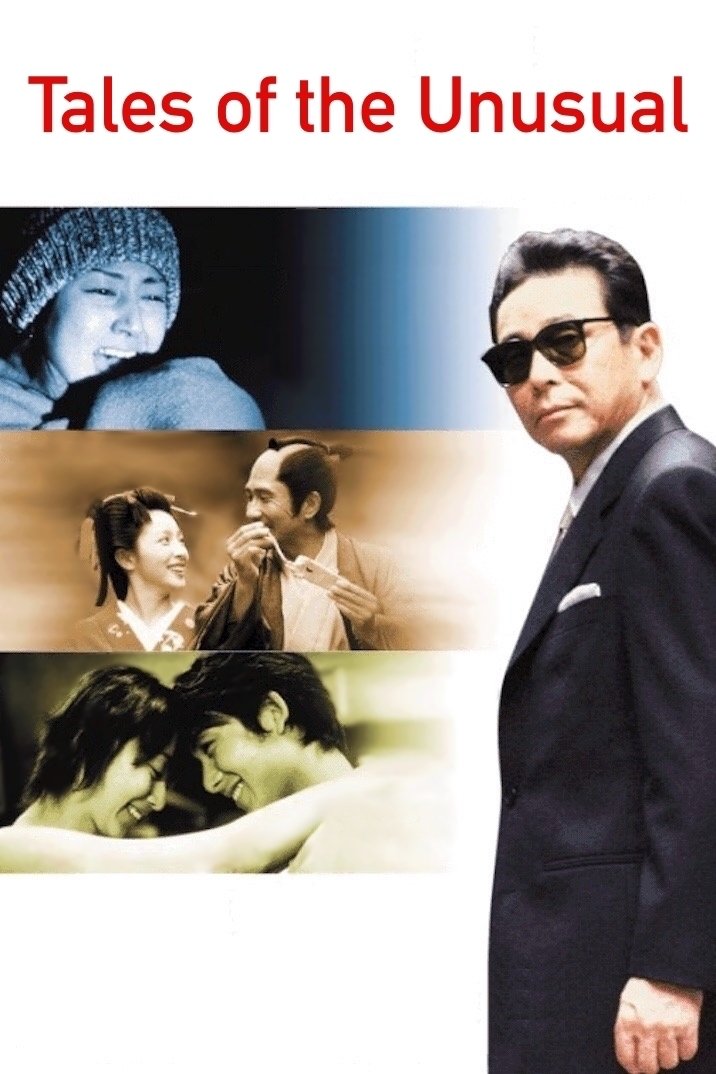
Tales of the Unusual
Horror · Comedy · Romance
Overview
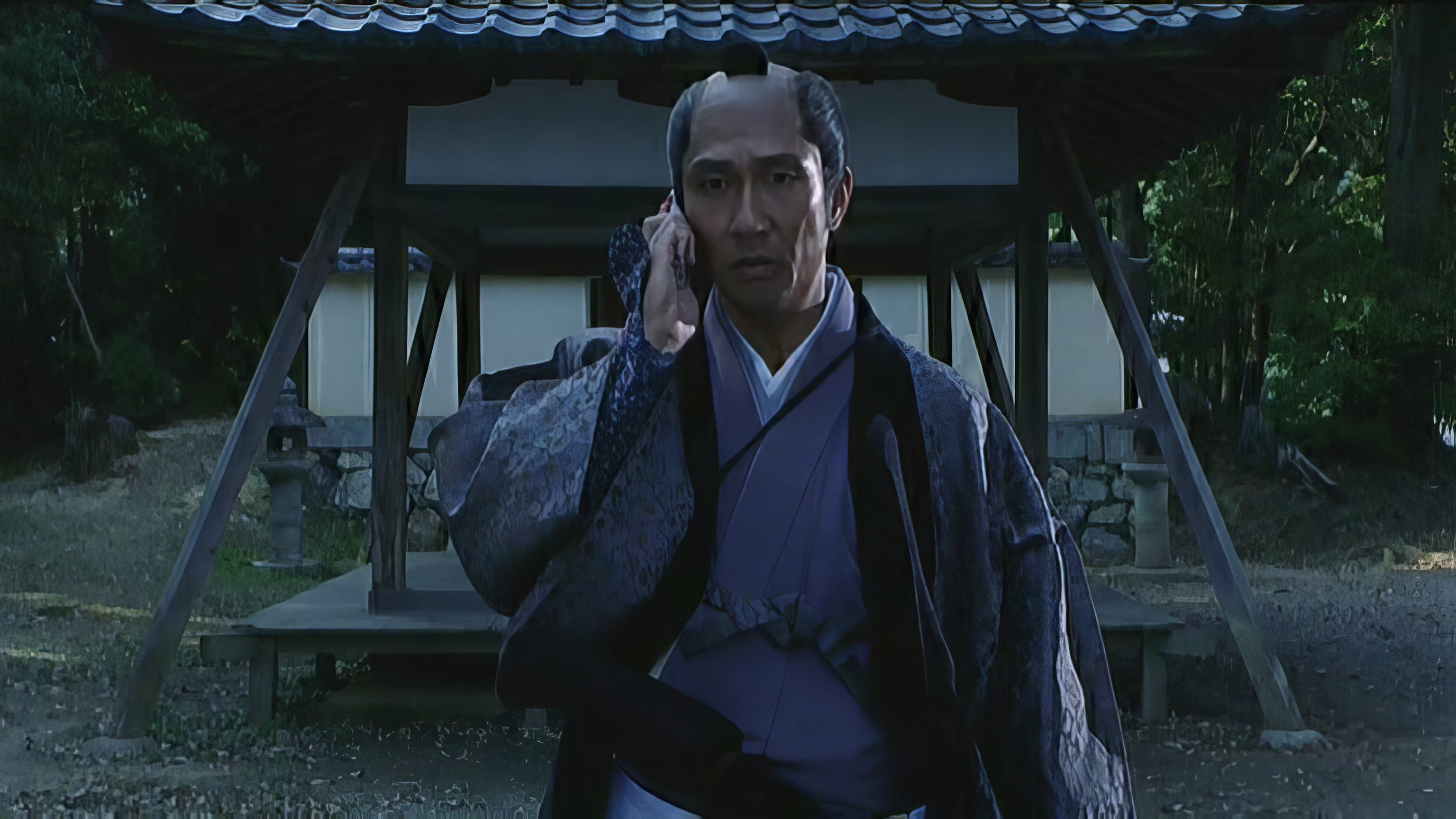
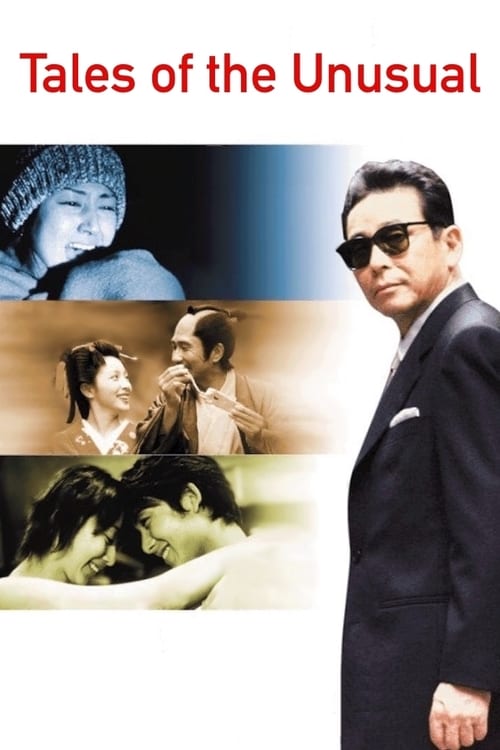
A four-part anthology in the spirit of The Twilight Zone, this film starts off with a group of commuters stranded at a train station in the rain, listening to stories told by one of the group. These include tales of a group stranded in the mountains and haunted by guilt over a death they inadvertantly caused, an emotionally broken chessmaster pressed into playing a real-life game for an eccentric millionaire, a wandering medieval samurai who finds a modern-day cell phone on the ground and a person on the other end asking questions about the past, and a young couple who agree to try a computer simulation of what their future as husband and wife would be like.
Top Cast
Kazuyuki Aijima
Manabe (segment "One Snowy Night") / Salaryman (segment "The Storyteller")

Izumi Inamori
Chiharu Takajo (segment "The Marriage Simulator")
Renji Ishibashi
Old Man (segment "Chess")

Takashi Kashiwabara
Yuichi Tokunagi (segment "The Marriage Simulator")

Narumi Kayashima
(segment "The Marriage Simulator")
Masahiro Komoto
Seiichi Tomoda (segment "Chess")
Saya Takagi
(segment "The Marriage Simulator")
Akihiko Murata

Kiichi Nakai
(segment "Samurai Cellular")

Hideyuki Nakayama

Ren Osugi
Yoshiaki Yamauchi (segment "One Snowy Night")
Yukiko Okamoto
Kumi Kato (segment "Chess")







Kazuyuki Aijima
Kazuyuki Aijima
Manabe (segment "One Snowy Night") / Salaryman (segment "The Storyteller")
Kazuyuki Aijima
Manabe (segment "One Snowy Night") / Salaryman (segment "The Storyteller")
Izumi Inamori
Izumi Inamori
Chiharu Takajo (segment "The Marriage Simulator")
Izumi Inamori
Chiharu Takajo (segment "The Marriage Simulator")
Renji Ishibashi
Renji Ishibashi
Old Man (segment "Chess")
Renji Ishibashi
Old Man (segment "Chess")
Takashi Kashiwabara
Takashi Kashiwabara
Yuichi Tokunagi (segment "The Marriage Simulator")
Takashi Kashiwabara
Yuichi Tokunagi (segment "The Marriage Simulator")
Narumi Kayashima
Narumi Kayashima
(segment "The Marriage Simulator")
Narumi Kayashima
(segment "The Marriage Simulator")
Masahiro Komoto
Masahiro Komoto
Seiichi Tomoda (segment "Chess")
Masahiro Komoto
Seiichi Tomoda (segment "Chess")
Saya Takagi
Saya Takagi
(segment "The Marriage Simulator")
Saya Takagi
(segment "The Marriage Simulator")
Akihiko Murata
Akihiko Murata
Akihiko Murata
Kiichi Nakai
Kiichi Nakai
(segment "Samurai Cellular")
Kiichi Nakai
(segment "Samurai Cellular")
Hideyuki Nakayama
Hideyuki Nakayama
Hideyuki Nakayama
Similar Movies
Bernard, an executive for a big company, tries to get home in time for his wedding but is caught in the middle of a mass suicide. He saves a sect member who then follows him like a puppy, and is chased by the sect leaders, two over-the-top crooks with bloated egos and a craving for money.
The tranquility of a remote Armenian mountain community is disrupted when a group of shepherds affected by the pangs of an evening hunger, decide to butcher and barbecue the sheep of another's that have strayed into their herd. An official inquiry by the city police complicates matters, and questions of law, morality and community only seem to lead to further entanglements.
If you get the chance to fulfill your lifelong dream, you shouldn't hesitate for long and must seize the opportunity. That's how idealistic midwife Irene Lieblich sees it. Her big dream is to open her own birth center. She has already found the perfect place for her project: a beautifully situated property on the outskirts of a picturesque Bavarian town. It all seems like a sure thing - the application has been submitted to the local council, the building finance is secured thanks to an unexpected inheritance and Irene has already rented a small terraced house for herself and her nine-year-old daughter Katja. But then, to Irene's horror, another interested party turns up for the property: funeral director Siegfried Schroff. He also wants to fulfill his dream of opening a private cemetery in this rural idyll.
Swinging playboy Grand Duke Nicholas Goduno, a direct descendent of the Romanov family who were overthrown in the Russian Revolution of 1917, learns that his family's crown jewels will be exhibited at a London museum and plots to steal them. To this end, he gathers a crew of beautiful but dangerous women, led by Bridget Rafferty, to assist in his plot against Popov, the Soviet functionary in charge of the exhibit.
Jonathan Miller set his well-known production of The Mikado, staged for the English National Opera, in a British seaside resort of the 1920s. The result, complete with a chorus of gentlemen of Japan as cartoon-like British peers, emphatically underscores the Englishness of the satire. The occasional non sequiturs, like a bunch of gentry dressed for Ascot and singing in Japanese, are loonily fun, and no more absurd than the fantasyland Japan that Gilbert and Sullivan invented. The time frame, though, seems little more than an excuse for a smart black-and-white production design.
The Romanian count known as Dracula is summoned to London by Arthur Holmwood, a young Lord who is one the verge of being wed. Unknown to Arthur's future bride Lucy, her future husband is infected with syphilis and therefore cannot consummate their marriage. Arthur has laid his hopes of being cured on the enigmatic count; as it is said that Dracula has extraordinary powers. But these supernatural powers have sinister origins. The Count is a vampire. Soon Arthur realizes his serious mistake as all hell breaks loose and the Count infects others with his ancient curse. But Dracula has not counted on the young Lord acquiring the assistance of the Dutch Vampire expert Prof. Abraham Van Helsing.
After Elizabeth's husband dies, she begins to play her tenor saxophone again, and remembers when she was 15 and a member of the Blonde Bombshells, an all-girl (with one exception) swing band. Accompanied by the exception and urged on by her grand-daughter, Elizabeth hunts up all the old members of the band and urges them to perform, and in doing so, learns more than she knew about the band, its members, the roses on the drum set, and herself--the last of the Blonde Bombshells.