

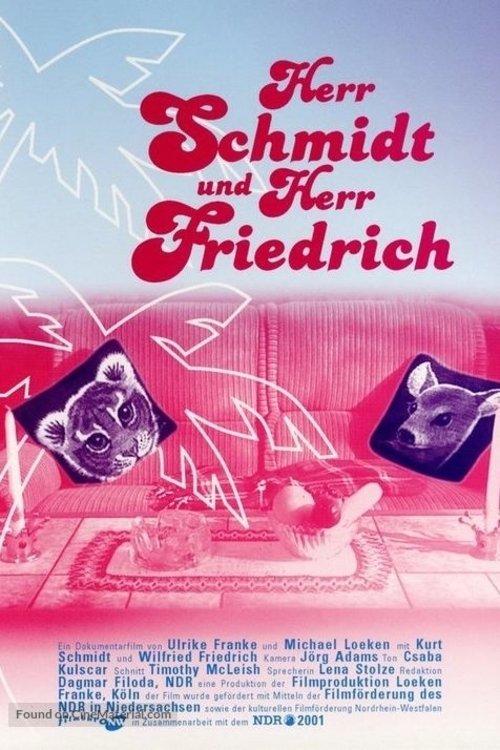
Herr Schmidt und Herr Friedrich
Documentary
Overview
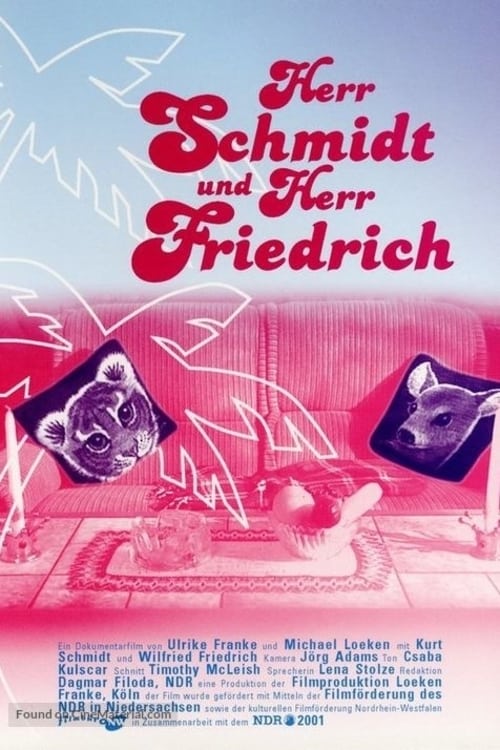
Scenes from the life of an aging homosexual couple - Wilfried Friedrich and Kurt "Kuddel" Schmidt. A relationship-comedy and at the same time, a trip into the German past and provincial life. The two men lead a life full of passion for trivial things, and they lead a pretty good marriage. Their story began before the fall of the Wall: one was a salesman in the west, the other was a waiter at a train station restaurant in East Berlin. The days of employment are long gone and the two men, both in their mid fifties, are confronted daily with the question of the meaning of life. They occupy themselves with various hobbies, like mini-golf, gardening, grilling, and above all, various well-maintained collections. For example, records, video cassettes, decorative plates, model trains, letters, and secret police files. Wilfried and Kuddel open closets to display their unbelievably well-organized collection of things and are themselves overwhelmed by all the memories.
Top Cast





Kurt Schmidt
Kurt Schmidt
Self
Kurt Schmidt
Self
Wilfried Friedrich
Wilfried Friedrich
Self
Wilfried Friedrich
Self
Similar Movies

Between the end of the Second World War and the abolition of the "offence of homosexuality" in 1982, 10,000 sentences were handed down in France. Sentences in correctional courts, fines and sometimes imprisonment, the convictions were mainly against men. The last witnesses of this period speak out and tell of four decades of clandestine life, just before the tragedy of AIDS.
“Being French in 2024 means being able to serve as Prime Minister while openly gay.” With these words closing his policy speech on January 30, 2024, Gabriel Attal made history. The documentary *Homos en politique: le dire ou pas?* uses this milestone — the appointment and visibility of France’s first openly gay Prime Minister — as a springboard for a broader inquiry. Journalists Jean-Baptiste Marteau and Renaud Saint-Cricq travel across France to meet LGBTQ politicians of all generations, from Paris to rural towns. Eleven years after the protests against same-sex marriage, has France really changed? Through interviews with figures like Bertrand Delanoë, Sarah El Haïry, Jean-Philippe Tanguy, Franck Riester, and others, the film explores how coming out intersects with politics, homophobia, and representation — questioning whether saying “I’m gay” in politics is still an act of courage or simply a sign of the times.
The story of the black, gay origins of rock n' roll. It explodes the whitewashed canon of American pop music to reveal the innovator – the originator – Richard Penniman. Through a wealth of archive and performance that brings us into Richard's complicated inner world, the film unspools the icon's life story with all its switchbacks and contradictions.
In 2008 French filmmaker Julie Gali traveled to the US to film the election of Barack Obama. In spite of this victory for civil rights, it soon became apparent that the rights of another minority were under threat. In California the passing of Proposition 8 marked the only time in U.S. history that a civil right was actually taken away after it had been granted. Upon seeing this, Ms. Gali decided to immerse herself in the growing grassroots struggle of the gay community, which culminated in the October 11, 2009 March for Equality in Washington DC.
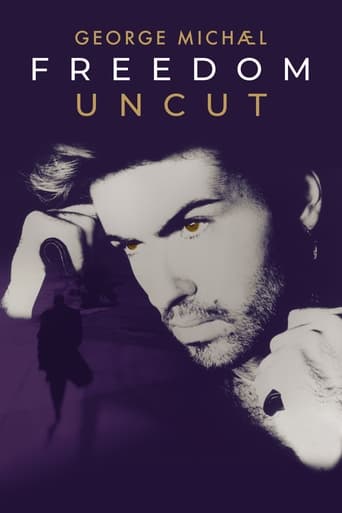
Freedom Uncut chronicles the tumultuous — yet creatively fruitful — period of George Michael’s life and career following the release of his 1987 solo debut, Faith, then through the creation and release of his 1990 follow-up Listen Without Prejudice, Vol. 1. Along with documenting his creative efforts during this period, the doc will also explore his relationship with Anselmo Feleppa — who died from AIDS-related complications — as well as the death of Michael’s mother.
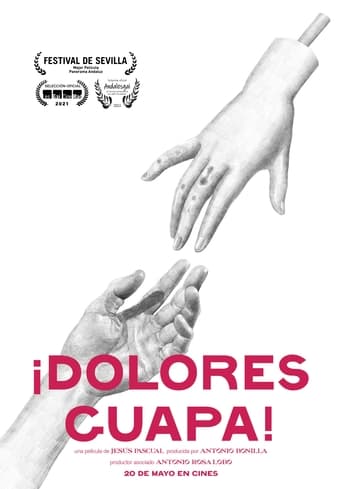
Religious-based images and traditions permeate the lives of all the people who inhabit Seville. Historically, the city's mariquitas ("sissies") have also assimilated them in their childhood and, through them, have been creating their own encounter spaces and their own codes. Nowadays, new dissident identities continue to respond to them: they participate or distance themselves, they continue what exists or transform it. This film looks at these traditions from a perspective always relegated to the margins.