



Every Face Has a Name
Documentary
Overview
Recalls the day when Holocaust survivors took their first steps into freedom, unaware of their future. Every Face Has a Name puts a name on those nameless faces and lets them recount their feelings of that day, the 28th of April, 1945.
Top Cast












Fredzia Marmur
Fredzia Marmur
Self
Fredzia Marmur
Self
Elsie Ragusin
Elsie Ragusin
Self
Elsie Ragusin
Self
Svenn Martinsen
Svenn Martinsen
Self
Svenn Martinsen
Self
Nurit Stern
Nurit Stern
Self
Nurit Stern
Self
Bernhard Kempler
Bernhard Kempler
Self
Bernhard Kempler
Self
Anita Lobel
Anita Lobel
Self
Anita Lobel
Self
Ryszard Lagemo
Ryszard Lagemo
Self
Ryszard Lagemo
Self
Piotr Górski
Piotr Górski
Self
Piotr Górski
Self
Philip Jackson
Philip Jackson
Self
Philip Jackson
Self
Judith Popinski
Judith Popinski
Self
Judith Popinski
Self
Similar Movies
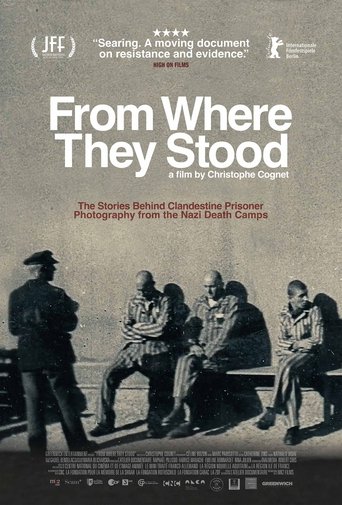
A handful of prisoners in WWII camps risked their lives to take clandestine photographs and document the hell the Nazis were hiding from the world. In the vestiges of the camps, director Christophe Cognet retraces the footsteps of these courageous men and women in a quest to unearth the circumstances and the stories behind their photographs, composing as such an archeology of images as acts of defiance.
The story of black and mixed race people in Nazi Germany who were sterilised, experimented upon, tortured and exterminated in the Nazi concentration camps. It also explores the history of German racism and examines the treatment of Black prisoners-of-war. The film uses interviews with survivors and their families as well as archival material to document the Black German Holocaust experience.

Fear and fascination arise in Muriel Grey when she remembers the figure of her father, who passed away when she was still very young. Thirty years after his death, Muriel will tell us the story of José Carlos Grey, a Black Holocaust survivor, freedom fighter in the Spanish Civil War and the French Resistance, and one of the only Black men known to have been imprisoned at the Mauthausen concentration camp in Austria.

One journalist described it as a chance "to see justice catch up with evil." On November 20, 1945, the twenty-two surviving representatives of the Nazi elite stood before an international military tribunal at the Palace of Justice in Nuremberg, Germany; they were charged with the systematic murder of millions of people. The ensuing trial pitted U.S. chief prosecutor and Supreme Court judge Robert Jackson against Hermann Göring, the former head of the Nazi air force, whom Adolf Hitler had once named to be his successor. Jackson hoped that the trial would make a statement that crimes against humanity would never again go unpunished. Proving the guilt of the defendants, however, was more difficult than Jackson anticipated. This American Experience production draws upon rare archival material and eyewitness accounts to recreate the dramatic tribunal that defines trial procedure for state criminals to this day.