

The Island of the Spirits
Documentary
Overview
A small island, a great history. Long before giving its name to the country, the Mozambique island had a fundamental role in the Indian Ocean during centuries. Anchor point for caravels, meeting point for pirates, it is a melting pot of races. It raises its walls in the middle of the sea. Its winding streets full of life reveal small palaces, churches and white houses. Its inhabitants are eccentric characters, proud of the island's past history. As we wander through the streets we meet an historian, a maritime archaeologist, a fisherman, the "doorman" of the island, a dancer, many spirits...







No cast information.
Similar Movies
This timely, bold set of one-on-one interviews presents two of the most venerable figures from the American Left—renowned historian Howard Zinn and linguist and philosopher Noam Chomsky—each reflecting upon his own life and political beliefs. At the age of 88, Howard Zinn reflects upon the Civil Rights and anti–Vietnam War movements, political empires, history, art, activism, and his political stance. Setting forth his personal views, Noam Chomsky explains the evolution of his libertarian socialist ideals, his vision for a future postcapitalist society, the Enlightenment, the state and empire, and the future of the planet.
A journey back through Dacia Maraini's and her trips around the world with her close friends cinema director Pier Paolo Pasolini and opera singer Maria Callas. An in-depth story of this fascinating woman's life. Maraini's memories come alive through personal photographs taken on the road as well as her own Super 8 films shot almost thirty years ago.
An Austrian director followed five successful African music and dance artists with his camera and followed their lives for a year. The artists, from villages in Ghana, Gambia and Congo, were the subjects of Africa! Africa! touring across Europe, but they have unbreakable roots to their homeland and their families. Schmiderer lovingly portrays his heroes, who tell their stories about themselves, their art and what it means to them to be African with captivating honesty. The interviews are interwoven with dance scenes and colourful vignettes set to authentic music.
Sir David Attenborough presents and narrates this wildlife series, a visual encyclopedia of the natural world. This episode looks at the fast, sleek and elegant cheetahs - supreme athletes and hunters of the animal world. Also the leopard, another deadly hunter, is observed in its natural habitat.
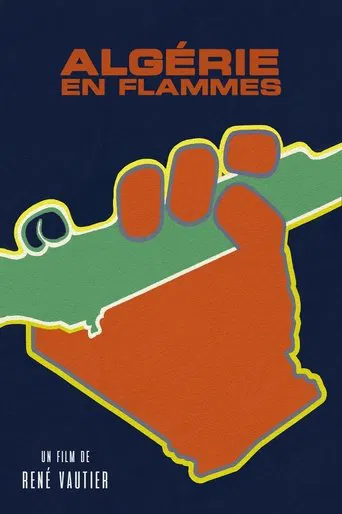
These are the first images shot in the ALN maquis, camera in hand, at the end of 1956 and in 1957. These war images taken in the Aurès-Nementchas are intended to be the basis of a dialogue between French and Algerians for peace in Algeria, by demonstrating the existence of an armed organization close to the people. Three versions of Algeria in Flames are produced: French, German and Arabic. From the end of the editing, the film circulates without any cuts throughout the world, except in France where the first screening takes place in the occupied Sorbonne in 1968. Certain images of the film have circulated and are found in films, in particular Algerian films. Because of the excitement caused by this film, he was forced to go into hiding for 25 months. After the declaration of independence, he founded the first Algerian Audiovisual Center.
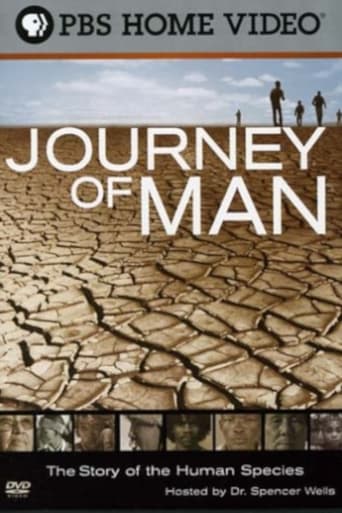
Many geneticists and archaeologists have long surmised that human life began in Africa. Dr. Spencer Wells, one of a group of scientists studying the origin of human life, offers evidence and theories to support such a thesis in this PBS special. He claims that Africa was populated by only a few thousand people that some deserted their homeland in a conquest that has resulted in global domination.
A Luta Continua explains the military struggle of the Liberation Front of Mozambique (FRELIMO) against the Portuguese. Produced and narrated by American activists Robert Van Lierop, it details the relationship of the liberation to the wider regional and continental demands for self-determination against minority rule. It notes the complicit roles of foreign governments and companies in supporting Portugal against the African nationalists. Footage from the front lines of the struggle helps contextualize FRELIMO's African socialist ideology, specifically the role of the military in building the new nation, a commitment to education, demands for sexual equality, the introduction of medical aid into the countryside, and the role of culture in creating a single national identity.