


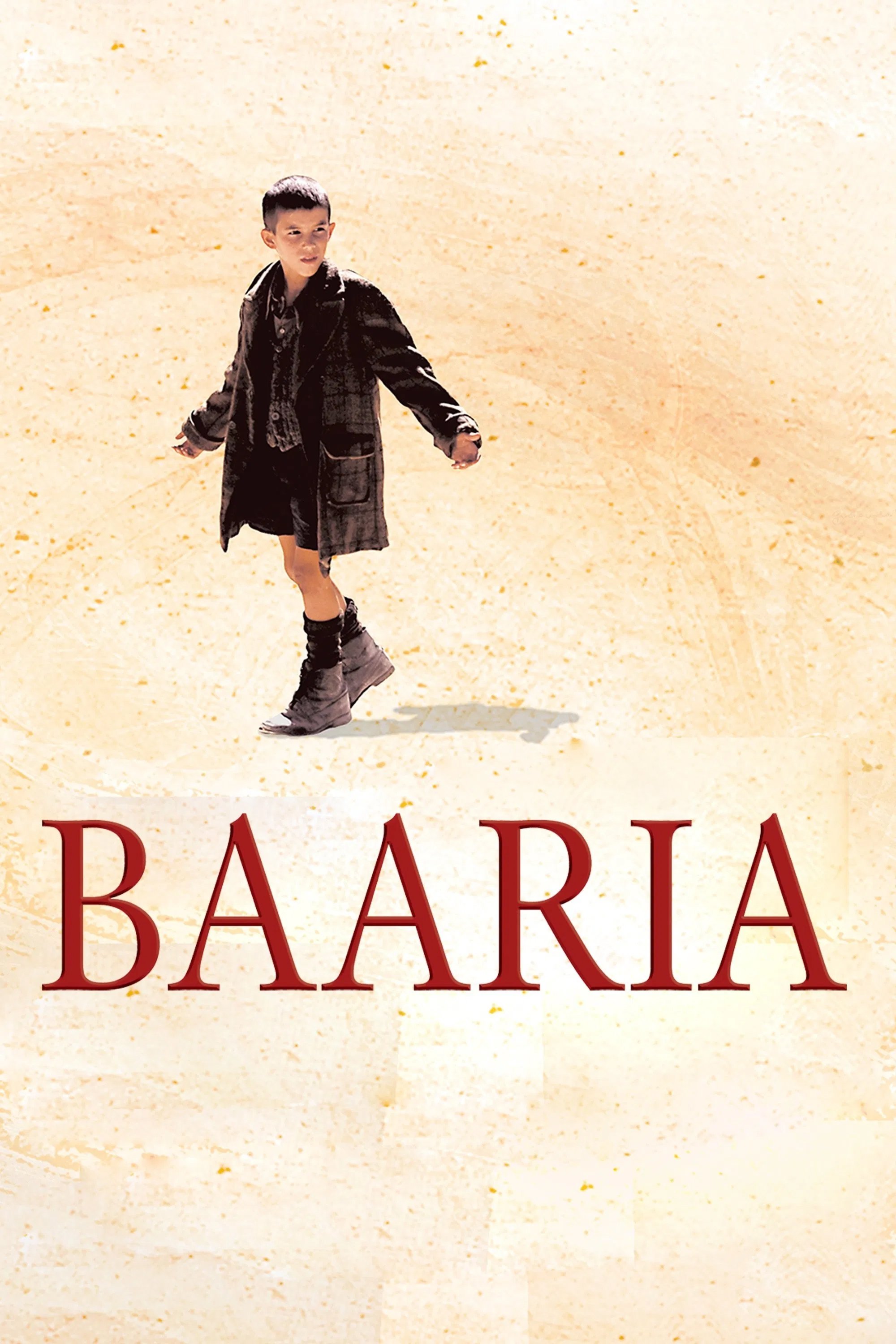
Baaria
Drama · Comedy · Romance
Overview
In 1920s Bagheria, Giuseppe 'Peppino' Torrenuova works as a shepherd to financially help his poor family. Over the next fifty years, Giuseppe's life, as well as the life of the village, is observed. Giuseppe grows up, joins the Communist Party, marries a local girl, has children, and forges a political career for himself.
Top Cast
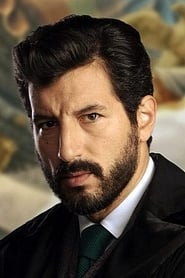
Francesco Scianna
Peppino

Margareth Madè
Mannina

Lina Sastri
Tana

Ángela Molina
Sarina adulta

Nicole Grimaudo
Sarina

Salvatore Ficarra
Nino Terranuova

Valentino Picone
Luigi Scalia

Gaetano Aronica
Ciccio Terranuova
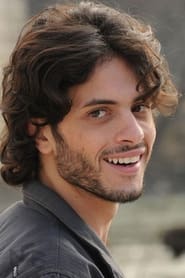
Marco Iermanò
Pietro da Ragazzo
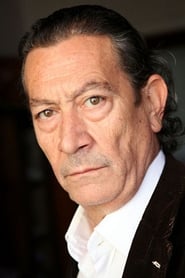
Lollo Franco
don Giacinto

Gisella Marengo
Matilde
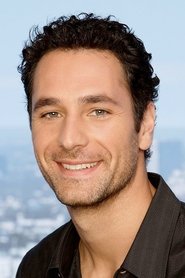
Raoul Bova
giornalista romano







Francesco Scianna
Francesco Scianna
Peppino
Francesco Scianna
Peppino
Margareth Madè
Margareth Madè
Mannina
Margareth Madè
Mannina
Lina Sastri
Lina Sastri
Tana
Lina Sastri
Tana
Ángela Molina
Ángela Molina
Sarina adulta
Ángela Molina
Sarina adulta
Nicole Grimaudo
Nicole Grimaudo
Sarina
Nicole Grimaudo
Sarina
Salvatore Ficarra
Salvatore Ficarra
Nino Terranuova
Salvatore Ficarra
Nino Terranuova
Valentino Picone
Valentino Picone
Luigi Scalia
Valentino Picone
Luigi Scalia
Gaetano Aronica
Gaetano Aronica
Ciccio Terranuova
Gaetano Aronica
Ciccio Terranuova
Marco Iermanò
Marco Iermanò
Pietro da Ragazzo
Marco Iermanò
Pietro da Ragazzo
Lollo Franco
Lollo Franco
don Giacinto
Lollo Franco
don Giacinto
Similar Movies
At the end of the Spanish civil war, Fando, a boy of about ten, tries to make sense of war and his father's arrest. His mother is religious, sympathetic to the Fascists; his father is accused of being a Red. Fando discovers that his mother may have aided in his father's arrest. Sometimes we witness Fando imagining explanations for what's going on; sometimes we see him at play, alone or with his friend Thérèse. Oedipal fantasies and a lad's natural curiosity about sex and death mix with his search for his mother's nature and his father's fate. Will Fando survive the search?
What does the energy harnessed through orgasm have to do with the state of communist Yugoslavia circa 1971? Only counterculture filmmaker extraordinaire Dušan Makavejev has the answers (or the questions). His surreal documentary-fiction collision begins as an investigation into the life and work of controversial psychologist and philosopher Wilhelm Reich and then explodes into a free-form narrative of a beautiful young Slavic girl’s sexual liberation.
The study of a youth on the edge of adulthood and his aunt, ten years older. Fabrizio is passionate, idealistic, influenced by Cesare, a teacher and Marxist, engaged to the lovely but bourgeois Clelia, and stung by the drowning of his mercurial friend Agostino, a possible suicide. Gina is herself a bundle of nervous energy, alternately sweet, seductive, poetic, distracted, and unhinged. They begin a love affair after Agostino's funeral, then Gina confuses Fabrizio by sleeping with a stranger. Their visits to Cesare and then to Puck, one of Gina's older friends, a landowner losing his land, dramatize contrasting images of Italy's future. Their own futures are bleak.
Captain Vinka Kovalenko defects from Russia, but not for political reasons. She defects because she feels discriminated against as a woman. Captain Chuck Lockwood gets the order to show her the bright side of capitalism, while she tries to convince him of the superiority of communism. Naturally, they fall in love, but there's still the KGB, which doesn't like the idea of having a defected Russian officer running around in London.
Against a background of war breaking out in Europe and the Mexican fiesta Day of Death, we are taken through one day in the life of Geoffrey Firmin, a British consul living in alcoholic disrepair and obscurity in a small southern Mexican town in 1939. The consul's self-destructive behaviour, perhaps a metaphor for a menaced civilization, is a source of perplexity and sadness to his nomadic, idealistic half-brother, Hugh, and his ex-wife, Yvonne, who has returned with hopes of healing Geoffrey and their broken marriage.
After the Battle of Algiers, France and its army exported, as true experts, anti-subversive methods to Latin America and the United States in the 1960s. After more than a year of investigation in Argentina , in Chile, Brazil, the United States and France, the director collected, sometimes under the cover of a hidden camera, recorded conversations, the exclusive testimonies of the main protagonists. From General Aussaresses to former Minister of the Armed Forces Pierre Messmer, including General Reynaldo Bignone (head of the military junta in Argentina from 1982 to 1984), General Albano Harguindéguy, General Manuel Contreras, and Generals John Johns and Carl Bernard, this investigation gives us a hidden reality of the country of Human Rights.