



Music · Drama
Overview
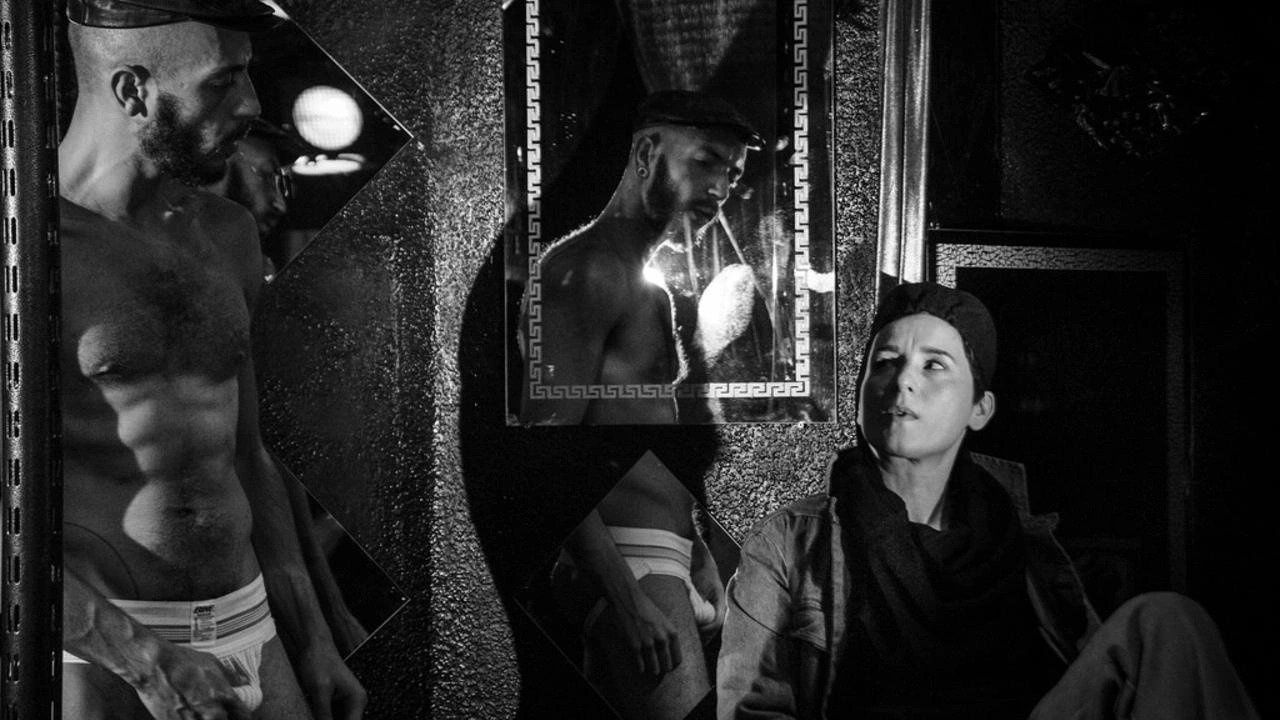
Invited by the conductor Premil Petrovic to stage Arnold Schoenberg’s Pierrot Lunaire, a musical theater work from 1912 based on the poems of Albert Giraud, LaBruce transposed a strange and tragic episode of true crime onto the composition. Complementing the original atonal score is a narrative about a trans man who is outed by his girlfriend’s father and forbidden from seeing the young woman again. Crestfallen, the protagonist decides to prove the fact of his manhood by castrating a taxi driver and then revealing his newly transplanted member to the two of them. This story, which for LaBruce “serves as a kind of allegory for all gender radicals and outcasts driven to extremes by the disapproval and hostility of the dominant order,” is rendered in a visual style that nods to the era of Schoenberg’s melodrama. LaBruce cheekily appropriates the formal vocabulary of silent cinema with black-and-white photography, irises, and intertitles like “A cock, a cock, my kingdom for a cock!”

















Susanne Sachße
Susanne Sachße
Pierrot Lunaire
Susanne Sachße
Pierrot Lunaire
Maria Ivanenko
Maria Ivanenko
Maria Ivanenko

Paulina Bachmann
Paulina Bachmann
Paulina Bachmann
Luizo Vega
Luizo Vega
Luizo Vega
Mehdi Berkouki
Mehdi Berkouki
Mehdi Berkouki
Boris Lisowski
Boris Lisowski
Boris Lisowski
Krishna Kumar Krishnan
Krishna Kumar Krishnan
Krishna Kumar Krishnan

Bruce LaBruce
Bruce LaBruce
Bruce LaBruce
Similar Movies
While walking his dog, Eric bumps into the confident and carefree Ryan. Taking a nervous leap, Eric accepts Ryan’s invitation to walk through the city en route to a concert. In the next six blocks, the two men discover that intimacy through anonymity also exposes one another’s flaws and insecurities. Will they make it to the concert in one piece?
The 1920s saw a revolution in technology, the advent of the recording industry, that created the first class of African-American women to sing their way to fame and fortune. Blues divas such as Bessie Smith, Ma Rainey, and Alberta Hunter created and promoted a working-class vision of blues life that provided an alternative to the Victorian gentility of middle-class manners. In their lives and music, blues women presented themselves as strong, independent women who lived hard lives and were unapologetic about their unconventional choices in clothes, recreational activities, and bed partners. Blues singers disseminated a Black feminism that celebrated emotional resilience and sexual pleasure, no matter the source.
A mysterious door in the basement of the Hercules house leads to the Sixth Dimension by way of a gigantic set of intestine. When Frenchy slips through the door, King Fausto falls in love with her. The jealous Queen Doris takes Frenchy prisoner, and it is up to the Hercules family and friend Squeezit Henderson to rescue her.