

No President
Documentary · Drama
Overview
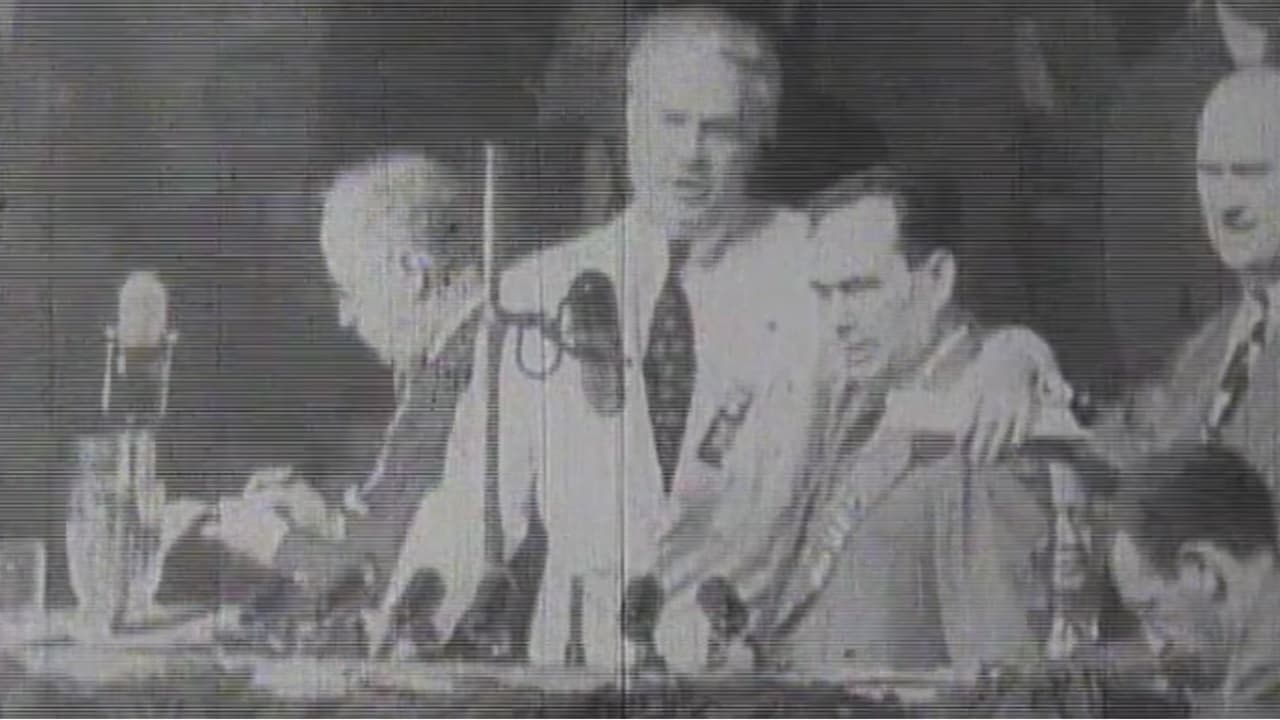
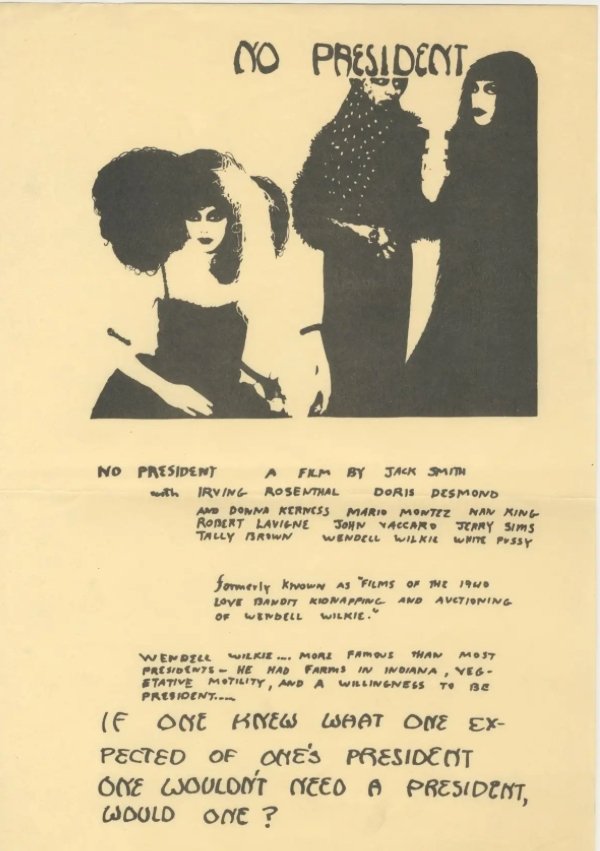
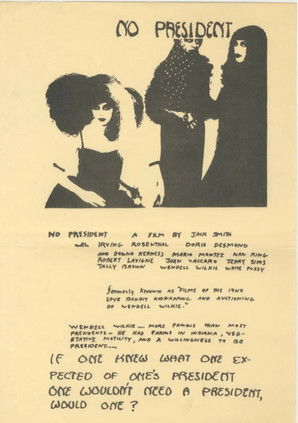
Smith's third feature film was originally titled "The Kidnapping of Wendell Willkie by the Love Bandit," in reaction to the 1968 Presidential Campaign. It mixes B&W footage of Smith's creatures with old campaign footage of Willkie, a liberal Republican who ran against FDR in the 1940's. The climax of the work appears to be the "auctioning" of the presidential candidate at a convention.

Mario Montez
Mario Montez
Mario Montez
Piero Heliczer
Piero Heliczer
Piero Heliczer
Tally Brown
Tally Brown
Tally Brown
Jerry Sims
Jerry Sims
Jerry Sims

Donna Kerness
Donna Kerness
Donna Kerness
Charles Henri Ford
Charles Henri Ford
Charles Henri Ford
Francis Francine
Francis Francine
Francis Francine
Gerard Malanga
Gerard Malanga
Gerard Malanga
Similar Movies
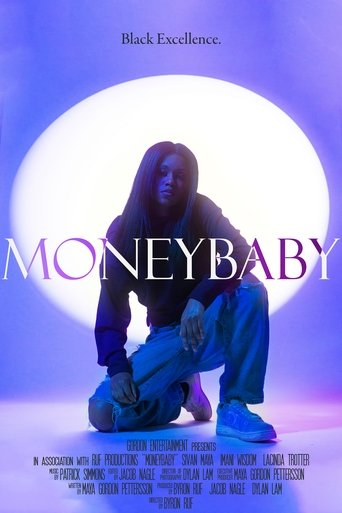
The inner mind of Aaliyah Petra, a young black dancer fighting to withstand the immense pressure of being her family and community's “Moneybaby.” Aaliyah battles through the overwhelming pressure to succeed, discovers her own resilience, and realizes the true meaning of Black Excellence.
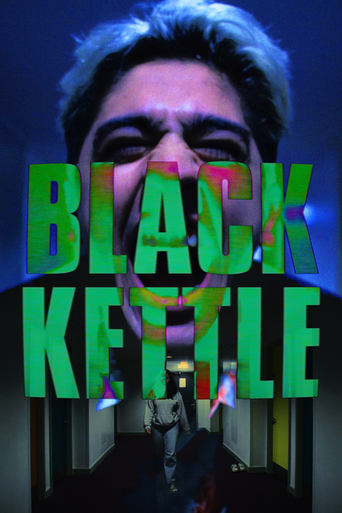
A man trapped in an aimless routine becomes the spectator of his own life as he wanders through the urban landscapes of his city in search of something that gives him meaning. Between memories and ghosts, he faces his doubts and longings, questioning what is real and what is just a projection of his loneliness.
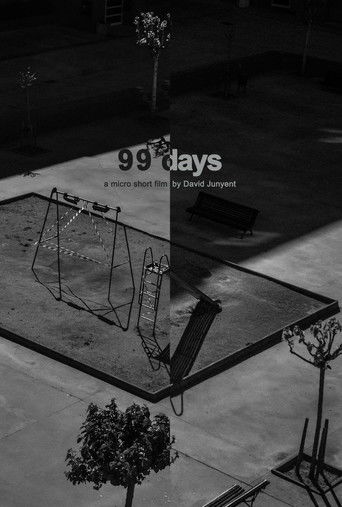
Rua de Santa Catarina, a street that was formerly home to dozens of local businesses and hundreds of Porto residents, now sees a crowd of tourists attracted by the cheap, disposable amenities that are popping up everywhere at once. Gentrification has decontextualized Portuguese culture, rendering the landscape uncanny. The Basin Woman, a symbol of the female workers of the historic Bolhão Market, is chased down by seagulls in the midst of this transcendent chaos.
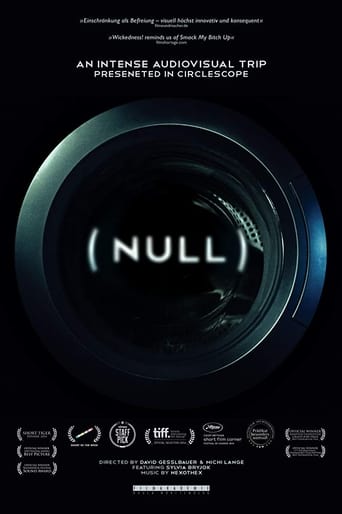
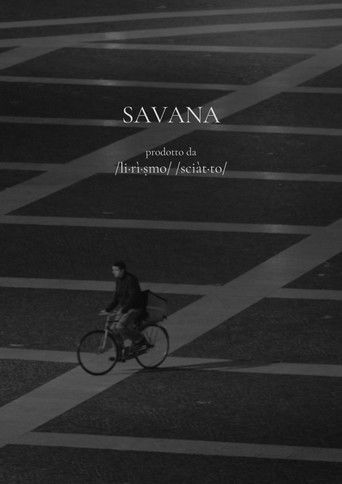
The story takes place in the landscapes of La Spezia, where urban and rural environments intertwine. Water plays a primary role as a form, alongside the circle (e.g., bicycle wheels, pizzas, clocks…), which sets the rhythm of the character’s life, dynamically accelerating until it becomes very fast. The overlapping forms invite the viewer into the cyclical rhythm of the short film, moving from the spinning bicycle wheel to the washing machine drum in the character’s bathroom, from a freshly tossed pizza to the delivery mailbox, and finally to a dead-end wall. Savana is a race against oneself and against others; it’s a matter of decision and unpredictability — it’s black or white.