

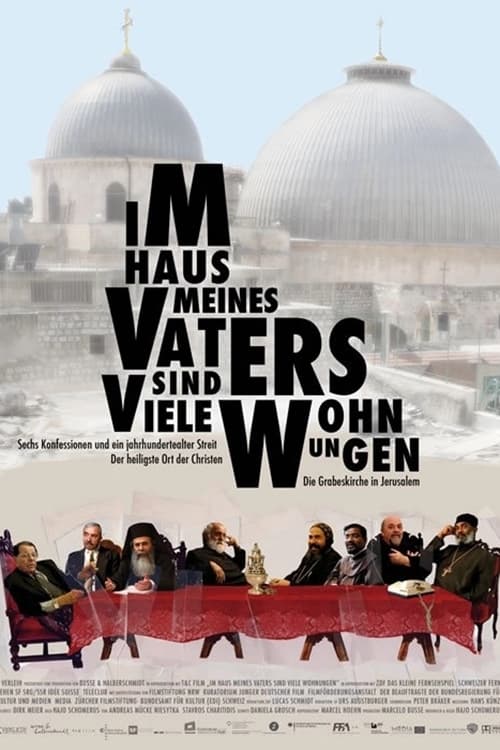
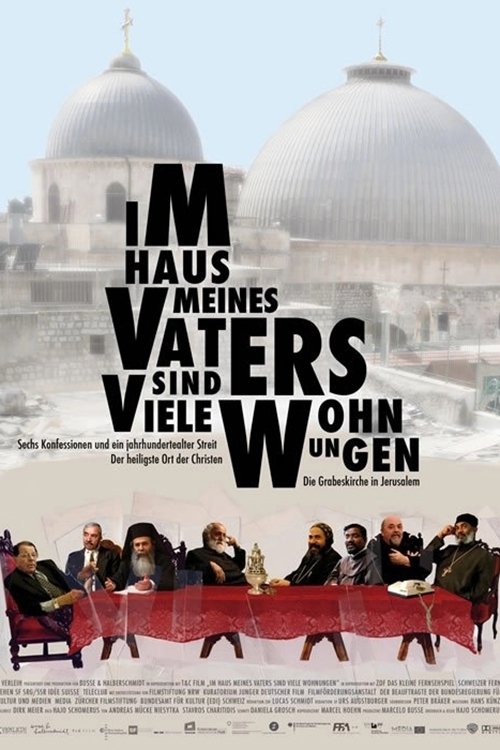
In My Father's House are Many Mansions
Documentary
Overview
In the Church of the Holy Sepulchre, in the heart of Jerusalem, six different Christian denominations, Greek Orthodox, Armenian, Syrian, Roman Catholic, Ethiopian and Coptic Christians-have divided the sacred site and simply can not agree on which of the claims on the tomb of Jesus is the most legitimate. So they fight. Sometimes through a difficult time cleaning, sometimes even by force. An intuitive and entertaining approach to the fact that faith is a very human thing.
Top Cast


Afrayem Elorashalimy
Afrayem Elorashalimy
Afrayem Elorashalimy
Brother Jayaseelan
Brother Jayaseelan
Brother Jayaseelan
Samuel Aghoyan
Samuel Aghoyan
Samuel Aghoyan
Gebreselassie Tesfa
Gebreselassie Tesfa
Gebreselassie Tesfa
Theophilos III
Theophilos III
Theophilos III
Robert Jauch
Robert Jauch
Robert Jauch
Wajeeh Nuseibeh
Wajeeh Nuseibeh
Wajeeh Nuseibeh
Similar Movies
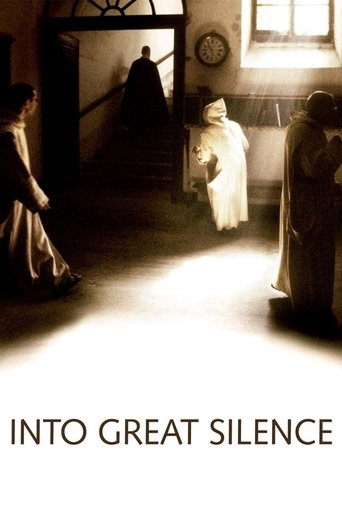
An intimate portrayal of the everyday lives of Carthusian monks of the Grande Chartreuse, high in the French Alps (Chartreuse Mountains). The idea for the film was proposed to the monks in 1984, but the Carthusians said they wanted time to think about it. The Carthusians finally contacted Gröning 16 years later to say they were now willing to permit Gröning to shoot the movie, if he was still interested.
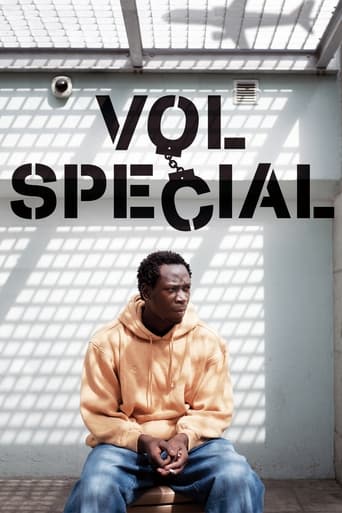
Switzerland still carries out special flights, where passengers, dressed in diapers and helmets, are chained to their seats for 40 hours at worst. They are accompanied by police officers and immigration officials. The passengers are flown to their native countries, where they haven't set foot in in up to twenty years, and where their lives might be in danger. Children, wives and work are left behind in Switzerland. Near Geneva, in Frambois prison, live 25 illegal immigrants waiting for deportation. They are offered an opportunity to say goodbye to their families and return to their native countries on a regular flight, escorted by plain-clothes police officers. If they refuse this offer, the special flight is arranged fast and unexpectedly. The stories behind the locked cells are truly heartbreaking.
In May of 1982 Julio Cortázar, the Argentinean writer and his companion in life, Carol Dunlop set out in their VW bus on a journey along the highway from Paris to Marseille that, for each of them, was to be their final one. Twenty-five years later, Océane Madelaine and Jocelyn Bonnerave set out to undertake the journey again.
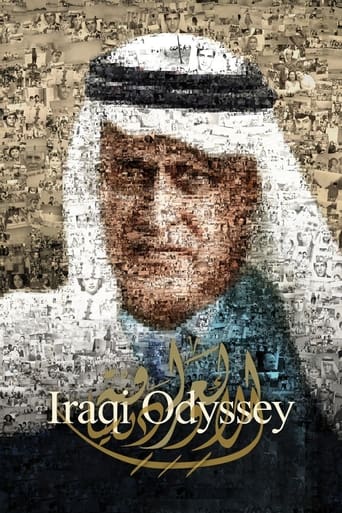
Tracing the emigrations of his family over more than half a century, this riveting documentary epic from acclaimed expatriate Iraqi filmmaker Samir pays moving homage to the frustrated democratic dreams of a people successively plagued by the horrors of dictatorship, war and foreign occupation of Iraq.
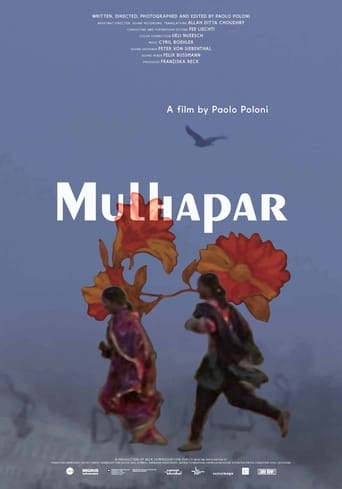
Mulhapar is a village in the wide expanses of the Punjab in Pakistan. A country associated with violence and intolerance. Beyond this sombre prejudice, the film plunges into the brimming life of a community of poor and rich people, Muslims and Christians, the young and the old, women and men. In Mulhapar, their family and individual destinies, as well as their stories and anecdotes are condensed into a vivid mosaic.
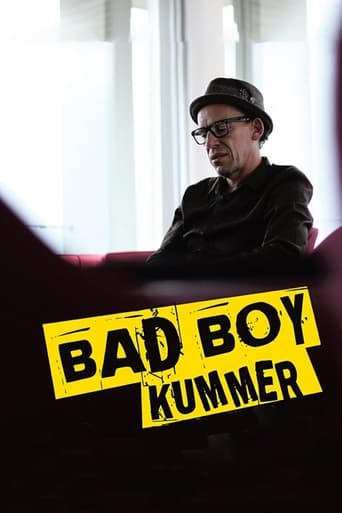
For four years, Tom Kummer fooled SZ Magazine and other reputable media outlets in Germany and Switzerland with his fake interviews. He owed his longevity to his professionalism: his work always demonstrated seriousness, thoroughness, and quality. He faked interviews with Sharon Stone, Nicolas Cage, Sean Penn, and Bruce Willis, in which he also talked to the stars about personal topics such as sex and drugs. Today, Kummer works as a tennis instructor in Los Angeles.
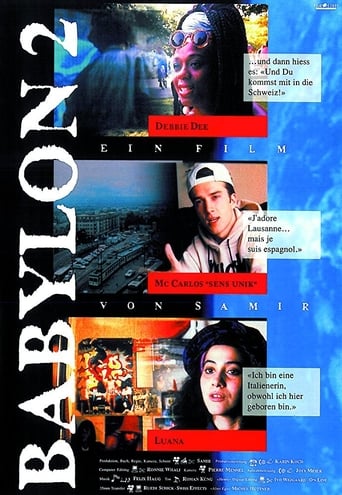
The first film about second-generation Swiss immigrants: A Turkish ice hockey player explains why, in Switzerland, he could only fall in love with an Italian. A young Italian woman explains why she prefers to rap in English. A hip-hop artist with Hispanic origins fights for his political rights and the director reminisces on how, despite his Arabic roots, he's been persecuted as a Jew. Babylon 2 reflects the rise of a new urban culture in Switzerland, which is instigated by the second generation of immigrants and the help of electronic media.