


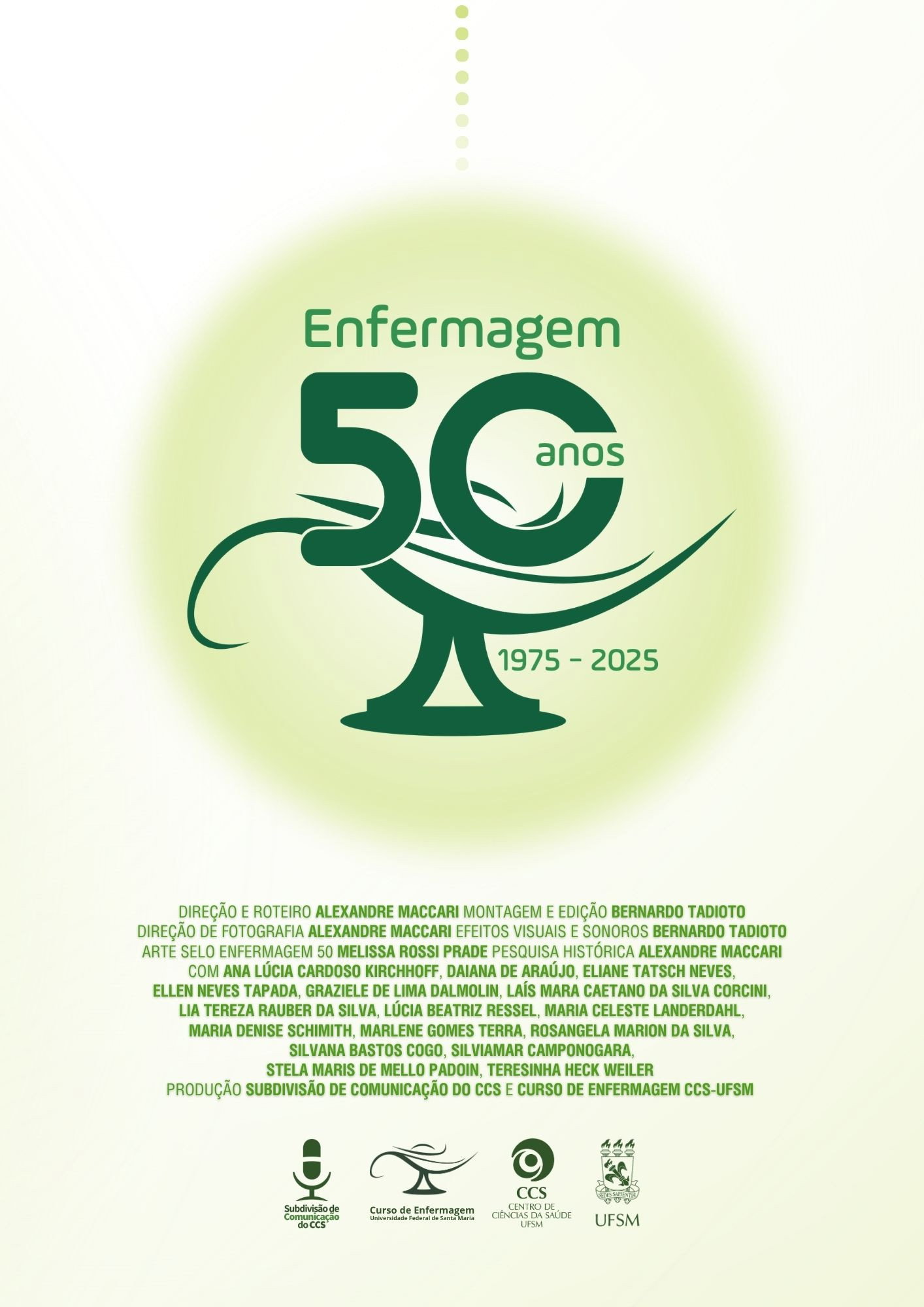
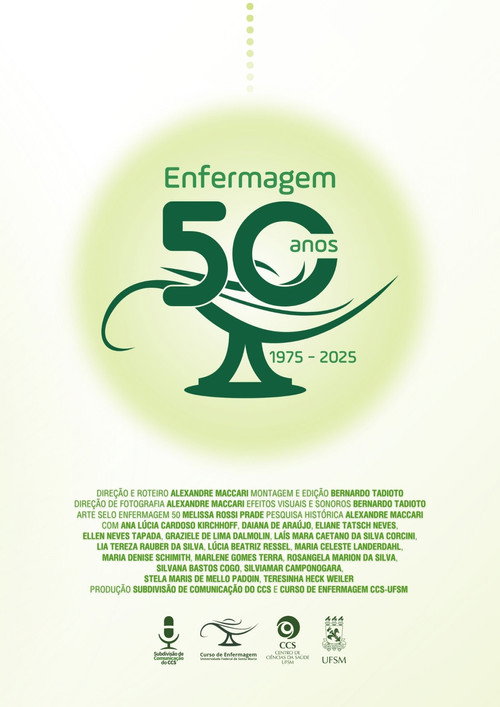
Enfermagem 50
Documentary
Top Cast


Ana Lúcia Cardoso Kirchhoff
Ana Lúcia Cardoso Kirchhoff
Herself
Ana Lúcia Cardoso Kirchhoff
Herself
Daiana de Araújo
Daiana de Araújo
Narrator
Daiana de Araújo
Narrator
Eliane Tatsch Neves
Eliane Tatsch Neves
Herself
Eliane Tatsch Neves
Herself
Ellen Neves Tapada
Ellen Neves Tapada
Herself
Ellen Neves Tapada
Herself
Graziele de Lima Dalmolin
Graziele de Lima Dalmolin
Herself
Graziele de Lima Dalmolin
Herself
Laís Mara Caetano da Silva Corcini
Laís Mara Caetano da Silva Corcini
Herself
Laís Mara Caetano da Silva Corcini
Herself
Lia Tereza Rauber da Silva
Lia Tereza Rauber da Silva
Herself
Lia Tereza Rauber da Silva
Herself
Lúcia Beatriz Ressel
Lúcia Beatriz Ressel
Herself
Lúcia Beatriz Ressel
Herself
Maria Celeste Landerdahl
Maria Celeste Landerdahl
Herself
Maria Celeste Landerdahl
Herself
Maria Denise Schimith
Maria Denise Schimith
Herself
Maria Denise Schimith
Herself
Similar Movies
After 50 years in theatre, film and television, Carme Elias is diagnosed with Alzheimer's Disease. Together with Claudia Pinto, a director and friend, they decide to record her last conscious voyage. The characters played by Carme accompany this difficult period, while the borders between fiction and reality disappear. While You're Still You is a constant game of mirrors, a pact of love and friendship.
The lastest neuroscience discoveries show surprising results: false memories, distortion, modification, déjà vus. Our memory is affected in many ways, and deceives us every day. The very fact of recalling souvenirs modifies them. The everyday consequences are manyfold. To what extent can we rely on our souvenirs? How much credit can we give them during trials? Even more shocking, scientists have proved to be able to manipulate our memory: creating artificial souvenirs, deleting, emphasizing or restoring them on demand.
Engaging themes of love and betrayal, hope, belonging and place, Glad You’re Here documents my nineteen--year journey through building a family life, seeing it suffer the damage of mental illness, grief and separation, and then rebuilding with empathy. A story about an extreme moment of crisis has turned into a documentary that deals not just with the subjective but with the important issue of spousal abuse.
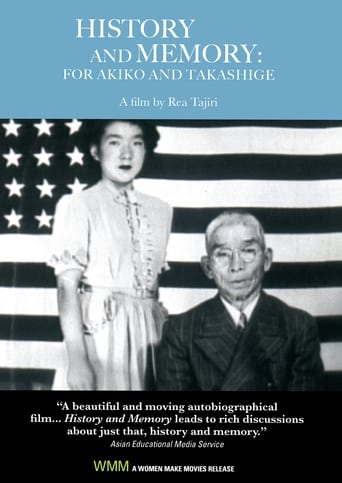
This film is a poetic composition of recorded history and non-recorded memory. Filmmaker Rea Tajiri’s family was among the 120,000 Japanese and Japanese Americans who were imprisoned in internment camps after the attack on Pearl Harbor. And like so many who were in the camps, Tajiri’s family wrapped their memories of that experience in a shroud of silence and forgetting. This film raises questions about collective history – questions that prompt Tajiri to daringly re-imagine and re-create what has been stolen and what has been lost.
This documentary film is the continuation of “Digging Out the Truth” and it shows the mourning of the families of those who were, until recently, missing. During this second investigation the team discovered more graves close to the Moroccan wall and its accompanying line of antipersonnel mines. There are still more than 400 Saharawis missing in the Western Sahara.
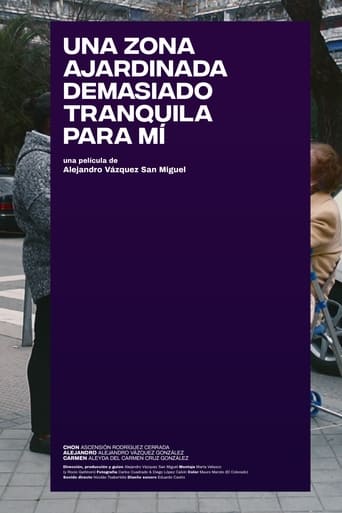
Memory prevents rest and a woman about to die takes advantage of cinema to tell her story (inseparable from that of Franco’s Spain) and to say goodbye. A terrace as a border and a song that crosses time. At home, nothing is always—and everything is still—in the present and defunct now. A home movie of ghosts, a generous gesture of intimacy and solidarity that not witnesses two people at the end of their long lives, but also reveals the weight of history and of the 20th century, which is always present today.
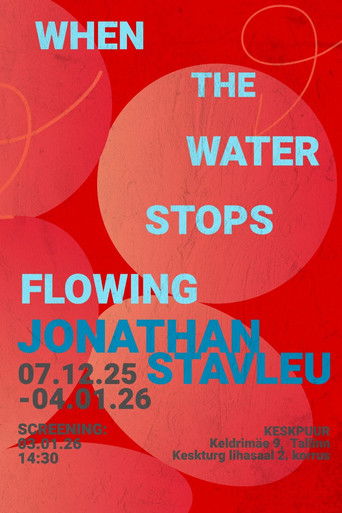
Jonathan Stavleu explores, in a stream-of-consciousness video essay, the relationship people have with water and what happens when access to it is taken away. For this work, he examines anecdotal histories he has heard from Estonians, as well as stories from his own family history in the Netherlands, weaving them together into a journal-like narrative.