

Dialectic Discourse
Overview
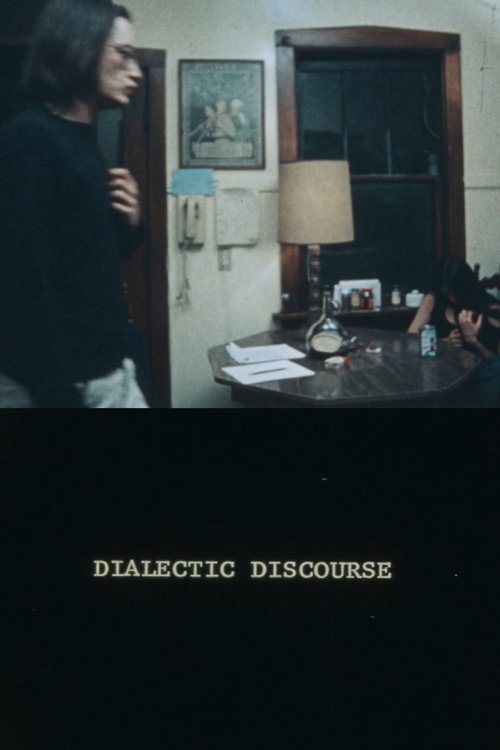
A conceptual film about the limits of the frame
Top Cast

Linda Henry
Linda Henry
Linda Henry
Michael S. O'Brien
Michael S. O'Brien
Michael S. O'Brien
Similar Movies
Two adult siblings, confined to their childhood home, live under the lingering presence of their parents, whose memory is mirrored in a portrait on the wall. They strive to preserve their existence through a “sacred ceremony” of nourishment and cleansing. Trapped in the family’s gilded cage, they become both inmates and bathers, with heightened senses that console and are consoled, faithful to rituals that have vanished from modern times, where everyone is violated by the rush of time. In a classic urban house, marked by decay, they tend to each other like young mammals in the wild— with love, with exposure, with violence, frustration, and shame.
In one of those wonderful coincidences of history, lumière, the French word for “light,” was also the last name of brothers Auguste and Louis, whose brilliant invention, the cinematograph, helped to inaugurate the most beloved art form of the last 130 years. Institute Lumière director Thierry Frémaux uses Lumière, Le Cinema! to guide the viewer through over a hundred shorts—some famous, some forgotten, some never before seen—directed by Lumière and company. In the process, Frémaux illuminates how the brothers employed the camera as a creative instrument as they (and their operators) mastered framing, staging, and subject selection for quotidian and exotic microdocumentaries as well as the first ever fictional motion pictures. The result is not only a glorious re(telling) of the genesis of cinema but a profound meditation on the beautiful world captured—and the mysterious world imagined—by the Lumières.
Jean-Luc Godard is synonymous with cinema. With the release of Breathless in 1960, he established himself overnight as a cinematic rebel and symbol for the era's progressive and anti-war youth. Sixty-two years and 140 films later, Godard is among the most renowned artists of all time, taught in every film school yet still shrouded in mystery. One of the founders of the French New Wave, political agitator, revolutionary misanthrope, film theorist and critic, the list of his descriptors goes on and on. Godard Cinema offers an opportunity for film lovers to look back at his career and the subjects and themes that obsessed him, while paying tribute to the ineffable essence of the most revered French director of all time.
In Preparação I (Preparation I) Letícia Parente prepares herself to go out. In front of a bathroom mirror, she places bandages over her mouth and eyes, draws eyes and a mouth over the bandages, fixes her hair, takes her bag and leaves the room. This masquerade becomes a political commentary about the female gaze, voice, modes of interaction, sociality and corporeality in Brazilian society during the 1970s.
A film about peace, love and war. Dedicated to the 100th anniversary of the end of the Civil War in Russia. The film takes place at the end of the summer of 1917, when Russia and the whole world were at a crossroads between two eras. None of the people could even imagine how much his life would change in the very near future. In a strange way, the atmosphere of the film echoes our current reality and what is happening in Russia today. According to the form of visualization, the film belongs to experimental mockumentary cinema. To give greater authenticity to what is happening on the screen, the shooting was carried out on black-and-white negatives of 16 and 35 mm, hand-operated cameras were used and the material was developed in manual spiral tanks. The documentary chronicle of the Kolchak army of 1919 and the White army in the Far East of 1922 is embedded in the finale of the film.
a 22-minute French experimental short film directed by Marin Karmitz and Jean Ravel, based on Samuel Beckett's 1963 play. It features actors Eléonore Hirt, Michael Lonsdale, and Delphine Seyrig in a stark, black-and-white adaptation focusing on light and sound, which was notably showcased at the 1966 Venice Biennale.