

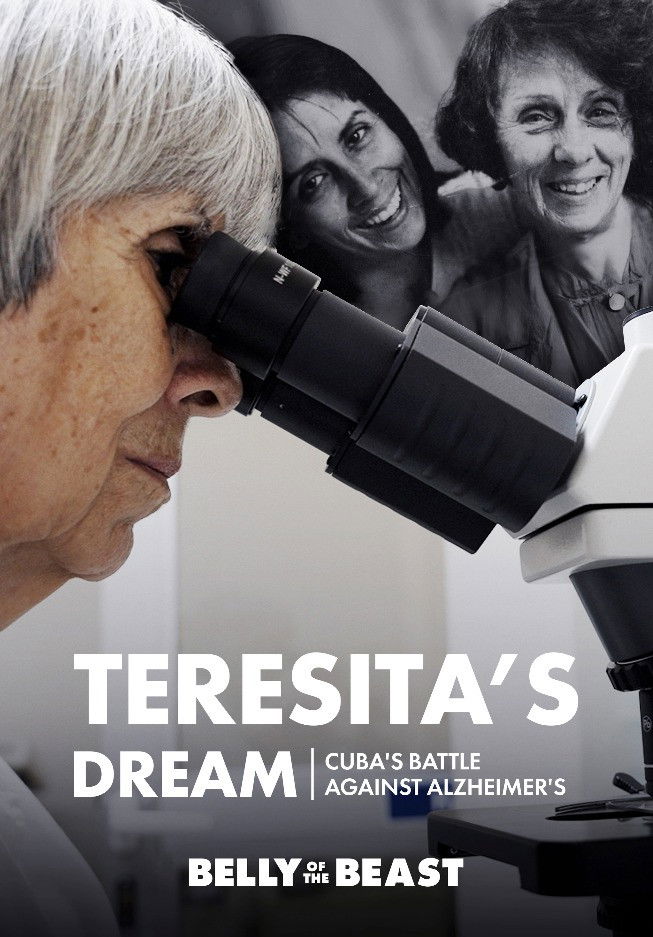
Teresita's Dream
Documentary
Overview
Teresita's Dream follows the extraordinary story of Cuban scientist Teresita Rodríguez. When her mother is diagnosed with Alzheimer’s, Teresita embarks on a deeply personal and politically complex journey to find a treatment – joined by a team of mostly women scientists. What begins as an effort to help her mother, leads to a discovery that could change how the world treats this devastating disease forever.





No cast information.
Similar Movies
This program examines Cuban exile terrorists living in Miami. These terrorists were secretly trained and employed by the U.S. government in the early 1960s to fight Fidel Castro. Now, without U.S. support, terrorist activities continue in Miami and Latin America. The program reviews secret U.S. policies toward Cuba in the 1960s and includes interviews with Castro and former top CIA officials. Members of this group, formerly secretly trained and employed by U.S. Government until 1967, have been active in Watergate crimes and anti-Castro terrorism including bomb explosion on Cuban Airline killing seventy-three. Includes interviews with Castro, E. Howard Hunt, Bernard Barker, and Rolando Martinez.' - The Paley Center For Media
When the U.S. trade embargo left Cuba isolated from medical resources, Cuban scientists were forced to get creative. Now they've developed lung cancer vaccines that show so much promise, some Americans are defying the embargo and traveling to Cuba for treatment. In an unprecedented move, Cuban researchers are working with U.S. partners to make the medicines more widely available.

After 50 years in theatre, film and television, Carme Elias is diagnosed with Alzheimer's Disease. Together with Claudia Pinto, a director and friend, they decide to record her last conscious voyage. The characters played by Carme accompany this difficult period, while the borders between fiction and reality disappear. While You're Still You is a constant game of mirrors, a pact of love and friendship.
Afro-Cubans played a leading role in the fight to free Cuba from Spanish domination; as part of that struggle, slavery was abolished. Nevertheless, as African descendants began to achieve a semblance of social and economic parity, the plantocracy, backed up by the US army, sought to undo their gains. Determined to resist, veterans of the Mambi army formed the Party of Independents of Color, gaining wide popular support and ultimately threatening the domination of the white Cuban rulers. Their response was savage, and 6,000 Afro-Cubans were massacred; until this film, these events have been shrouded in silence.
Half blind and half deaf, ostraziced Cuban writer Rafael Alcides tries to finish his unpublished novels to discover that after several decades, the home made ink from the typewriter he used to write them has faded. The Cuban revolution as a love story and eventual deception is seen through the eyes of a man who is living an inner exile.
Born to Korean immigrant parents freed from indentured servitude in early twentieth century Mexico, Jerónimo Lim Kim joins the Cuban Revolution with his law school classmate Fidel Castro and becomes an accomplished government official in the Castro regime, until he rediscovers his ethnic roots and dedicates his later life to reconstructing his Korean Cuban identity. After Jerónimo's death, younger Korean Cubans recognize his legacy, but it is not until they are presented with the opportunity to visit South Korea that questions about their mixed identity resurface.
In this fascinating Oscar-nominated documentary, American guitarist Ry Cooder brings together a group of legendary Cuban folk musicians (some in their 90s) to record a Grammy-winning CD in their native city of Havana. The result is a spectacular compilation of concert footage from the group's gigs in Amsterdam and New York City's famed Carnegie Hall, with director Wim Wenders capturing not only the music -- but also the musicians' life stories.
This black-and-white film is a loving portrait of Santiago de Cuba and its people. It provides a view of Cuba as a picturesque country, the product of an earthy mix of black and criollo cultures. The film uses historical images which portray the end of the eighteenth century when Haitian slave owners fled with their slaves to Cuba after the Haitian Revolution.