

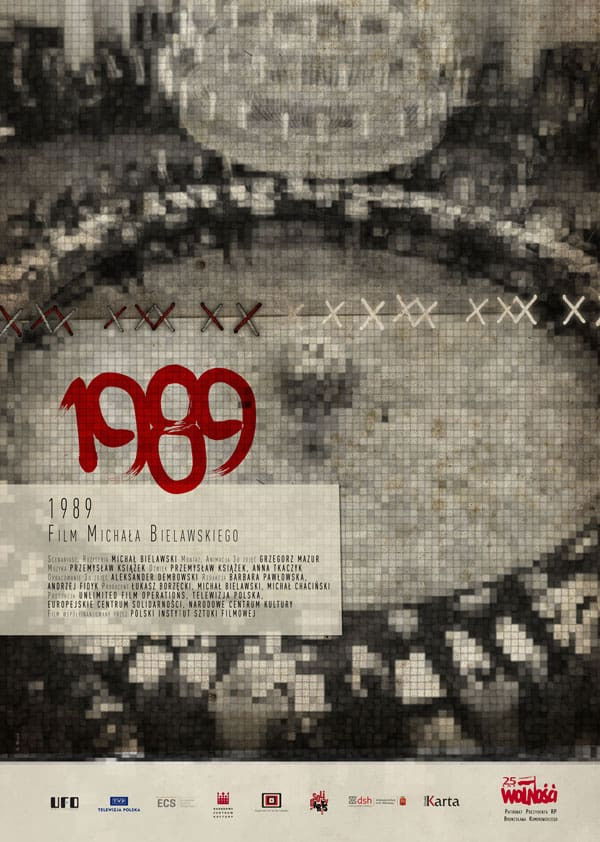
1989
Documentary · History
Overview
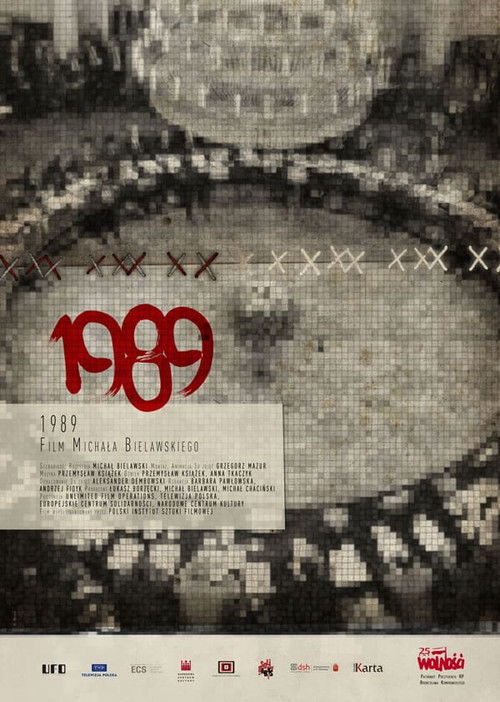
Such changes took place in Poland over a period of several months - from the end of 1988 to the end of January 1990? Michał Bielawski, through the prism of official and underground archives, shows the then state of mind of Poles, their fears, hopes and reflections. Film materials from the 1988-1990 period are in harmony with the photographs and diaries written by Poles at that time, as well as with the messages about the changes taking place. We observe the most important political, social and moral events of that period, confronted or reinforced by the comments of their active observers: ordinary people, politicians of the government camp and oppositionists.
Top Cast
Marta Perchuć-Burzyńska
Voiceover (voice)
Andrzej Matul
Voiceover (voice)
Adam Tkaczyk
Voiceover (voice)
Jacek Ambroziak
Self (archive footage)
Jan Dworak
Self (archive footage)
Konstanty Gebert
Self (archive footage)
Jacek Kuroń
Self (archive footage)
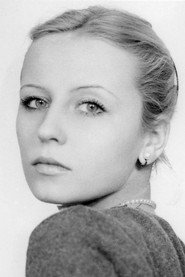
Krystyna Janda
Self (archive footage)
Mieczysław F. Rakowski
Self (archive footage)
Janusz Korwin-Mikke
Self (archive footage)
Aleksander Hall
Self (archive footage)
Piotr Ikonowicz
Self (archive footage)

Marta Perchuć-Burzyńska
Marta Perchuć-Burzyńska
Voiceover (voice)
Marta Perchuć-Burzyńska
Voiceover (voice)
Andrzej Matul
Andrzej Matul
Voiceover (voice)
Andrzej Matul
Voiceover (voice)
Adam Tkaczyk
Adam Tkaczyk
Voiceover (voice)
Adam Tkaczyk
Voiceover (voice)
Jacek Ambroziak
Jacek Ambroziak
Self (archive footage)
Jacek Ambroziak
Self (archive footage)
Jan Dworak
Jan Dworak
Self (archive footage)
Jan Dworak
Self (archive footage)
Konstanty Gebert
Konstanty Gebert
Self (archive footage)
Konstanty Gebert
Self (archive footage)
Jacek Kuroń
Jacek Kuroń
Self (archive footage)
Jacek Kuroń
Self (archive footage)
Krystyna Janda
Krystyna Janda
Self (archive footage)
Krystyna Janda
Self (archive footage)
Mieczysław F. Rakowski
Mieczysław F. Rakowski
Self (archive footage)
Mieczysław F. Rakowski
Self (archive footage)
Janusz Korwin-Mikke
Janusz Korwin-Mikke
Self (archive footage)
Janusz Korwin-Mikke
Self (archive footage)
Similar Movies
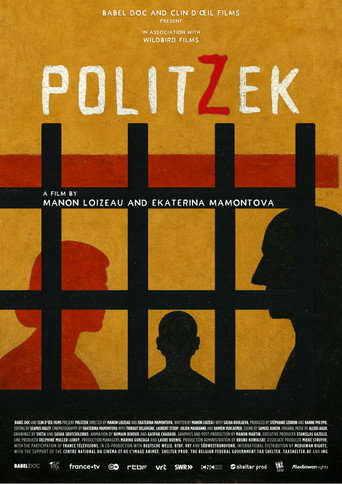
In Russia, criticizing the war in Ukraine or Vladimir Putin’s regime has become a crime. Thousands of ordinary citizens are being arrested, tried, and imprisoned. They are called “Politzek”: political prisoners. Filmed clandestinely over the course of more than a year, Politzek gives a platform to those who, despite the fear, continue to speak out against Putin’s repressive Russia. Through the intersecting stories of a teenager sentenced to five years in prison for criticizing the government on social media, a young artist jailed for placing anti-war stickers, a human rights activist, and two theater directors facing Kafkaesque trials, the film unveils the machinery of state repression in Russia. With rare footage, broken yet unyielding voices, this is a story of silenced resistance.
In the panorama of Kurdish music, Koma Berxwedan (Group Resistance) is one of the most interesting, innovative, experimental groups. To a deep love for music research the group has always associated a strong political commitment. Some of its members have joined the PKK guerrillas in the mountains of Kurdistan. Three of them died in combat. Some have been forced to live in exile and others continued to challenge the Turkish authorities by carrying out their work in Kurdistan.
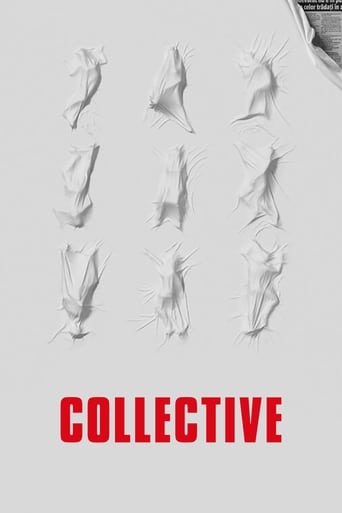
In the aftermath of a tragic fire in a Romanian club, burn victims begin dying in hospitals from wounds that were not life threatening. A team of investigative journalists move into action uncovering the mass corruption of the health system and of the state institutions. Collective follows journalists, whistle blowers, and authorities alike. An immersive and uncompromising look into a dysfunctional system, exposing corruption, propaganda, and manipulation that nowadays affect not only Romania, but societies around the world.
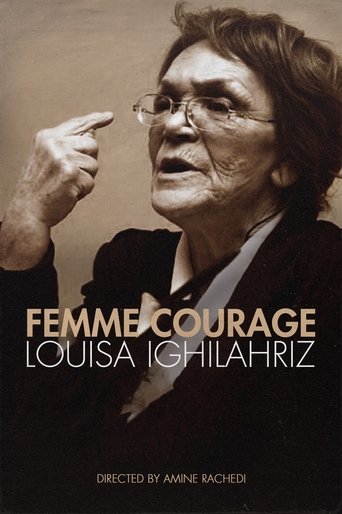
The autobiographical account of the tormented life of a witness of the century: Louisa Ighilahriz, activist and leading figure in Algerian independence. A student, she joined the independence struggle at the age of 20, joining the ranks of the FLN on the eve of the Battle of Algiers in late 1956 under the name Lila. She took part in the high school students' strike, then fled into the maquis when she was actively sought after. She was part of the French FLN support network of "suitcase carriers" during the Battle of Algiers. Seriously wounded alongside her network leader, Saïd Bakel, during an ambush in 1957, hospitalized and then imprisoned, she suffered numerous tortures in French prisons. She will be saved from certain death by an anonymous person, she will seek, for forty years, to find him just to show him her gratitude... Emblematic of the painful Franco-Algerian history, Louisa's story is poignant and imbued with humanism.
Throughout the Islamic world, each year hundreds of women are shot, stabbed, strangled or burned to death by male relatives because they are thought to have “dishonoured” their families. They may have lost their virginity, refused an arranged marriage or left an abusive husband. Even if a woman is raped or merely the victim of gossip, she must pay the price. Crimes of Honour documents the terrible reality of femicide – the belief that a girl’s body is the property of the family, and any suggestion of sexual impropriety must be cleansed with her blood. We meet women in hiding from their families, a brother who describes his reasons for killing the sister he loved, and a handful of women who have committed themselves to the protection of young women in danger of losing their lives.