


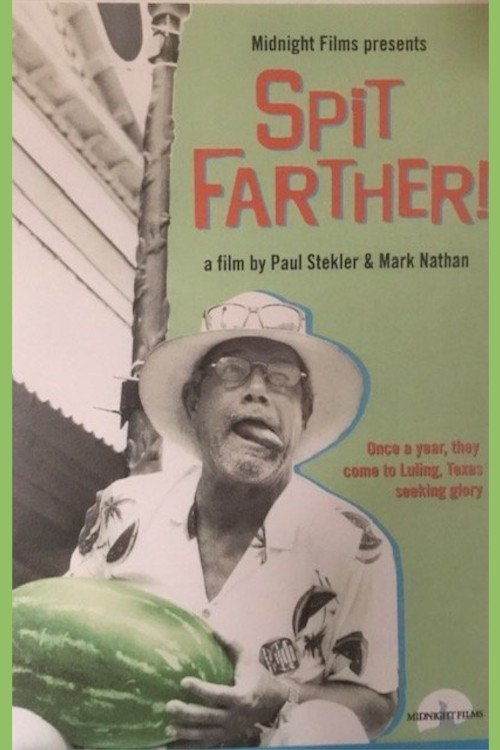
Spit Farther!
Documentary
Overview
For the last half century, the little town of Luling, Texas has held an annual Watermelon Thump Festival – and its own world championship watermelon seed spitting competition. This short documentary is about both the contest and the chief seed spitting judge, Phil, an underemployed, over-stimulated, former expatriate, who’s come home after years abroad in Europe.







No cast information.
Similar Movies
In the United States, there is an active shooter incident every 12 days. In Memoriam shows the wrenching perspective of wounded survivors, grieving relatives, and heroes of the horrific attacks at the Las Vegas Route 91 Harvest Music Festival, the Sutherland Springs Baptist Church in Texas, and the Marjory Stoneman Douglas High School in Parkland, Florida.

From the masters who create the mind-bending diversions to the tense competition at the American Crossword Puzzle Tournament, Patrick Creadon's documentary reveals a fascinating look at a decidedly addictive pastime. Creadon captures New York Times editor Will Shortz at work, talks to celebrity solvers -- including Bill Clinton and Ken Burns -- and presents an intimate look at the national tournament and its competitors.

The corruption runs deeper than you'd ever imagine. A multi-billion dollar industry you've never heard of. This is the world Patent Trolls thrive in: A world created for them by our own U. S. Patent system. You can be sued for clicking on a hyperlink, using your own scanner, or sharing your Wi-Fi! It sounds insane, but the reality is even crazier. Patent Trolls look for obvious ideas, patent them, and then sue anyone they claim is infringing on their idea. People's lives and businesses are being destroyed.. and they have no way out. “The Patent Scam” exposes the underbelly of this system, and the people that commit this practice.
A flamboyant restaurateur, a good ol' boy and a political ingénue, walk into a small town political contest and compete head to head to head, for the non-paid mayoral seat of the Tomato Republic. What happens next is anyones guess. The only thing that could slow this race down is a freight train. Let the takeover begin. - Written by Whitney Graham Carter
In the early 1830s Texas was about to explode. Although ruled by Mexico, the region was home to more than 20,000 U.S. settlers agitated by what they saw as restrictive Mexican policies. Mexican officials, concerned with illegal trading and immigration, were prepared to fight hard to keep the province under their control. Caught in the middle were the area's 4,000 Mexican Texans or Tejanos. With war on the horizon, the Tejanos had to pick a side. Many chose to fight with their Anglo neighbors against an army sent by Mexico City. The conflict pitted brother against brother and devastated the community. The Tejano gamble for a more prosperous future in an independent Texas proved tragic. Following the revolution, the Tejanos were overwhelmed by a surge of Anglo immigration -- leaving them foreigners in a land they had fought to defend.
Scott Panetti was tried for the capital murder of his parents-in-law on September 8, 1992 in Gillespie County, Texas. He was subsequently sentenced to death on September 22, 1995. Panetti has an extensive history of mental illness, including schizophrenia, manic depression, auditory hallucinations and paranoia. Panetti was hospitalized, both voluntarily and involuntarily for mental illness fourteen times in six different hospitals before his arrest for capital murder in 1992. Following his conviction, Panetti’s former wife, and daughter of the victims, Sonja Alvarado, filed a petition stating that Panetti never should have been tried for the crimes as he was suffering from paranoid delusions at the time of the killings.

Rosa is a Mexican woman who, at the age of 17, migrated illegally to Austin, Texas. Some years later, she was jailed under suspicion of murder and then taken to trial. This film demonstrates how the judicial process, the verdict, the separation from her family, and the helplessness of being imprisoned in a foreign country make Rosa’s story an example of the hard life of Mexican migrants in the United States.