

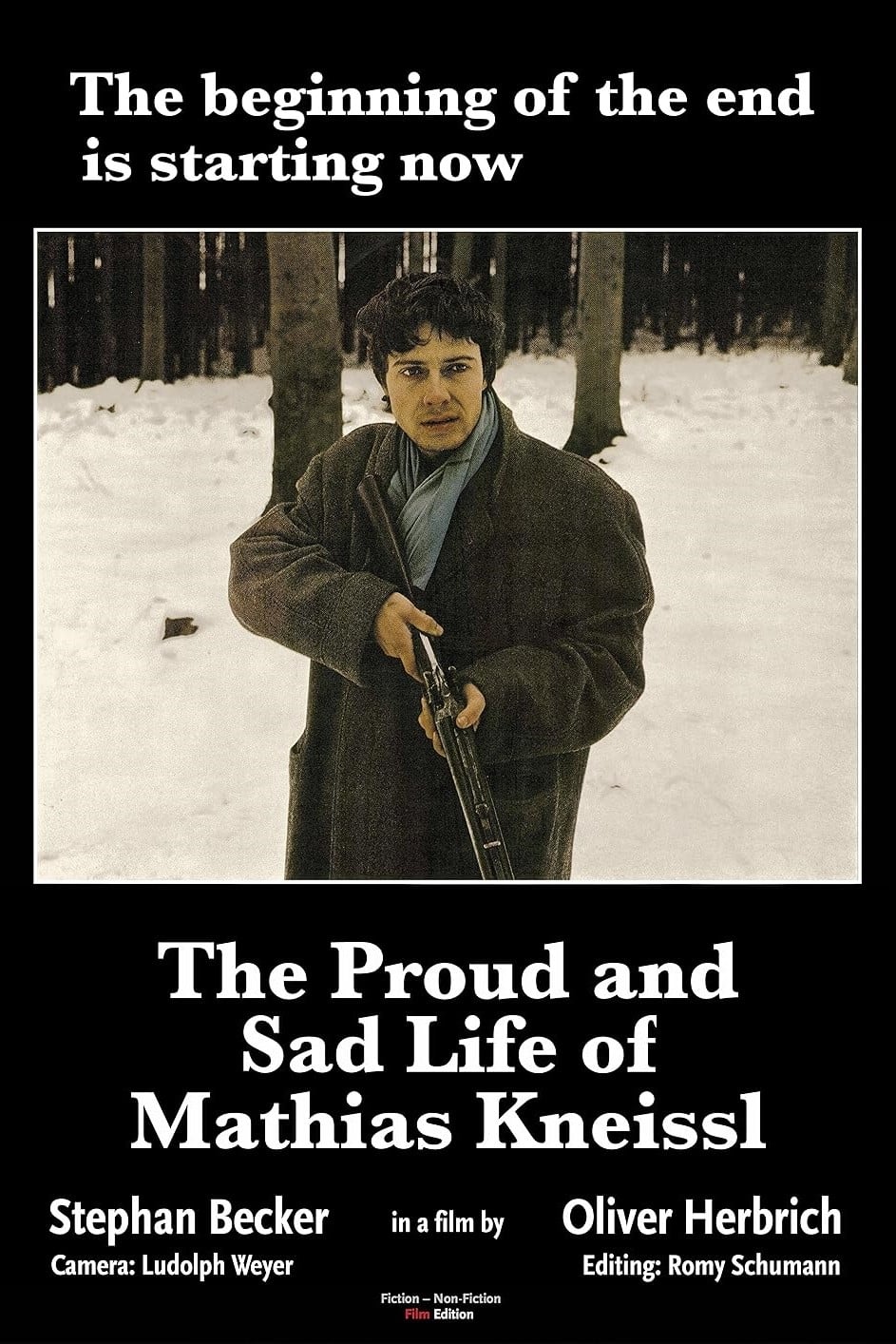
The Proud and Sad Life of Mathias Kneißl
Drama
Overview
The Robber Mathias Kneißl became a legend in Bavaria. The film is based on the historical criminal case and describes the last year of the rebel and folk hero. At the age of 23, he is released from prison, where he has served an unreasonably harsh six-year sentence. When this becomes known, he loses his job as a carpenter and now wants to emigrate to America with his girlfriend. He hopes to earn the money for the journey by committing crimes. In the process, he fatally wounds a gendarme. Despite this, Mathias Kneißl does not leave the area and stays in the Dachau hinterland. Only when his girlfriend betrays him is he able to find his hiding place. The farm was besieged by 300 police officers for days and then shot up. Kneißl was seriously injured and treated in a clinic in Munich before being beheaded in Augsburg in 1902.









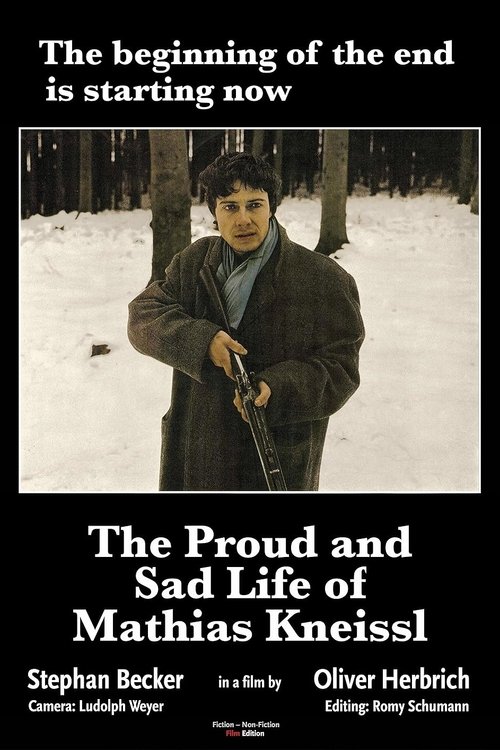
Stephan Becker
Stephan Becker
Mathias Kneißl
Stephan Becker
Mathias Kneißl
Marianne Ploog
Marianne Ploog
Mathilde Danner
Marianne Ploog
Mathilde Danner
Joseph Reitinger
Joseph Reitinger
Flecklbauer
Joseph Reitinger
Flecklbauer
Rudi Eydmann
Rudi Eydmann
Shepherd
Rudi Eydmann
Shepherd
Elfriede Hildebrand
Elfriede Hildebrand
Clairvoyant
Elfriede Hildebrand
Clairvoyant
Martin Spiegler
Martin Spiegler
Carter
Martin Spiegler
Carter
Helmut Echtler
Helmut Echtler
Vöst
Helmut Echtler
Vöst
Ulrich Hauswaldt
Ulrich Hauswaldt
Moseder
Ulrich Hauswaldt
Moseder
Bernhard Brychcy
Bernhard Brychcy
Monk
Bernhard Brychcy
Monk

Gerd Silberbauer
Gerd Silberbauer
Gerd Silberbauer
Similar Movies
Inspired by the real-life events of Mathias Kneißl, a marginal man, son of poor farmers from Bavaria, in the late XIX century. Mathias stole from the rich to give to the poor, becoming a hero for the rural people and a popular social rebel. He was chased by the police until his unfortunate sentence.
In this black comedy set in small-town Bavaria, 11-year-old Sebastian thinks you can never be too young to be a murderer. He's convinced that he killed his mother on the day he was born and is certain he's already been condemned to purgatory. Deciding he might be able to knock off a few years of his sentence by doing good deeds, Sebastian sets out to find a wife for his father Lorenz. When Lorenz and Sebastian's schoolteacher Veronika fall madly in love with each other, it seems the heavens must be smiling. There's just one hitch: Veronika is married.
Jánošík has been topic of many Slovak and Polish legends, books and films. According to the legend, he robbed nobles and gave the loot to the poor. The legend were also known in neighboring Silesia, the Margraviate of Moravia and later spread to the Kingdom of Bohemia. The actual robber had little to do with the modern legend, whose content partly reflects the ubiquitous folk myths of a hero taking from the rich and giving to the poor. However, the legend was also shaped in important ways by the activists and writers in the 19th century when Jánošík became the key highwayman character in stories that spread in the north counties of the Kingdom of Hungary (present Slovakia) and among the local Gorals and Polish tourists in the Podhale region north of the Tatras.
Young blonde translator Rebecca lives with her boyfriend ski instructor Marco in a mountain villa owned by her friend, nurse Laura. Rene, local cinema projectionist, steals Marco's car and gets into a car crash with local Theo, whose daughter, after being in coma for a time, dies. Rene suffers from partial short term memory loss and starts a relationship with Laura. Meanwhile Marco is looking for the man who stole his car and Theo - for the man who killed his daughter...
Germany in the autumn of 1957: Lola, a seductive cabaret singer-prostitute exults in her power as a temptress of men, but she wants out—she wants money, property, and love. Pitting a corrupt building contractor against the new straight-arrow building commissioner, Lola launches an outrageous plan to elevate herself in a world where everything, and everyone, is for sale. Shot in childlike candy colors, Fassbinder’s homage to Josef von Sternberg’s classic The Blue Angel stands as a satiric tribute to capitalism.
Kati drives the VW bus of her parents even without a license quite fast. But what else should one do in the Bavarian province? Kati and her best friend Jo keep asking themselves this question when they philosophize about God and the world with the tip in one hand and the beer in the other hand. After all, Kati's swarm Mike has just come back from the Bundeswehr, but while she dreams of the great love, he seems to take the matter far less seriously. And there's only stress with her dad.
After they have graduated from school, the two best friends Kati and Jo jump into their purple Benz and embark on a journey around the world southwards. Kati, however, struggled with the decision for the journey as the love of her life returned to their hometown Tandern shortly before their departure. The journey leads the two friends over the Brenner pass, where their car suddenly stops working. When Kati then also learns that her grandfather is about to die, she wants to return home – this puts the friendship of the two to an acid test.