


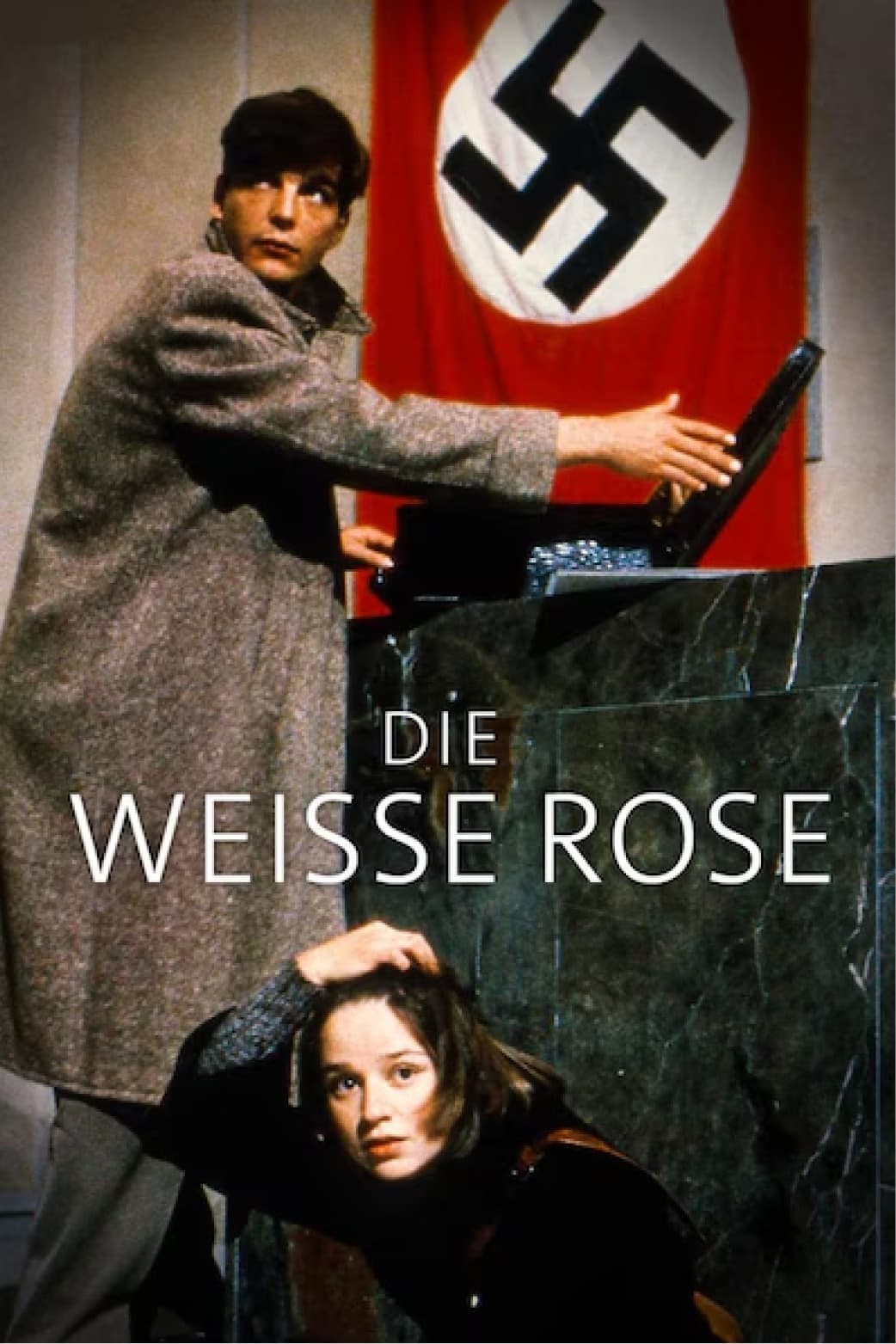
The White Rose
Drama · History
Overview
During the Second World War, a small group of students at Munich University begin to question the decisions and sanity of Germany's Nazi government. The students form a resistance cell which they name the "White Rose" after a newsletter that is secretly distributed to the student body. At first small in numbers and fearful of discovery, the White Rose begins to gain massive support after a Nazi Gauleiter nearly incites a student riot after a provokative speech. At this point, the matter is taken over by the German Gestapo, who pledge to hunt down and destroy the members of the White Rose.
Top Cast

Lena Stolze
Sophie Scholl
Wulf Kessler
Hans Scholl
Oliver Siebert
Alex Schmorell

Ulrich Tukur
Willi Graf

Werner Stocker
Christoph Probst

Anja Kruse
Traute Lafrenz

Martin Benrath
Prof. Kurt Huber

Hans-Jürgen Schatz
Studentenführer
Jörg Hube
Oberregierungsrat
Gerhard Friedrich
Herr Scholl
Sabine Kretzschmar
Frau Scholl

Jean-Paul Raths
Heinz Bollinger


















Lena Stolze
Lena Stolze
Sophie Scholl
Lena Stolze
Sophie Scholl
Wulf Kessler
Wulf Kessler
Hans Scholl
Wulf Kessler
Hans Scholl
Oliver Siebert
Oliver Siebert
Alex Schmorell
Oliver Siebert
Alex Schmorell
Ulrich Tukur
Ulrich Tukur
Willi Graf
Ulrich Tukur
Willi Graf
Werner Stocker
Werner Stocker
Christoph Probst
Werner Stocker
Christoph Probst
Anja Kruse
Anja Kruse
Traute Lafrenz
Anja Kruse
Traute Lafrenz
Martin Benrath
Martin Benrath
Prof. Kurt Huber
Martin Benrath
Prof. Kurt Huber
Hans-Jürgen Schatz
Hans-Jürgen Schatz
Studentenführer
Hans-Jürgen Schatz
Studentenführer
Jörg Hube
Jörg Hube
Oberregierungsrat
Jörg Hube
Oberregierungsrat
Gerhard Friedrich
Gerhard Friedrich
Herr Scholl
Gerhard Friedrich
Herr Scholl
Similar Movies
Ramón Sampedro is a ship mechanic and part-time poet left a quadriplegic following a diving accident. Ramón fought for 30 years for the legal right to end his own life. He develops close relationships with his long-term lawyer Julia and his friend Rosa, who tries to convince him that his life is worth living. Despite his situation, Ramón manages to inspire those around him to live life to the fullest.
Focuses on three very different siblings, all searching for happiness. Hans-Jörg is a sex addicted librarian, who is interested in young students. Werner is a successful politician with a dysfunctional family. Agnes, a trans woman, works as a table dancer in a night club. The three brothers just have one thing in common: their longing for a happy life.
Louise, who has just written a novel, comes to Paris to meet with a potential publisher. While in the city, she stays with her older sister, Martine, who in many ways is the exact opposite of Louise: she lives in a fashionable neighborhood, is cold to others, and has snobby friends, while Louise lives in a small town and is thoroughly unpretentious. Louise's apparent happiness -- and similarities to their mother -- gradually gets on Martine's nerves.
Au revoir les enfants tells a heartbreaking story of friendship and devastating loss concerning two boys living in Nazi-occupied France. At a provincial Catholic boarding school, the precocious youths enjoy true camaraderie—until a secret is revealed. Based on events from writer-director Malle’s own childhood, the film is a subtle, precisely observed tale of courage, cowardice, and tragic awakening.